Event submissions
Published

This submission belongs to the session S5. Biomolecules as therapeutics of the event 8th International Electronic Conference on Medicinal Chemistry
Published date
01 Nov, 2022
Academic Editor
'%3e%3cpath%20d='M12.6657%2010.9104C12.4185%2010.325%2012.0599%209.79327%2011.6097%209.34482C11.1609%208.89508%2010.6293%208.5365%2010.0442%208.28888C10.0389%208.28626%2010.0337%208.28495%2010.0285%208.28233C10.8446%207.69279%2011.3752%206.73249%2011.3752%205.64904C11.3752%203.8542%209.92103%202.39999%208.1262%202.39999C6.33136%202.39999%204.87715%203.8542%204.87715%205.64904C4.87715%206.73249%205.40774%207.69279%206.22393%208.28364C6.21869%208.28626%206.21345%208.28757%206.20821%208.29019C5.62129%208.5378%205.09463%208.89284%204.64265%209.34613C4.1929%209.79493%203.83432%2010.3266%203.58671%2010.9117C3.34345%2011.4845%203.21226%2012.0987%203.20023%2012.7209C3.19988%2012.7349%203.20233%2012.7488%203.20744%2012.7619C3.21255%2012.7749%203.22022%2012.7867%203.22998%2012.7968C3.23975%2012.8068%203.25142%2012.8147%203.26431%2012.8202C3.2772%2012.8256%203.29105%2012.8284%203.30504%2012.8284H4.09109C4.14874%2012.8284%204.19459%2012.7825%204.1959%2012.7262C4.2221%2011.7148%204.62823%2010.7676%205.34617%2010.0497C6.08899%209.30683%207.0755%208.89808%208.1262%208.89808C9.17689%208.89808%2010.1634%209.30683%2010.9062%2010.0497C11.6242%2010.7676%2012.0303%2011.7148%2012.0565%2012.7262C12.0578%2012.7838%2012.1037%2012.8284%2012.1613%2012.8284H12.9474C12.9613%2012.8284%2012.9752%2012.8256%2012.9881%2012.8202C13.001%2012.8147%2013.0126%2012.8068%2013.0224%2012.7968C13.0322%2012.7867%2013.0398%2012.7749%2013.0449%2012.7619C13.0501%2012.7488%2013.0525%2012.7349%2013.0522%2012.7209C13.0391%2012.0947%2012.9094%2011.4855%2012.6657%2010.9104ZM8.1262%207.9024C7.52486%207.9024%206.9589%207.6679%206.53312%207.24211C6.10733%206.81633%205.87283%206.25037%205.87283%205.64904C5.87283%205.0477%206.10733%204.48174%206.53312%204.05596C6.9589%203.63018%207.52486%203.39567%208.1262%203.39567C8.72753%203.39567%209.29349%203.63018%209.71927%204.05596C10.1451%204.48174%2010.3796%205.0477%2010.3796%205.64904C10.3796%206.25037%2010.1451%206.81633%209.71927%207.24211C9.29349%207.6679%208.72753%207.9024%208.1262%207.9024Z'%20fill='%235D1EE1'/%3e%3c/g%3e%3c/svg%3e) Maria Emília Sousa
Maria Emília SousaCitation
Tiago Azevedo, Jessica Silva, Abigaël Valada, Lara Anjos, Ana Cristina Silvestre-Ferreira, Tiane Cristine Finimundy, Lillian Barros, Manuela Matos, Maria João Neuparth, Maria João Pires, Paula A. Oliveira, Effect of Santolina chamaecyparissus on physiological parameters: data from an animal model of mammary cancer, in Proceedings of 8th International Electronic Conference on Medicinal Chemistry, 1 November–30 November 2022, MDPI: Basel, Switzerland, doi: 10.3390/ECMC2022-13441
Share
Email
Facebook
Twitter
LinkedIn
Effect of Santolina chamaecyparissus on physiological parameters: data from an animal model of mammary cancer

Tiago Azevedo 1,2
'%3e%3cpath%20d='M12.6647%2010.9104C12.4176%2010.325%2012.0589%209.7933%2011.6088%209.34485C11.16%208.89511%2010.6283%208.53653%2010.0432%208.28891C10.038%208.28629%2010.0327%208.28498%2010.0275%208.28236C10.8437%207.69282%2011.3743%206.73252%2011.3743%205.64907C11.3743%203.85423%209.92005%202.40002%208.12522%202.40002C6.33038%202.40002%204.87618%203.85423%204.87618%205.64907C4.87618%206.73252%205.40677%207.69282%206.22296%208.28367C6.21772%208.28629%206.21248%208.2876%206.20724%208.29022C5.62031%208.53783%205.09365%208.89287%204.64167%209.34616C4.19192%209.79496%203.83334%2010.3266%203.58573%2010.9117C3.34247%2011.4846%203.21128%2012.0987%203.19925%2012.721C3.1989%2012.735%203.20135%2012.7489%203.20646%2012.7619C3.21157%2012.7749%203.21924%2012.7868%203.22901%2012.7968C3.23877%2012.8068%203.25045%2012.8148%203.26334%2012.8202C3.27623%2012.8256%203.29007%2012.8284%203.30406%2012.8284H4.09012C4.14776%2012.8284%204.19362%2012.7825%204.19493%2012.7262C4.22113%2011.7148%204.62726%2010.7676%205.34519%2010.0497C6.08802%209.30686%207.07452%208.89811%208.12522%208.89811C9.17592%208.89811%2010.1624%209.30686%2010.9052%2010.0497C11.6232%2010.7676%2012.0293%2011.7148%2012.0555%2012.7262C12.0568%2012.7839%2012.1027%2012.8284%2012.1603%2012.8284H12.9464C12.9604%2012.8284%2012.9742%2012.8256%2012.9871%2012.8202C13%2012.8148%2013.0117%2012.8068%2013.0214%2012.7968C13.0312%2012.7868%2013.0389%2012.7749%2013.044%2012.7619C13.0491%2012.7489%2013.0515%2012.735%2013.0512%2012.721C13.0381%2012.0947%2012.9084%2011.4856%2012.6647%2010.9104ZM8.12522%207.90243C7.52388%207.90243%206.95792%207.66793%206.53214%207.24215C6.10636%206.81636%205.87185%206.2504%205.87185%205.64907C5.87185%205.04773%206.10636%204.48177%206.53214%204.05599C6.95792%203.63021%207.52388%203.3957%208.12522%203.3957C8.72655%203.3957%209.29252%203.63021%209.7183%204.05599C10.1441%204.48177%2010.3786%205.04773%2010.3786%205.64907C10.3786%206.2504%2010.1441%206.81636%209.7183%207.24215C9.29252%207.66793%208.72655%207.90243%208.12522%207.90243Z'%20fill='%235D1EE1'/%3e%3c/g%3e%3c/svg%3e)
Jessica Silva 3
Abigaël Valada 3
Lara Anjos 3
Ana Cristina Silvestre-Ferreira 4,5

Tiane Cristine Finimundy 6,7

Lillian Barros 6,7
Manuela Matos 3
Maria João Neuparth 8,9
Maria João Pires 3

Paula A. Oliveira 3
1. Centre for the Research and Technology of Agro-Environmental and Biological Sciences (CITAB), University of Trás-os-Montes and Alto Douro, 5000-801 Vila Real, Portugal
2. Institute for Innovation, Capacity Building and Sustainability of Agri-food Production (Inov4Agro), University of Trás-os-Montes and Alto Douro, 5000-801 Vila Real, Portugal
3. Centre for Research and Technology of Agro-Environmental and Biological Sciences (CITAB), Inov4Agro, University of Trás-os-Montes and Alto Douro (UTAD), Quinta de Prados, 5000-801 Vila Real, Portugal
4. Animal and Veterinary Research Centre (CECAV), UTAD, 5000-801 Vila Real, Portugal
5. Associate Laboratory for Animal and Veterinary Science – AL4AnimalS, UTAD, 5000-801 Vila Real, Portugal
6. Centro de Investigação de Montanha (CIMO), Instituto Politécnico de Bragança, Campus de Santa Apolónia, 5300-253 Bragança, Portugal
7. Laboratório Associado para a Sustentabilidade e Tecnologia em Regiões de Montanha (SusTEC), Instituto Politécnico de Bragança, Campus de Santa Apolónia, 5300-253 Bragança, Portugal
8. Centro de Investigação em Atividade Física, saúde e lazer (CIAFEL), Faculdade de Desporto da Universidade do Porto (FADEUP). Laboratório para a Investigação Integrativa e Translacional em Saúde Populacional (ITR)
9. TOXRUN – Unidade de Investigação em Toxicologia, Instituto Universitário de Ciências da Saúde, CESPU, CRL, Gandra, Portugal
Abstract
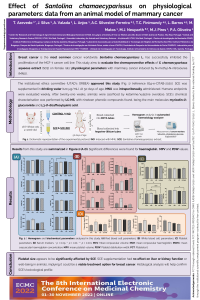
Breast cancer is the most common cancer worldwide. Santolina chamaecyparissus L. has successfully inhibited the MCF-7 cancer cell line. This study aims to evaluate the chemopreventive effects of S. chamaecyparissus aqueous extract (SCE) on female rats' physiological parameters with mammary cancer induced by N-methyl-N-nitrosourea (MNU).
The institutional ethics committee approved this study. Twenty-eight four-week-old female Wistar rats were divided into Control, MNU-induced (IND), SCE and SCE+IND. SCE was supplemented in drinking water (120µg/mL). At 50 days of age, MNU was intraperitoneally administered. Humane endpoints were evaluated weekly. After twenty-one weeks, animals were sacrificed by ketamine/xylazine overdose, and blood was collected. A complete blood count was performed using an automated haematology analyser. An autoanalyser was used to measure serum markers (albumin, cholesterol, glucose, and triglycerides). SCE’s chemical characterisation was performed by LC-MS, being found nineteen phenolic compounds, being the main molecules myricetin-O-glucuronide and 1,3-O-dicaffeoylquinic acid.
Regarding haemoglobin concentration, there was a difference (p=0.050) between SCE and Control (16.38±0.41g/dL and 15.18±0.29g/dL, respectively). Mean Platelet Volume differed between SCE+IND (8.29±0.15fL) and IND (9.03±0.26fL) (p=0.014). Platelet Distribution Width differed between 9.06±0.14fL (SCE+IND) and 10.58±0.42fL (IND) (p<0.001), but also between SCE (8.78±0.16fL) and SCE+IND versus control (9.86±0.17fL) (p=0.007 and p=0.034, respectively). SCE had no effect on the humane endpoints or serum markers.
Platelet size appears to be significantly affected by SCE. SCE supplementation had no effect on liver or kidney function or well-being in animals, implying it could be a viable treatment option for breast cancer. Histological analysis will help confirm SCE’s toxicological profile.
Keywords
mammary cancer
natural compounds
Santolina
Wistar rats
Poster
sciforum-066353.pdf
Fumiquinazoline related alkaloids with antibacterial, anti-biofilm and efflux pump inhibition properties
Ionic Liquids Based on Valproate as Antitumor Agents Against Human Neuroblastoma