Event submissions
Published

This submission belongs to the session S4. Small molecules as drug candidates of the event 8th International Electronic Conference on Medicinal Chemistry
Published date
01 Nov, 2022
Academic Editor
'%3e%3cpath%20d='M12.6657%2010.9104C12.4185%2010.325%2012.0599%209.79327%2011.6097%209.34482C11.1609%208.89508%2010.6293%208.5365%2010.0442%208.28888C10.0389%208.28626%2010.0337%208.28495%2010.0285%208.28233C10.8446%207.69279%2011.3752%206.73249%2011.3752%205.64904C11.3752%203.8542%209.92103%202.39999%208.1262%202.39999C6.33136%202.39999%204.87715%203.8542%204.87715%205.64904C4.87715%206.73249%205.40774%207.69279%206.22393%208.28364C6.21869%208.28626%206.21345%208.28757%206.20821%208.29019C5.62129%208.5378%205.09463%208.89284%204.64265%209.34613C4.1929%209.79493%203.83432%2010.3266%203.58671%2010.9117C3.34345%2011.4845%203.21226%2012.0987%203.20023%2012.7209C3.19988%2012.7349%203.20233%2012.7488%203.20744%2012.7619C3.21255%2012.7749%203.22022%2012.7867%203.22998%2012.7968C3.23975%2012.8068%203.25142%2012.8147%203.26431%2012.8202C3.2772%2012.8256%203.29105%2012.8284%203.30504%2012.8284H4.09109C4.14874%2012.8284%204.19459%2012.7825%204.1959%2012.7262C4.2221%2011.7148%204.62823%2010.7676%205.34617%2010.0497C6.08899%209.30683%207.0755%208.89808%208.1262%208.89808C9.17689%208.89808%2010.1634%209.30683%2010.9062%2010.0497C11.6242%2010.7676%2012.0303%2011.7148%2012.0565%2012.7262C12.0578%2012.7838%2012.1037%2012.8284%2012.1613%2012.8284H12.9474C12.9613%2012.8284%2012.9752%2012.8256%2012.9881%2012.8202C13.001%2012.8147%2013.0126%2012.8068%2013.0224%2012.7968C13.0322%2012.7867%2013.0398%2012.7749%2013.0449%2012.7619C13.0501%2012.7488%2013.0525%2012.7349%2013.0522%2012.7209C13.0391%2012.0947%2012.9094%2011.4855%2012.6657%2010.9104ZM8.1262%207.9024C7.52486%207.9024%206.9589%207.6679%206.53312%207.24211C6.10733%206.81633%205.87283%206.25037%205.87283%205.64904C5.87283%205.0477%206.10733%204.48174%206.53312%204.05596C6.9589%203.63018%207.52486%203.39567%208.1262%203.39567C8.72753%203.39567%209.29349%203.63018%209.71927%204.05596C10.1451%204.48174%2010.3796%205.0477%2010.3796%205.64904C10.3796%206.25037%2010.1451%206.81633%209.71927%207.24211C9.29349%207.6679%208.72753%207.9024%208.1262%207.9024Z'%20fill='%235D1EE1'/%3e%3c/g%3e%3c/svg%3e) Maria Emília Sousa
Maria Emília SousaCitation
Renata Paprocka, Małgorzata Wiese-Szadkowska, Jolanta Kutkowska, Adam Kowalewski, The synthesis and biological activity of amidrazone derivatives obtained in reaction with cis-1,2,3,6-tetrahydrophthalic anhydride, in Proceedings of 8th International Electronic Conference on Medicinal Chemistry, 1 November–30 November 2022, MDPI: Basel, Switzerland, doi: 10.3390/ECMC2022-13453
Share
Email
Facebook
Twitter
LinkedIn
The synthesis and biological activity of amidrazone derivatives obtained in reaction with cis-1,2,3,6-tetrahydrophthalic anhydride
'%3e%3cpath%20d='M12.6647%2010.9104C12.4176%2010.325%2012.0589%209.7933%2011.6088%209.34485C11.16%208.89511%2010.6283%208.53653%2010.0432%208.28891C10.038%208.28629%2010.0327%208.28498%2010.0275%208.28236C10.8437%207.69282%2011.3743%206.73252%2011.3743%205.64907C11.3743%203.85423%209.92005%202.40002%208.12522%202.40002C6.33038%202.40002%204.87618%203.85423%204.87618%205.64907C4.87618%206.73252%205.40677%207.69282%206.22296%208.28367C6.21772%208.28629%206.21248%208.2876%206.20724%208.29022C5.62031%208.53783%205.09365%208.89287%204.64167%209.34616C4.19192%209.79496%203.83334%2010.3266%203.58573%2010.9117C3.34247%2011.4846%203.21128%2012.0987%203.19925%2012.721C3.1989%2012.735%203.20135%2012.7489%203.20646%2012.7619C3.21157%2012.7749%203.21924%2012.7868%203.22901%2012.7968C3.23877%2012.8068%203.25045%2012.8148%203.26334%2012.8202C3.27623%2012.8256%203.29007%2012.8284%203.30406%2012.8284H4.09012C4.14776%2012.8284%204.19362%2012.7825%204.19493%2012.7262C4.22113%2011.7148%204.62726%2010.7676%205.34519%2010.0497C6.08802%209.30686%207.07452%208.89811%208.12522%208.89811C9.17592%208.89811%2010.1624%209.30686%2010.9052%2010.0497C11.6232%2010.7676%2012.0293%2011.7148%2012.0555%2012.7262C12.0568%2012.7839%2012.1027%2012.8284%2012.1603%2012.8284H12.9464C12.9604%2012.8284%2012.9742%2012.8256%2012.9871%2012.8202C13%2012.8148%2013.0117%2012.8068%2013.0214%2012.7968C13.0312%2012.7868%2013.0389%2012.7749%2013.044%2012.7619C13.0491%2012.7489%2013.0515%2012.735%2013.0512%2012.721C13.0381%2012.0947%2012.9084%2011.4856%2012.6647%2010.9104ZM8.12522%207.90243C7.52388%207.90243%206.95792%207.66793%206.53214%207.24215C6.10636%206.81636%205.87185%206.2504%205.87185%205.64907C5.87185%205.04773%206.10636%204.48177%206.53214%204.05599C6.95792%203.63021%207.52388%203.3957%208.12522%203.3957C8.72655%203.3957%209.29252%203.63021%209.7183%204.05599C10.1441%204.48177%2010.3786%205.04773%2010.3786%205.64907C10.3786%206.2504%2010.1441%206.81636%209.7183%207.24215C9.29252%207.66793%208.72655%207.90243%208.12522%207.90243Z'%20fill='%235D1EE1'/%3e%3c/g%3e%3c/svg%3e)
Renata Paprocka 1
Małgorzata Wiese-Szadkowska 2
Jolanta Kutkowska 3
Adam Kowalewski 4,5
1. Department of Organic Chemistry, Faculty of Pharmacy, Collegium Medicum in Bydgoszcz, Nicolaus Copernicus University in Toruń, Poland
2. Department of Immunology, Faculty of Pharmacy, Collegium Medicum in Bydgoszcz, Nicolaus Copernicus University in Toruń, Poland
3. Department of Genetics and Microbiology, Institute of Biological Sciences, Maria Curie-Skłodowska University, Poland
4. Department of Clinical Pathomorphology, Collegium Medicum in Bydgoszcz, Nicolaus Copernicus University in Toruń, Poland
5. Department of Tumor Pathology and Pathomorphology, Oncology Centre — Prof. Franciszek Łukaszczyk Memorial Hospital, Bydgoszcz, Poland
Abstract
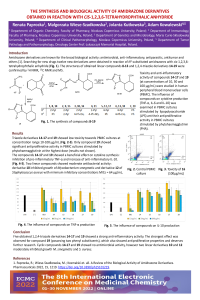
Amidrazones are known for the broad biological activity of their derivatives (antimicrobial, anti-inflammatory, antiparasitic, antitumor and others). Searching for new drugs twelve new derivatives of N3-substituted amidrazones were obtained in the reaction with cis-1,2,3,6-tetrahydrophthalic anhydride. The structures of obtained linear compounds and 1,2,4-triazole derivatives were confirmed by 1H NMR, 13C NMR and MS. Toxicity and inflammatory activity of obtained compounds (at concentrations of 10, 50 and 100 µg/mL) were studied in human peripheral blood mononuclear cells (PBMC). The influence of new derivatives on cytokine production (TNF-α, IL-6 and IL-10) was examined in PBMC cultures stimulated by LPS. Antiproliferative activity of compounds was studied in PBMC cultures stimulated by phytohaemagglutinin. Minimal inhibitory activity of compounds was studied by broth microdilution method on Gram-positive (S. aureus, M. smegmatis,) and Gram-negative (E. coli, Y. enterocolitica, K. pneumonia) bacterial and fungal C. albicans strain.
Obtained 1,2,4-triazole derivatives were no toxic to PBMC at concentration range 10-100 µg/mL. Only one 1,2,4-triazole derivative showed significant antiproliferative activity at the highest dose. Five 1,2,4-triazole derivatives showed significant, stronger than ibuprofen inhibition of pro-inflammatory TNF-α production at concentrations 10 and 50 µg/mL as well as significant elevation of levels of anti-inflammatory cytokine IL-10 at each used dose. Two linear compounds showed antibacterial activity against Gram-positive bacteria. In conclusion five obtained compounds showed a strong anti-inflammatory effect and deserves further research.
Keywords
amidrazones
anti-inflammatory
antibacterial
anthelmintic
PBMC
drug research
Poster
sciforum-066553.pdf
Spreading the Medicinal Chemistry frontiers: Novel Thiourea-Metal Complexes
Design, synthesis, and biological evaluation of new Benzoxaborole derivatives as potential antimycobacterial agents