Event submissions
Published
 10.3390/ECMC2022-13475 (registering DOI)
 This submission belongs to the session S5. Biomolecules as therapeutics of the event 8th International Electronic Conference on Medicinal Chemistry
Published date
01 Nov, 2022
Academic Editor
'%3e%3cpath%20d='M12.6657%2010.9104C12.4185%2010.325%2012.0599%209.79327%2011.6097%209.34482C11.1609%208.89508%2010.6293%208.5365%2010.0442%208.28888C10.0389%208.28626%2010.0337%208.28495%2010.0285%208.28233C10.8446%207.69279%2011.3752%206.73249%2011.3752%205.64904C11.3752%203.8542%209.92103%202.39999%208.1262%202.39999C6.33136%202.39999%204.87715%203.8542%204.87715%205.64904C4.87715%206.73249%205.40774%207.69279%206.22393%208.28364C6.21869%208.28626%206.21345%208.28757%206.20821%208.29019C5.62129%208.5378%205.09463%208.89284%204.64265%209.34613C4.1929%209.79493%203.83432%2010.3266%203.58671%2010.9117C3.34345%2011.4845%203.21226%2012.0987%203.20023%2012.7209C3.19988%2012.7349%203.20233%2012.7488%203.20744%2012.7619C3.21255%2012.7749%203.22022%2012.7867%203.22998%2012.7968C3.23975%2012.8068%203.25142%2012.8147%203.26431%2012.8202C3.2772%2012.8256%203.29105%2012.8284%203.30504%2012.8284H4.09109C4.14874%2012.8284%204.19459%2012.7825%204.1959%2012.7262C4.2221%2011.7148%204.62823%2010.7676%205.34617%2010.0497C6.08899%209.30683%207.0755%208.89808%208.1262%208.89808C9.17689%208.89808%2010.1634%209.30683%2010.9062%2010.0497C11.6242%2010.7676%2012.0303%2011.7148%2012.0565%2012.7262C12.0578%2012.7838%2012.1037%2012.8284%2012.1613%2012.8284H12.9474C12.9613%2012.8284%2012.9752%2012.8256%2012.9881%2012.8202C13.001%2012.8147%2013.0126%2012.8068%2013.0224%2012.7968C13.0322%2012.7867%2013.0398%2012.7749%2013.0449%2012.7619C13.0501%2012.7488%2013.0525%2012.7349%2013.0522%2012.7209C13.0391%2012.0947%2012.9094%2011.4855%2012.6657%2010.9104ZM8.1262%207.9024C7.52486%207.9024%206.9589%207.6679%206.53312%207.24211C6.10733%206.81633%205.87283%206.25037%205.87283%205.64904C5.87283%205.0477%206.10733%204.48174%206.53312%204.05596C6.9589%203.63018%207.52486%203.39567%208.1262%203.39567C8.72753%203.39567%209.29349%203.63018%209.71927%204.05596C10.1451%204.48174%2010.3796%205.0477%2010.3796%205.64904C10.3796%206.25037%2010.1451%206.81633%209.71927%207.24211C9.29349%207.6679%208.72753%207.9024%208.1262%207.9024Z'%20fill='%235D1EE1'/%3e%3c/g%3e%3c/svg%3e) Maria Emília Sousa
Maria Emília SousaCitation
Maria Spilia, Yannis Simos, Angelos Papanikolaou, Alexandra V Chatzikonstantinou, Athanasia Dimitrakouli, Dimitrios Peschos, Haralambos Stamatis, Comparison of the biological potential of luteolin before and after enzymatic modification with Thermomyces lanuginosus lipase, in Proceedings of 8th International Electronic Conference on Medicinal Chemistry, 1 November–30 November 2022, MDPI: Basel, Switzerland, doi: 10.3390/ECMC2022-13475
Share
Email
Facebook
Twitter
LinkedIn
Comparison of the biological potential of luteolin before and after enzymatic modification with Thermomyces lanuginosus lipase
'%3e%3cpath%20d='M12.6647%2010.9104C12.4176%2010.325%2012.0589%209.7933%2011.6088%209.34485C11.16%208.89511%2010.6283%208.53653%2010.0432%208.28891C10.038%208.28629%2010.0327%208.28498%2010.0275%208.28236C10.8437%207.69282%2011.3743%206.73252%2011.3743%205.64907C11.3743%203.85423%209.92005%202.40002%208.12522%202.40002C6.33038%202.40002%204.87618%203.85423%204.87618%205.64907C4.87618%206.73252%205.40677%207.69282%206.22296%208.28367C6.21772%208.28629%206.21248%208.2876%206.20724%208.29022C5.62031%208.53783%205.09365%208.89287%204.64167%209.34616C4.19192%209.79496%203.83334%2010.3266%203.58573%2010.9117C3.34247%2011.4846%203.21128%2012.0987%203.19925%2012.721C3.1989%2012.735%203.20135%2012.7489%203.20646%2012.7619C3.21157%2012.7749%203.21924%2012.7868%203.22901%2012.7968C3.23877%2012.8068%203.25045%2012.8148%203.26334%2012.8202C3.27623%2012.8256%203.29007%2012.8284%203.30406%2012.8284H4.09012C4.14776%2012.8284%204.19362%2012.7825%204.19493%2012.7262C4.22113%2011.7148%204.62726%2010.7676%205.34519%2010.0497C6.08802%209.30686%207.07452%208.89811%208.12522%208.89811C9.17592%208.89811%2010.1624%209.30686%2010.9052%2010.0497C11.6232%2010.7676%2012.0293%2011.7148%2012.0555%2012.7262C12.0568%2012.7839%2012.1027%2012.8284%2012.1603%2012.8284H12.9464C12.9604%2012.8284%2012.9742%2012.8256%2012.9871%2012.8202C13%2012.8148%2013.0117%2012.8068%2013.0214%2012.7968C13.0312%2012.7868%2013.0389%2012.7749%2013.044%2012.7619C13.0491%2012.7489%2013.0515%2012.735%2013.0512%2012.721C13.0381%2012.0947%2012.9084%2011.4856%2012.6647%2010.9104ZM8.12522%207.90243C7.52388%207.90243%206.95792%207.66793%206.53214%207.24215C6.10636%206.81636%205.87185%206.2504%205.87185%205.64907C5.87185%205.04773%206.10636%204.48177%206.53214%204.05599C6.95792%203.63021%207.52388%203.3957%208.12522%203.3957C8.72655%203.3957%209.29252%203.63021%209.7183%204.05599C10.1441%204.48177%2010.3786%205.04773%2010.3786%205.64907C10.3786%206.2504%2010.1441%206.81636%209.7183%207.24215C9.29252%207.66793%208.72655%207.90243%208.12522%207.90243Z'%20fill='%235D1EE1'/%3e%3c/g%3e%3c/svg%3e)
Maria Spilia 1,2

Yannis Simos 2,3
Angelos Papanikolaou 1
Alexandra V Chatzikonstantinou 1
Athanasia Dimitrakouli 1
Dimitrios Peschos 2,3
_Stamatis.png)
Haralambos Stamatis 1,3
1. Department of Biological Applications and Technologies, University of Ioannina, Ioannina, 45110, Greece
2. Laboratory of Physiology, Faculty of Medicine, University of Ioannina, Ioannina, 45110, Greece
3. Nanomedicine and Nanobiotechnology Research Group, University of Ioannina, Ioannina, 45110, Greece
Abstract
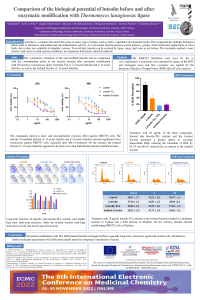
Luteolin is a common flavonoid that exists in many types of plants and exerts antioxidant and anti-inflammatory activity. Luteolin presents several hydroxyl groups, which limits their applications in some fields, due to their low solubility in lipophilic systems. To avoid that, luteolin can be acylated by lipase, using vinyl ester as acyl-donor. The aim of this study was the cytotoxicity evaluation of the non-modified luteolin and its comparison with the corresponding action of the reaction mixture after enzymatic modification with Thermomyces lanuginosus lipase (Luteolin-TLL) (3΄-O-acetyl luteolin and 4΄-O-acetyl luteolin), as well as the isolated fraction (3΄-O-acetyl luteolin). The NIH/3T3 fibroblasts were used for the in vitro experiments. Cytotoxicity was estimated by means of the MTT and clonogenic assay and flow cytometry was applied for the detection of Reactive Oxygen Forms (ROS) and cell cycle analysis. The compounds showed a dose- and time-dependent cytotoxic effect against NIH/3T3 cells. Long-term toxicities of luteolin and luteolin-TLL were higher than their short-term toxicities, while the isolated fraction with high short-term toxicity had lower long-term toxicity. Treatment with 10 μg/mL luteolin-TLL or the isolated product resulted in a mild increase in S-phase. On the contrary, luteolin arrested proliferating NIH/3T3 cells at Go/G1 phase. Luteolin-TLL and the isolated compound presented a greater ability to scavenge intracellular ROS. Enzymatic modification with TLL differentiated luteolin’s biological effects especially long-term cytotoxicity against the normal cells. Nonetheless, further molecular experiments will unfold more details about the compound’s mechanism of action.
Keywords
luteolin
lipase
enzymatic modification
cytotoxicity
reactive species
cell cycle
Poster
sciforum-066766.pdf
Molecular Docking, PASS Prediction, Pharmacokinetic and Toxicity studies of Focal Adhesion Kinase inhibitors
In vitro cytotoxicity of 3,3',4',7-tetrahydroxyflavone derivatives in human osteosarcoma