Event submissions
Published

This submission belongs to the session 1. Behavioral Neuroscience of the event The 3rd International Electronic Conference on Brain Sciences
Published date
09 Nov, 2022
Academic Editor
'%3e%3cpath%20d='M12.6657%2010.9104C12.4185%2010.325%2012.0599%209.79327%2011.6097%209.34482C11.1609%208.89508%2010.6293%208.5365%2010.0442%208.28888C10.0389%208.28626%2010.0337%208.28495%2010.0285%208.28233C10.8446%207.69279%2011.3752%206.73249%2011.3752%205.64904C11.3752%203.8542%209.92103%202.39999%208.1262%202.39999C6.33136%202.39999%204.87715%203.8542%204.87715%205.64904C4.87715%206.73249%205.40774%207.69279%206.22393%208.28364C6.21869%208.28626%206.21345%208.28757%206.20821%208.29019C5.62129%208.5378%205.09463%208.89284%204.64265%209.34613C4.1929%209.79493%203.83432%2010.3266%203.58671%2010.9117C3.34345%2011.4845%203.21226%2012.0987%203.20023%2012.7209C3.19988%2012.7349%203.20233%2012.7488%203.20744%2012.7619C3.21255%2012.7749%203.22022%2012.7867%203.22998%2012.7968C3.23975%2012.8068%203.25142%2012.8147%203.26431%2012.8202C3.2772%2012.8256%203.29105%2012.8284%203.30504%2012.8284H4.09109C4.14874%2012.8284%204.19459%2012.7825%204.1959%2012.7262C4.2221%2011.7148%204.62823%2010.7676%205.34617%2010.0497C6.08899%209.30683%207.0755%208.89808%208.1262%208.89808C9.17689%208.89808%2010.1634%209.30683%2010.9062%2010.0497C11.6242%2010.7676%2012.0303%2011.7148%2012.0565%2012.7262C12.0578%2012.7838%2012.1037%2012.8284%2012.1613%2012.8284H12.9474C12.9613%2012.8284%2012.9752%2012.8256%2012.9881%2012.8202C13.001%2012.8147%2013.0126%2012.8068%2013.0224%2012.7968C13.0322%2012.7867%2013.0398%2012.7749%2013.0449%2012.7619C13.0501%2012.7488%2013.0525%2012.7349%2013.0522%2012.7209C13.0391%2012.0947%2012.9094%2011.4855%2012.6657%2010.9104ZM8.1262%207.9024C7.52486%207.9024%206.9589%207.6679%206.53312%207.24211C6.10733%206.81633%205.87283%206.25037%205.87283%205.64904C5.87283%205.0477%206.10733%204.48174%206.53312%204.05596C6.9589%203.63018%207.52486%203.39567%208.1262%203.39567C8.72753%203.39567%209.29349%203.63018%209.71927%204.05596C10.1451%204.48174%2010.3796%205.0477%2010.3796%205.64904C10.3796%206.25037%2010.1451%206.81633%209.71927%207.24211C9.29349%207.6679%208.72753%207.9024%208.1262%207.9024Z'%20fill='%235D1EE1'/%3e%3c/g%3e%3c/svg%3e) Stephen Meriney
Stephen MerineyCitation
Lydia Giménez-Llort, Miguel Llauradó-Sánchez, Intrinsic and extrinsic factors in the bizarre patterns elicited in the open-field test in male and female mice with normal and AD-pathological aging under social or isolated housing conditions., in Proceedings of The 3rd International Electronic Conference on Brain Sciences, 1 October–15 October 2022, MDPI: Basel, Switzerland, doi: 10.3390/IECBS2022-13506
Share
Email
Facebook
Twitter
LinkedIn
Intrinsic and extrinsic factors in the bizarre patterns elicited in the open-field test in male and female mice with normal and AD-pathological aging under social or isolated housing conditions.

Lydia Giménez-Llort 1,2
'%3e%3cpath%20d='M12.6647%2010.9104C12.4176%2010.325%2012.0589%209.7933%2011.6088%209.34485C11.16%208.89511%2010.6283%208.53653%2010.0432%208.28891C10.038%208.28629%2010.0327%208.28498%2010.0275%208.28236C10.8437%207.69282%2011.3743%206.73252%2011.3743%205.64907C11.3743%203.85423%209.92005%202.40002%208.12522%202.40002C6.33038%202.40002%204.87618%203.85423%204.87618%205.64907C4.87618%206.73252%205.40677%207.69282%206.22296%208.28367C6.21772%208.28629%206.21248%208.2876%206.20724%208.29022C5.62031%208.53783%205.09365%208.89287%204.64167%209.34616C4.19192%209.79496%203.83334%2010.3266%203.58573%2010.9117C3.34247%2011.4846%203.21128%2012.0987%203.19925%2012.721C3.1989%2012.735%203.20135%2012.7489%203.20646%2012.7619C3.21157%2012.7749%203.21924%2012.7868%203.22901%2012.7968C3.23877%2012.8068%203.25045%2012.8148%203.26334%2012.8202C3.27623%2012.8256%203.29007%2012.8284%203.30406%2012.8284H4.09012C4.14776%2012.8284%204.19362%2012.7825%204.19493%2012.7262C4.22113%2011.7148%204.62726%2010.7676%205.34519%2010.0497C6.08802%209.30686%207.07452%208.89811%208.12522%208.89811C9.17592%208.89811%2010.1624%209.30686%2010.9052%2010.0497C11.6232%2010.7676%2012.0293%2011.7148%2012.0555%2012.7262C12.0568%2012.7839%2012.1027%2012.8284%2012.1603%2012.8284H12.9464C12.9604%2012.8284%2012.9742%2012.8256%2012.9871%2012.8202C13%2012.8148%2013.0117%2012.8068%2013.0214%2012.7968C13.0312%2012.7868%2013.0389%2012.7749%2013.044%2012.7619C13.0491%2012.7489%2013.0515%2012.735%2013.0512%2012.721C13.0381%2012.0947%2012.9084%2011.4856%2012.6647%2010.9104ZM8.12522%207.90243C7.52388%207.90243%206.95792%207.66793%206.53214%207.24215C6.10636%206.81636%205.87185%206.2504%205.87185%205.64907C5.87185%205.04773%206.10636%204.48177%206.53214%204.05599C6.95792%203.63021%207.52388%203.3957%208.12522%203.3957C8.72655%203.3957%209.29252%203.63021%209.7183%204.05599C10.1441%204.48177%2010.3786%205.04773%2010.3786%205.64907C10.3786%206.2504%2010.1441%206.81636%209.7183%207.24215C9.29252%207.66793%208.72655%207.90243%208.12522%207.90243Z'%20fill='%235D1EE1'/%3e%3c/g%3e%3c/svg%3e)
Miguel Llauradó-Sánchez 1,2
1. Institut de Neurociències, Universitat Autònoma de Barcelona, Barcelona, Spain
2. Department of Psychiatry and Forensic Medicine, School of Medicine, Universitat Autònoma de Barcelona, Barcelona, Spain
Abstract
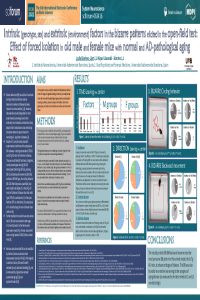
Bizarre behaviors (BB) are elicited in animals during stressful conditions and behavioral markers of disease/sickness relevant to animal welfare. These behaviors are disregarded in most experimental screenings due to their low incidence and short duration, despite their translational value mimicking disruptive behaviors associated with neurological/psychiatric diseases. However, we previously reported experimental conditions with conspicuous BB incidence: 1) the 3xTg-AD mice for Alzheimer's disease vs. wild-types; 2) the open-field test (OF) vs. other tests; 3) + 6 months of age and female sex; 4) at older ages (+13 months) male 3xTg-AD mice also exhibit more circling behavior (BB-CB) than control mice; 5) early neonatal handling reduces BB; whereas 6) they are enhanced by d-galactose-induced accelerated aging. In the present work, we studied the BB patterns elicited in the OF using a longitudinal design with sixty-six 13-month-old male/female mice with normal/AD-pathological aging under social/isolated housing conditions, aimed to explore the effects of intrinsic (genotype, sex) and extrinsic (environment) factors (n=7-8/group). BB were recorded in 39% of animals. Sex, re-test at an older age, and genotype factors differentiated two BB patterns: higher circling behavior (BB-CB, n=12) in wild-type and males, whereas higher backward movements (BB-BM, n=14) in 3xTg-AD, females, and older age. Isolation increased the incidence of freezing, mostly in 3xTg-AD mice, and exerted a modulatory role in BB, but interaction effects with other factors led to residual significance. The results point to BB-BM as the most pervasive BB pattern in this animal model, which is also sensitive to the progress of aging/disease.
Keywords
bizarre behaviors
animal welfare
Alzheimer's disease
aging
social isolation
gender perspective
Manuscript
IECBS Sciforum-2022 BB Abstract Submitted.pdf
Poster
Posters Sciforum 2022 BB submitted.pdf
Tic reduction following dehydration in Gilles de la Tourette Syndrome (TS)
The food-finding test paradigm without deprivation delays the ethogram but preserves the olfactory signatures in female mice with normal and AD-pathological aging and detects their ethogram derangement due to social isolation