Event submissions
Published
 10.3390/ECMC2022-13520 (registering DOI)
 This submission belongs to the session S5. Biomolecules as therapeutics of the event 8th International Electronic Conference on Medicinal Chemistry
Published date
14 Nov, 2022
Academic Editor
'%3e%3cpath%20d='M12.6657%2010.9104C12.4185%2010.325%2012.0599%209.79327%2011.6097%209.34482C11.1609%208.89508%2010.6293%208.5365%2010.0442%208.28888C10.0389%208.28626%2010.0337%208.28495%2010.0285%208.28233C10.8446%207.69279%2011.3752%206.73249%2011.3752%205.64904C11.3752%203.8542%209.92103%202.39999%208.1262%202.39999C6.33136%202.39999%204.87715%203.8542%204.87715%205.64904C4.87715%206.73249%205.40774%207.69279%206.22393%208.28364C6.21869%208.28626%206.21345%208.28757%206.20821%208.29019C5.62129%208.5378%205.09463%208.89284%204.64265%209.34613C4.1929%209.79493%203.83432%2010.3266%203.58671%2010.9117C3.34345%2011.4845%203.21226%2012.0987%203.20023%2012.7209C3.19988%2012.7349%203.20233%2012.7488%203.20744%2012.7619C3.21255%2012.7749%203.22022%2012.7867%203.22998%2012.7968C3.23975%2012.8068%203.25142%2012.8147%203.26431%2012.8202C3.2772%2012.8256%203.29105%2012.8284%203.30504%2012.8284H4.09109C4.14874%2012.8284%204.19459%2012.7825%204.1959%2012.7262C4.2221%2011.7148%204.62823%2010.7676%205.34617%2010.0497C6.08899%209.30683%207.0755%208.89808%208.1262%208.89808C9.17689%208.89808%2010.1634%209.30683%2010.9062%2010.0497C11.6242%2010.7676%2012.0303%2011.7148%2012.0565%2012.7262C12.0578%2012.7838%2012.1037%2012.8284%2012.1613%2012.8284H12.9474C12.9613%2012.8284%2012.9752%2012.8256%2012.9881%2012.8202C13.001%2012.8147%2013.0126%2012.8068%2013.0224%2012.7968C13.0322%2012.7867%2013.0398%2012.7749%2013.0449%2012.7619C13.0501%2012.7488%2013.0525%2012.7349%2013.0522%2012.7209C13.0391%2012.0947%2012.9094%2011.4855%2012.6657%2010.9104ZM8.1262%207.9024C7.52486%207.9024%206.9589%207.6679%206.53312%207.24211C6.10733%206.81633%205.87283%206.25037%205.87283%205.64904C5.87283%205.0477%206.10733%204.48174%206.53312%204.05596C6.9589%203.63018%207.52486%203.39567%208.1262%203.39567C8.72753%203.39567%209.29349%203.63018%209.71927%204.05596C10.1451%204.48174%2010.3796%205.0477%2010.3796%205.64904C10.3796%206.25037%2010.1451%206.81633%209.71927%207.24211C9.29349%207.6679%208.72753%207.9024%208.1262%207.9024Z'%20fill='%235D1EE1'/%3e%3c/g%3e%3c/svg%3e) Maria Emília Sousa
Maria Emília SousaCitation
Allulu Alturki Yousef Alturki, Raghad Alshafi, Sara Alghashem, Rasha Suliman, Sahar Alghamdi, Anti -proliferative and Apoptotic Effects of Selected Saudi Herbs from
the Rhamnaceae, Polygonaceae, and Apocynaceae Families
Against Various Cancer Cell Lines, in Proceedings of 8th International Electronic Conference on Medicinal Chemistry, 1 November–30 November 2022, MDPI: Basel, Switzerland, doi: 10.3390/ECMC2022-13520
Share
Email
Facebook
Twitter
LinkedIn
Anti -proliferative and Apoptotic Effects of Selected Saudi Herbs from
the Rhamnaceae, Polygonaceae, and Apocynaceae Families
Against Various Cancer Cell Lines
'%3e%3cpath%20d='M12.6647%2010.9104C12.4176%2010.325%2012.0589%209.7933%2011.6088%209.34485C11.16%208.89511%2010.6283%208.53653%2010.0432%208.28891C10.038%208.28629%2010.0327%208.28498%2010.0275%208.28236C10.8437%207.69282%2011.3743%206.73252%2011.3743%205.64907C11.3743%203.85423%209.92005%202.40002%208.12522%202.40002C6.33038%202.40002%204.87618%203.85423%204.87618%205.64907C4.87618%206.73252%205.40677%207.69282%206.22296%208.28367C6.21772%208.28629%206.21248%208.2876%206.20724%208.29022C5.62031%208.53783%205.09365%208.89287%204.64167%209.34616C4.19192%209.79496%203.83334%2010.3266%203.58573%2010.9117C3.34247%2011.4846%203.21128%2012.0987%203.19925%2012.721C3.1989%2012.735%203.20135%2012.7489%203.20646%2012.7619C3.21157%2012.7749%203.21924%2012.7868%203.22901%2012.7968C3.23877%2012.8068%203.25045%2012.8148%203.26334%2012.8202C3.27623%2012.8256%203.29007%2012.8284%203.30406%2012.8284H4.09012C4.14776%2012.8284%204.19362%2012.7825%204.19493%2012.7262C4.22113%2011.7148%204.62726%2010.7676%205.34519%2010.0497C6.08802%209.30686%207.07452%208.89811%208.12522%208.89811C9.17592%208.89811%2010.1624%209.30686%2010.9052%2010.0497C11.6232%2010.7676%2012.0293%2011.7148%2012.0555%2012.7262C12.0568%2012.7839%2012.1027%2012.8284%2012.1603%2012.8284H12.9464C12.9604%2012.8284%2012.9742%2012.8256%2012.9871%2012.8202C13%2012.8148%2013.0117%2012.8068%2013.0214%2012.7968C13.0312%2012.7868%2013.0389%2012.7749%2013.044%2012.7619C13.0491%2012.7489%2013.0515%2012.735%2013.0512%2012.721C13.0381%2012.0947%2012.9084%2011.4856%2012.6647%2010.9104ZM8.12522%207.90243C7.52388%207.90243%206.95792%207.66793%206.53214%207.24215C6.10636%206.81636%205.87185%206.2504%205.87185%205.64907C5.87185%205.04773%206.10636%204.48177%206.53214%204.05599C6.95792%203.63021%207.52388%203.3957%208.12522%203.3957C8.72655%203.3957%209.29252%203.63021%209.7183%204.05599C10.1441%204.48177%2010.3786%205.04773%2010.3786%205.64907C10.3786%206.2504%2010.1441%206.81636%209.7183%207.24215C9.29252%207.66793%208.72655%207.90243%208.12522%207.90243Z'%20fill='%235D1EE1'/%3e%3c/g%3e%3c/svg%3e)
Allulu Alturki Yousef Alturki 1
Raghad Alshafi 1
Sara Alghashem 1
Rasha Suliman 2
Sahar Alghamdi 1
1. ksau-hs
2. fchs
Abstract
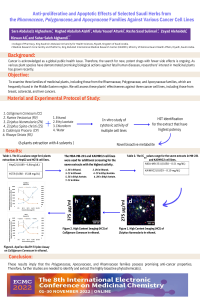
Cancer is recognized as a worldwide public health concern. Therefore, there is a continuous quest to discover new effective medications with less side-effects. In recent years, researchers have shown an increased interest in medicinal plants as several plant species have shown promising biological activities. Thus, we seek to investigate three medicinal herbs that are commonly-found in the Middle Eastern region and yet have not been explored in depth including plants belonging to the Rhamnaceae, Polygonaceae, and Apocynaceae plant families. Initially, we investigated using three types of cancer cell lines for breast, colorectal, and liver cancers. We performed High Content Imaging (HCI)-Apoptosis Assay and ApoTox-Glo™ Triplex Assay on KAIMRC2 and HCT8 cell lines. The highest activity of HCI-Apoptosis Assay was with Calligonum comosum and Ziziphus nummularia in ethanol followed by Calotropis procera and Ziziphus nummularia in ethyl acetate. The IC50 values for the families of Rhamnaceae, Polygonaceae, and Apocynaceae in HepG2 and HCT8 cell lines ranged from 0.089 to 9.84 mg/mL and 0.080 to 15.08 mg/mL, respectively. Further screening was conducted on an additional two cell lines namely the MDA-MB-231 and KAIMRC2 for selected seven extracts with the highest activity having IC50 values ranged from 0.058 to 0.51 mg/mL and 0.029 to 0.19 mg/mL, respectively. Continuous scientific investigations to isolate and characterize the potent bioactive phytochemical(s) are warranted.
Keywords
Apocynaceae
Polygonaceae
natural products
and Rhamnaceae.
Poster
sciforum-065691.pdf
The combined use of AuNP and NIR radiation enables cytosolic protein delivery
The FTIR Analysis of Some Macrofungus Extract-Antibiotic Interactions in Some Multi Drug Resistant (MDR) Bacterial Strains Having Active Efflux Pumps