Event submissions
Published

This submission belongs to the session C. Biomacromolecules: Nucleic Acids of the event The 2nd International Electronic Conference on Biomolecules
Published date
25 Nov, 2022
Academic Editor
'%3e%3cpath%20d='M12.6657%2010.9104C12.4185%2010.325%2012.0599%209.79327%2011.6097%209.34482C11.1609%208.89508%2010.6293%208.5365%2010.0442%208.28888C10.0389%208.28626%2010.0337%208.28495%2010.0285%208.28233C10.8446%207.69279%2011.3752%206.73249%2011.3752%205.64904C11.3752%203.8542%209.92103%202.39999%208.1262%202.39999C6.33136%202.39999%204.87715%203.8542%204.87715%205.64904C4.87715%206.73249%205.40774%207.69279%206.22393%208.28364C6.21869%208.28626%206.21345%208.28757%206.20821%208.29019C5.62129%208.5378%205.09463%208.89284%204.64265%209.34613C4.1929%209.79493%203.83432%2010.3266%203.58671%2010.9117C3.34345%2011.4845%203.21226%2012.0987%203.20023%2012.7209C3.19988%2012.7349%203.20233%2012.7488%203.20744%2012.7619C3.21255%2012.7749%203.22022%2012.7867%203.22998%2012.7968C3.23975%2012.8068%203.25142%2012.8147%203.26431%2012.8202C3.2772%2012.8256%203.29105%2012.8284%203.30504%2012.8284H4.09109C4.14874%2012.8284%204.19459%2012.7825%204.1959%2012.7262C4.2221%2011.7148%204.62823%2010.7676%205.34617%2010.0497C6.08899%209.30683%207.0755%208.89808%208.1262%208.89808C9.17689%208.89808%2010.1634%209.30683%2010.9062%2010.0497C11.6242%2010.7676%2012.0303%2011.7148%2012.0565%2012.7262C12.0578%2012.7838%2012.1037%2012.8284%2012.1613%2012.8284H12.9474C12.9613%2012.8284%2012.9752%2012.8256%2012.9881%2012.8202C13.001%2012.8147%2013.0126%2012.8068%2013.0224%2012.7968C13.0322%2012.7867%2013.0398%2012.7749%2013.0449%2012.7619C13.0501%2012.7488%2013.0525%2012.7349%2013.0522%2012.7209C13.0391%2012.0947%2012.9094%2011.4855%2012.6657%2010.9104ZM8.1262%207.9024C7.52486%207.9024%206.9589%207.6679%206.53312%207.24211C6.10733%206.81633%205.87283%206.25037%205.87283%205.64904C5.87283%205.0477%206.10733%204.48174%206.53312%204.05596C6.9589%203.63018%207.52486%203.39567%208.1262%203.39567C8.72753%203.39567%209.29349%203.63018%209.71927%204.05596C10.1451%204.48174%2010.3796%205.0477%2010.3796%205.64904C10.3796%206.25037%2010.1451%206.81633%209.71927%207.24211C9.29349%207.6679%208.72753%207.9024%208.1262%207.9024Z'%20fill='%235D1EE1'/%3e%3c/g%3e%3c/svg%3e) Peter Nielsen
Peter NielsenCitation
Anastasia Sannikova, Margarita Sharipova, Eugene Shakirov, Lia Valeeva, Natural Diversity of Telomeric DNA Sequences in Bryophytes, in Proceedings of The 2nd International Electronic Conference on Biomolecules, 1 November–15 November 2022, MDPI: Basel, Switzerland, doi: 10.3390/IECBM2022-13740
Share
Email
Facebook
Twitter
LinkedIn
Natural Diversity of Telomeric DNA Sequences in Bryophytes
'%3e%3cpath%20d='M12.6647%2010.9104C12.4176%2010.325%2012.0589%209.7933%2011.6088%209.34485C11.16%208.89511%2010.6283%208.53653%2010.0432%208.28891C10.038%208.28629%2010.0327%208.28498%2010.0275%208.28236C10.8437%207.69282%2011.3743%206.73252%2011.3743%205.64907C11.3743%203.85423%209.92005%202.40002%208.12522%202.40002C6.33038%202.40002%204.87618%203.85423%204.87618%205.64907C4.87618%206.73252%205.40677%207.69282%206.22296%208.28367C6.21772%208.28629%206.21248%208.2876%206.20724%208.29022C5.62031%208.53783%205.09365%208.89287%204.64167%209.34616C4.19192%209.79496%203.83334%2010.3266%203.58573%2010.9117C3.34247%2011.4846%203.21128%2012.0987%203.19925%2012.721C3.1989%2012.735%203.20135%2012.7489%203.20646%2012.7619C3.21157%2012.7749%203.21924%2012.7868%203.22901%2012.7968C3.23877%2012.8068%203.25045%2012.8148%203.26334%2012.8202C3.27623%2012.8256%203.29007%2012.8284%203.30406%2012.8284H4.09012C4.14776%2012.8284%204.19362%2012.7825%204.19493%2012.7262C4.22113%2011.7148%204.62726%2010.7676%205.34519%2010.0497C6.08802%209.30686%207.07452%208.89811%208.12522%208.89811C9.17592%208.89811%2010.1624%209.30686%2010.9052%2010.0497C11.6232%2010.7676%2012.0293%2011.7148%2012.0555%2012.7262C12.0568%2012.7839%2012.1027%2012.8284%2012.1603%2012.8284H12.9464C12.9604%2012.8284%2012.9742%2012.8256%2012.9871%2012.8202C13%2012.8148%2013.0117%2012.8068%2013.0214%2012.7968C13.0312%2012.7868%2013.0389%2012.7749%2013.044%2012.7619C13.0491%2012.7489%2013.0515%2012.735%2013.0512%2012.721C13.0381%2012.0947%2012.9084%2011.4856%2012.6647%2010.9104ZM8.12522%207.90243C7.52388%207.90243%206.95792%207.66793%206.53214%207.24215C6.10636%206.81636%205.87185%206.2504%205.87185%205.64907C5.87185%205.04773%206.10636%204.48177%206.53214%204.05599C6.95792%203.63021%207.52388%203.3957%208.12522%203.3957C8.72655%203.3957%209.29252%203.63021%209.7183%204.05599C10.1441%204.48177%2010.3786%205.04773%2010.3786%205.64907C10.3786%206.2504%2010.1441%206.81636%209.7183%207.24215C9.29252%207.66793%208.72655%207.90243%208.12522%207.90243Z'%20fill='%235D1EE1'/%3e%3c/g%3e%3c/svg%3e)
Anastasia Sannikova 1
Margarita Sharipova 1
Eugene Shakirov 1,2
Lia Valeeva 1
1. Kazan Federal University
2. Department of Biological Sciences, College of Science, Marshall University
Abstract
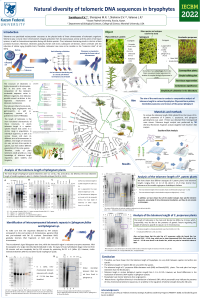
Telomeres - the most important specialized nucleoprotein structures at the ends of linear eukaryotic chromosomes involved in protecting of DNA from damage. The functional characteristic of telomeres is the length. Changes in telomere structure is of enormous evolutionary importance as they can affect whole-genome stability. However, plants remain a poorly studied group in the light of telomere biology. Bryophytes are the prospective plant group for the understanding of the protection and evolution mechanisms of plant telomeres. The aim of the work was to determine natural variability of telomere lengths in different bryophyte species and ecotypes. We used axenic cultures of moss Physcomitrium patens ecotypes (Gransden, Reute, Villersexel, Kaskaskia), moss Ceratodon purpureus (male R40 and female GG1), as well as natural isolates Sphagnum fallax, S. girgensohnii and Sphagnum sp. The analysis of the telomeres was carried out by the TRF method. It was found that different ecotypes of P. patens plants have different telomere lengths in the range from 1000 to 1500 bp. The mean telomere length in a female plant C. purpureus was 480-500 bp, in a male plant 900-1000 bp. The telomere lengths of S. fallax MW and S. girgensohnii were about mean ~2000 bp. However, telomeres were slightly shorter in isolate of S. sp, whose telomere length ranged from 1100 to 1500 bp. In addition, it was found that all studied Bryophytes had differences in the location of specific telomeric sequences. Thus, we have shown that the telomere lengths of bryophytes can vary both between species and within one species. Also, interstitial telomeric DNA is a distinguishing characteristic of bryophyte genomes.
Keywords
telomeres
bryophytes
moss
Physcomitrium patens
Ceratodon purpureus
Sphagnum
Manuscript
sciforum-065826-layout.pdf
Poster
MDPI poster_Sannikova_AV.pdf
Role of APOE Gene Polymorphisms in Coronary Artery Disease