Event submissions
Published

This submission belongs to the session M. Posters of the event The 3rd International Electronic Conference on Applied Sciences
Published date
01 Dec, 2022
Academic Editor
'%3e%3cpath%20d='M12.6657%2010.9104C12.4185%2010.325%2012.0599%209.79327%2011.6097%209.34482C11.1609%208.89508%2010.6293%208.5365%2010.0442%208.28888C10.0389%208.28626%2010.0337%208.28495%2010.0285%208.28233C10.8446%207.69279%2011.3752%206.73249%2011.3752%205.64904C11.3752%203.8542%209.92103%202.39999%208.1262%202.39999C6.33136%202.39999%204.87715%203.8542%204.87715%205.64904C4.87715%206.73249%205.40774%207.69279%206.22393%208.28364C6.21869%208.28626%206.21345%208.28757%206.20821%208.29019C5.62129%208.5378%205.09463%208.89284%204.64265%209.34613C4.1929%209.79493%203.83432%2010.3266%203.58671%2010.9117C3.34345%2011.4845%203.21226%2012.0987%203.20023%2012.7209C3.19988%2012.7349%203.20233%2012.7488%203.20744%2012.7619C3.21255%2012.7749%203.22022%2012.7867%203.22998%2012.7968C3.23975%2012.8068%203.25142%2012.8147%203.26431%2012.8202C3.2772%2012.8256%203.29105%2012.8284%203.30504%2012.8284H4.09109C4.14874%2012.8284%204.19459%2012.7825%204.1959%2012.7262C4.2221%2011.7148%204.62823%2010.7676%205.34617%2010.0497C6.08899%209.30683%207.0755%208.89808%208.1262%208.89808C9.17689%208.89808%2010.1634%209.30683%2010.9062%2010.0497C11.6242%2010.7676%2012.0303%2011.7148%2012.0565%2012.7262C12.0578%2012.7838%2012.1037%2012.8284%2012.1613%2012.8284H12.9474C12.9613%2012.8284%2012.9752%2012.8256%2012.9881%2012.8202C13.001%2012.8147%2013.0126%2012.8068%2013.0224%2012.7968C13.0322%2012.7867%2013.0398%2012.7749%2013.0449%2012.7619C13.0501%2012.7488%2013.0525%2012.7349%2013.0522%2012.7209C13.0391%2012.0947%2012.9094%2011.4855%2012.6657%2010.9104ZM8.1262%207.9024C7.52486%207.9024%206.9589%207.6679%206.53312%207.24211C6.10733%206.81633%205.87283%206.25037%205.87283%205.64904C5.87283%205.0477%206.10733%204.48174%206.53312%204.05596C6.9589%203.63018%207.52486%203.39567%208.1262%203.39567C8.72753%203.39567%209.29349%203.63018%209.71927%204.05596C10.1451%204.48174%2010.3796%205.0477%2010.3796%205.64904C10.3796%206.25037%2010.1451%206.81633%209.71927%207.24211C9.29349%207.6679%208.72753%207.9024%208.1262%207.9024Z'%20fill='%235D1EE1'/%3e%3c/g%3e%3c/svg%3e) Anuj K. Sharma
Anuj K. SharmaCitation
Yuki Okuda, Shigehito Osawa, Hidenori Otsuka, Synthesis of Target-directed Nanogel Carrier with Glycopolymers and Their Application to Immunotherapy, in Proceedings of The 3rd International Electronic Conference on Applied Sciences, 1 December–15 December 2022, MDPI: Basel, Switzerland, doi: 10.3390/ASEC2022-13764
Share
Email
Facebook
Twitter
LinkedIn
Synthesis of Target-directed Nanogel Carrier with Glycopolymers and Their Application to Immunotherapy
'%3e%3cpath%20d='M12.6647%2010.9104C12.4176%2010.325%2012.0589%209.7933%2011.6088%209.34485C11.16%208.89511%2010.6283%208.53653%2010.0432%208.28891C10.038%208.28629%2010.0327%208.28498%2010.0275%208.28236C10.8437%207.69282%2011.3743%206.73252%2011.3743%205.64907C11.3743%203.85423%209.92005%202.40002%208.12522%202.40002C6.33038%202.40002%204.87618%203.85423%204.87618%205.64907C4.87618%206.73252%205.40677%207.69282%206.22296%208.28367C6.21772%208.28629%206.21248%208.2876%206.20724%208.29022C5.62031%208.53783%205.09365%208.89287%204.64167%209.34616C4.19192%209.79496%203.83334%2010.3266%203.58573%2010.9117C3.34247%2011.4846%203.21128%2012.0987%203.19925%2012.721C3.1989%2012.735%203.20135%2012.7489%203.20646%2012.7619C3.21157%2012.7749%203.21924%2012.7868%203.22901%2012.7968C3.23877%2012.8068%203.25045%2012.8148%203.26334%2012.8202C3.27623%2012.8256%203.29007%2012.8284%203.30406%2012.8284H4.09012C4.14776%2012.8284%204.19362%2012.7825%204.19493%2012.7262C4.22113%2011.7148%204.62726%2010.7676%205.34519%2010.0497C6.08802%209.30686%207.07452%208.89811%208.12522%208.89811C9.17592%208.89811%2010.1624%209.30686%2010.9052%2010.0497C11.6232%2010.7676%2012.0293%2011.7148%2012.0555%2012.7262C12.0568%2012.7839%2012.1027%2012.8284%2012.1603%2012.8284H12.9464C12.9604%2012.8284%2012.9742%2012.8256%2012.9871%2012.8202C13%2012.8148%2013.0117%2012.8068%2013.0214%2012.7968C13.0312%2012.7868%2013.0389%2012.7749%2013.044%2012.7619C13.0491%2012.7489%2013.0515%2012.735%2013.0512%2012.721C13.0381%2012.0947%2012.9084%2011.4856%2012.6647%2010.9104ZM8.12522%207.90243C7.52388%207.90243%206.95792%207.66793%206.53214%207.24215C6.10636%206.81636%205.87185%206.2504%205.87185%205.64907C5.87185%205.04773%206.10636%204.48177%206.53214%204.05599C6.95792%203.63021%207.52388%203.3957%208.12522%203.3957C8.72655%203.3957%209.29252%203.63021%209.7183%204.05599C10.1441%204.48177%2010.3786%205.04773%2010.3786%205.64907C10.3786%206.2504%2010.1441%206.81636%209.7183%207.24215C9.29252%207.66793%208.72655%207.90243%208.12522%207.90243Z'%20fill='%235D1EE1'/%3e%3c/g%3e%3c/svg%3e)
Yuki Okuda 1
Shigehito Osawa 2

Hidenori Otsuka 1,2
1. Department of Chemistry, Graduate School of Science, Tokyo University of Science
2. Department of Applied Chemistry Faculty of Science Tokyo University of Science
Abstract
Immunotherapy to induces antigen-specific immunity is expected to be an effective and safe treatment for cancer and infectious diseases, and induction of cytotoxic T lymphocytes (CTL) is particular important to treat these diseases. For effective CTL activation, antigen-presenting cells (APC) such as macrophages and dendritic cells must take up antigenic proteins/antigen peptides, trough degradation them intracellularly, and present the generated peptide fragments on MHC class I molecules. Although various antigen administration methods have been studied to induce CTL efficiently, conventional techniques have not been sufficiently effective. The main reasons are low translocation of their antigens to APC and protein instability during in vivo delivery. In this study, we prepared a core-shell mannose-installed nanogel with a suitable aqueous environment for a protein stabilization that can be active-targeted to dendritic cells in vivo. Targeting of the nanogel to dendritic cells with mannose receptors was confirmed by aggregation inhibition experiments of silica particles mimicking nanogel structures. For higher sensitivity, gold nanoparticle grafted with mannose-glycopolymers was synthesized, and the specific binding to lectin was analyzed from the surface plasmon changes. In addition, inhibition experiments were also conducted to investigate the binding mode in more detail. Mannose-type glycan block copolymers (pManEMA-b-pMAA, Man) were synthesized by RAFT polymerization using the monomer consisting of D(+)-Mannose and 2-hydroxyethyl methacrylate (ManEMA) and methacrylic acid (MAA). Next, the surface of hydrophilic silica nanoparticle (SiNP) was modified with pManEMA-b -pMAA via a silane coupling agent having an amino group at the end. The specificity of mannose presenting SiNP (SiNP-Man) to the receptor protein was evaluated from the inhibition experiment by the addition of free mannose as an inhibitor. The structure of the synthesized glycopolymers was confirmed by 1H-NMR spectra and GPC measurements. Competitive inhibition of SiNP-Man aggregation by lectin was confirmed by the addition of free mannose as an inhibitor. When concanavalin A (ConA), mannose specific lectin, was added to the SiNP-Man solution, particles aggregated due to the specific interaction at the low inhibitor. However, when excess amount of inhibitor was added, the binding site of the lectin was competitively suppressed and the particles did not aggregate. These results confirm the active target property of the mannose-modified nanoparticles.
Keywords
nanogel carrier
protein delivery
cancer immunotherapy
Manuscript
sciforum_065597_original_ASEC-done.pdf
Poster
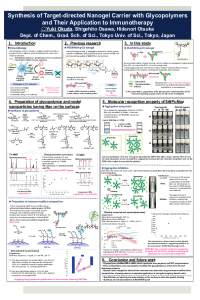
ASEC poster奥田 1013.pdf
Influence of agricultural activity on the surface climate of New Delta of Egypt using the RegCM4
The importance of nanosystems in antipsychotic drugs brain targeting