Event submissions
Published

This submission belongs to the session S4. Medicinally Active Plants and Phytochemicals of the event The 2nd International Electronic Conference on Biomedicines
Published date
01 Mar, 2023
Academic Editor
'%3e%3cpath%20d='M12.6657%2010.9104C12.4185%2010.325%2012.0599%209.79327%2011.6097%209.34482C11.1609%208.89508%2010.6293%208.5365%2010.0442%208.28888C10.0389%208.28626%2010.0337%208.28495%2010.0285%208.28233C10.8446%207.69279%2011.3752%206.73249%2011.3752%205.64904C11.3752%203.8542%209.92103%202.39999%208.1262%202.39999C6.33136%202.39999%204.87715%203.8542%204.87715%205.64904C4.87715%206.73249%205.40774%207.69279%206.22393%208.28364C6.21869%208.28626%206.21345%208.28757%206.20821%208.29019C5.62129%208.5378%205.09463%208.89284%204.64265%209.34613C4.1929%209.79493%203.83432%2010.3266%203.58671%2010.9117C3.34345%2011.4845%203.21226%2012.0987%203.20023%2012.7209C3.19988%2012.7349%203.20233%2012.7488%203.20744%2012.7619C3.21255%2012.7749%203.22022%2012.7867%203.22998%2012.7968C3.23975%2012.8068%203.25142%2012.8147%203.26431%2012.8202C3.2772%2012.8256%203.29105%2012.8284%203.30504%2012.8284H4.09109C4.14874%2012.8284%204.19459%2012.7825%204.1959%2012.7262C4.2221%2011.7148%204.62823%2010.7676%205.34617%2010.0497C6.08899%209.30683%207.0755%208.89808%208.1262%208.89808C9.17689%208.89808%2010.1634%209.30683%2010.9062%2010.0497C11.6242%2010.7676%2012.0303%2011.7148%2012.0565%2012.7262C12.0578%2012.7838%2012.1037%2012.8284%2012.1613%2012.8284H12.9474C12.9613%2012.8284%2012.9752%2012.8256%2012.9881%2012.8202C13.001%2012.8147%2013.0126%2012.8068%2013.0224%2012.7968C13.0322%2012.7867%2013.0398%2012.7749%2013.0449%2012.7619C13.0501%2012.7488%2013.0525%2012.7349%2013.0522%2012.7209C13.0391%2012.0947%2012.9094%2011.4855%2012.6657%2010.9104ZM8.1262%207.9024C7.52486%207.9024%206.9589%207.6679%206.53312%207.24211C6.10733%206.81633%205.87283%206.25037%205.87283%205.64904C5.87283%205.0477%206.10733%204.48174%206.53312%204.05596C6.9589%203.63018%207.52486%203.39567%208.1262%203.39567C8.72753%203.39567%209.29349%203.63018%209.71927%204.05596C10.1451%204.48174%2010.3796%205.0477%2010.3796%205.64904C10.3796%206.25037%2010.1451%206.81633%209.71927%207.24211C9.29349%207.6679%208.72753%207.9024%208.1262%207.9024Z'%20fill='%235D1EE1'/%3e%3c/g%3e%3c/svg%3e) Shaker Mousa
Shaker MousaCitation
Ifeoma Felicia Chukwuma, Florence Nkechi Nworah, Victor Onukwube Apeh, Modulatory Action of Phenolic-enriched Combretum paniculatum Vent Ethanolic Extract on Oxidoinflammatory Anomalies in Experimental Animals, in Proceedings of The 2nd International Electronic Conference on Biomedicines, 1 March–31 March 2023, MDPI: Basel, Switzerland, doi: 10.3390/ECB2023-14085
Share
Email
Facebook
Twitter
LinkedIn
Modulatory Action of Phenolic-enriched Combretum paniculatum Vent Ethanolic Extract on Oxidoinflammatory Anomalies in Experimental Animals
'%3e%3cpath%20d='M12.6647%2010.9104C12.4176%2010.325%2012.0589%209.7933%2011.6088%209.34485C11.16%208.89511%2010.6283%208.53653%2010.0432%208.28891C10.038%208.28629%2010.0327%208.28498%2010.0275%208.28236C10.8437%207.69282%2011.3743%206.73252%2011.3743%205.64907C11.3743%203.85423%209.92005%202.40002%208.12522%202.40002C6.33038%202.40002%204.87618%203.85423%204.87618%205.64907C4.87618%206.73252%205.40677%207.69282%206.22296%208.28367C6.21772%208.28629%206.21248%208.2876%206.20724%208.29022C5.62031%208.53783%205.09365%208.89287%204.64167%209.34616C4.19192%209.79496%203.83334%2010.3266%203.58573%2010.9117C3.34247%2011.4846%203.21128%2012.0987%203.19925%2012.721C3.1989%2012.735%203.20135%2012.7489%203.20646%2012.7619C3.21157%2012.7749%203.21924%2012.7868%203.22901%2012.7968C3.23877%2012.8068%203.25045%2012.8148%203.26334%2012.8202C3.27623%2012.8256%203.29007%2012.8284%203.30406%2012.8284H4.09012C4.14776%2012.8284%204.19362%2012.7825%204.19493%2012.7262C4.22113%2011.7148%204.62726%2010.7676%205.34519%2010.0497C6.08802%209.30686%207.07452%208.89811%208.12522%208.89811C9.17592%208.89811%2010.1624%209.30686%2010.9052%2010.0497C11.6232%2010.7676%2012.0293%2011.7148%2012.0555%2012.7262C12.0568%2012.7839%2012.1027%2012.8284%2012.1603%2012.8284H12.9464C12.9604%2012.8284%2012.9742%2012.8256%2012.9871%2012.8202C13%2012.8148%2013.0117%2012.8068%2013.0214%2012.7968C13.0312%2012.7868%2013.0389%2012.7749%2013.044%2012.7619C13.0491%2012.7489%2013.0515%2012.735%2013.0512%2012.721C13.0381%2012.0947%2012.9084%2011.4856%2012.6647%2010.9104ZM8.12522%207.90243C7.52388%207.90243%206.95792%207.66793%206.53214%207.24215C6.10636%206.81636%205.87185%206.2504%205.87185%205.64907C5.87185%205.04773%206.10636%204.48177%206.53214%204.05599C6.95792%203.63021%207.52388%203.3957%208.12522%203.3957C8.72655%203.3957%209.29252%203.63021%209.7183%204.05599C10.1441%204.48177%2010.3786%205.04773%2010.3786%205.64907C10.3786%206.2504%2010.1441%206.81636%209.7183%207.24215C9.29252%207.66793%208.72655%207.90243%208.12522%207.90243Z'%20fill='%235D1EE1'/%3e%3c/g%3e%3c/svg%3e)
Ifeoma Felicia Chukwuma 1
Florence Nkechi Nworah 1
Victor Onukwube Apeh 2
1. Department of Biochemistry, Faculty of Biological Sciences, University of Nigeria, Nsukka, Nigeria
2. Department of Applied Sciences, Federal College of Dental Technology and Therapy, Enugu, Nigeria
Abstract
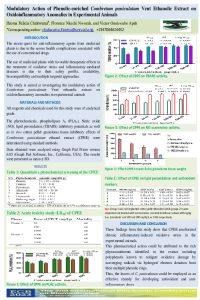
The use of medicinal plants with favourable therapeutic effects has gained interest over conventional drugs in the treatment of oxidative stress and inflammatory-mediated diseases. The antioxidant and anti-inflammatory activities of Combretum paniculatum ethanolic extract (CPEE) were investigated in this study using in vitro and in vivo analysis. The results of phytochemical screening recorded in mg/100 g revealed that CPEE contains phenols (2711.02 ± 60.66), tannins (21.12 ± 0.41), flavonoids (49.00 ± 6.74), alkaloids (605.83 ± 10.10), steroids (0.64 ± 0.06), terpenoids (12.17 ± 0.55), reducing sugar (57.03 ± 0.12), and glycosides (2.59 ± 0.82). Our in vitro analysis revealed that CPEE inhibited nitric oxide, phospholipase A2, and thiobarbituric acid reactive substance activities with half-maximal inhibitory concentration (IC50) values of 6.55, 361.1, and 2.28 µg/mL, respectively. Furthermore, the in vivo study showed that implantation of cotton pellets elicited an increase in granuloma tissue formation, levels of malondialdehyde (MDA), and C-reactive protein (CRP) while decreasing the activities of superoxide dismutase (SOD), catalase (CAT), and reduced glutathione (GSH) in the untreated groups compared to normal rats. Interestingly, the groups treated with 100 and 200 mg/kg body weight of CPEE had decreased granuloma tissue, MDA, and CRP with an increase in the activities of SOD, CAT, and GSH. These findings suggest that CPEE ameliorated chronic inflammatory-induced oxidative stress in the experimental animals. Thus, it could be applied as an effective remedy for developing antioxidant and anti-inflammatory drugs.
Keywords
Antioxidant
inflammation
medicinal plants
oxidative stress
phenols and phytochemicals
Manuscript
sciforum_068086_original_Manuscript_sciforum_068086-done.pdf
Poster
sciforum-068086 Poster.pdf
The development of medical shampoo with plant-based pharmaceutical substance for treatment of seborrheic dermatitis
Nepeta nuda L. plant extract preserves the morphologhy of red blood cells subjected to oxidative stress