Event submissions
Published

This submission belongs to the session S4. Medicinally Active Plants and Phytochemicals of the event The 2nd International Electronic Conference on Biomedicines
Published date
01 Mar, 2023
Academic Editor
'%3e%3cpath%20d='M12.6657%2010.9104C12.4185%2010.325%2012.0599%209.79327%2011.6097%209.34482C11.1609%208.89508%2010.6293%208.5365%2010.0442%208.28888C10.0389%208.28626%2010.0337%208.28495%2010.0285%208.28233C10.8446%207.69279%2011.3752%206.73249%2011.3752%205.64904C11.3752%203.8542%209.92103%202.39999%208.1262%202.39999C6.33136%202.39999%204.87715%203.8542%204.87715%205.64904C4.87715%206.73249%205.40774%207.69279%206.22393%208.28364C6.21869%208.28626%206.21345%208.28757%206.20821%208.29019C5.62129%208.5378%205.09463%208.89284%204.64265%209.34613C4.1929%209.79493%203.83432%2010.3266%203.58671%2010.9117C3.34345%2011.4845%203.21226%2012.0987%203.20023%2012.7209C3.19988%2012.7349%203.20233%2012.7488%203.20744%2012.7619C3.21255%2012.7749%203.22022%2012.7867%203.22998%2012.7968C3.23975%2012.8068%203.25142%2012.8147%203.26431%2012.8202C3.2772%2012.8256%203.29105%2012.8284%203.30504%2012.8284H4.09109C4.14874%2012.8284%204.19459%2012.7825%204.1959%2012.7262C4.2221%2011.7148%204.62823%2010.7676%205.34617%2010.0497C6.08899%209.30683%207.0755%208.89808%208.1262%208.89808C9.17689%208.89808%2010.1634%209.30683%2010.9062%2010.0497C11.6242%2010.7676%2012.0303%2011.7148%2012.0565%2012.7262C12.0578%2012.7838%2012.1037%2012.8284%2012.1613%2012.8284H12.9474C12.9613%2012.8284%2012.9752%2012.8256%2012.9881%2012.8202C13.001%2012.8147%2013.0126%2012.8068%2013.0224%2012.7968C13.0322%2012.7867%2013.0398%2012.7749%2013.0449%2012.7619C13.0501%2012.7488%2013.0525%2012.7349%2013.0522%2012.7209C13.0391%2012.0947%2012.9094%2011.4855%2012.6657%2010.9104ZM8.1262%207.9024C7.52486%207.9024%206.9589%207.6679%206.53312%207.24211C6.10733%206.81633%205.87283%206.25037%205.87283%205.64904C5.87283%205.0477%206.10733%204.48174%206.53312%204.05596C6.9589%203.63018%207.52486%203.39567%208.1262%203.39567C8.72753%203.39567%209.29349%203.63018%209.71927%204.05596C10.1451%204.48174%2010.3796%205.0477%2010.3796%205.64904C10.3796%206.25037%2010.1451%206.81633%209.71927%207.24211C9.29349%207.6679%208.72753%207.9024%208.1262%207.9024Z'%20fill='%235D1EE1'/%3e%3c/g%3e%3c/svg%3e) Shaker Mousa
Shaker MousaCitation
Anuja D. Kamble, Anupa Kumbhar, Rashmi P. Kulkarni, Anjali A. Kulkarni, Potential hypoglycemic secondary metabolites from Argyreia nervosa (Burm. f.) Bojer influencing human gut health, in Proceedings of The 2nd International Electronic Conference on Biomedicines, 1 March–31 March 2023, MDPI: Basel, Switzerland, doi: 10.3390/ECB2023-14090
Share
Email
Facebook
Twitter
LinkedIn
Potential hypoglycemic secondary metabolites from Argyreia nervosa (Burm. f.) Bojer influencing human gut health
'%3e%3cpath%20d='M12.6647%2010.9104C12.4176%2010.325%2012.0589%209.7933%2011.6088%209.34485C11.16%208.89511%2010.6283%208.53653%2010.0432%208.28891C10.038%208.28629%2010.0327%208.28498%2010.0275%208.28236C10.8437%207.69282%2011.3743%206.73252%2011.3743%205.64907C11.3743%203.85423%209.92005%202.40002%208.12522%202.40002C6.33038%202.40002%204.87618%203.85423%204.87618%205.64907C4.87618%206.73252%205.40677%207.69282%206.22296%208.28367C6.21772%208.28629%206.21248%208.2876%206.20724%208.29022C5.62031%208.53783%205.09365%208.89287%204.64167%209.34616C4.19192%209.79496%203.83334%2010.3266%203.58573%2010.9117C3.34247%2011.4846%203.21128%2012.0987%203.19925%2012.721C3.1989%2012.735%203.20135%2012.7489%203.20646%2012.7619C3.21157%2012.7749%203.21924%2012.7868%203.22901%2012.7968C3.23877%2012.8068%203.25045%2012.8148%203.26334%2012.8202C3.27623%2012.8256%203.29007%2012.8284%203.30406%2012.8284H4.09012C4.14776%2012.8284%204.19362%2012.7825%204.19493%2012.7262C4.22113%2011.7148%204.62726%2010.7676%205.34519%2010.0497C6.08802%209.30686%207.07452%208.89811%208.12522%208.89811C9.17592%208.89811%2010.1624%209.30686%2010.9052%2010.0497C11.6232%2010.7676%2012.0293%2011.7148%2012.0555%2012.7262C12.0568%2012.7839%2012.1027%2012.8284%2012.1603%2012.8284H12.9464C12.9604%2012.8284%2012.9742%2012.8256%2012.9871%2012.8202C13%2012.8148%2013.0117%2012.8068%2013.0214%2012.7968C13.0312%2012.7868%2013.0389%2012.7749%2013.044%2012.7619C13.0491%2012.7489%2013.0515%2012.735%2013.0512%2012.721C13.0381%2012.0947%2012.9084%2011.4856%2012.6647%2010.9104ZM8.12522%207.90243C7.52388%207.90243%206.95792%207.66793%206.53214%207.24215C6.10636%206.81636%205.87185%206.2504%205.87185%205.64907C5.87185%205.04773%206.10636%204.48177%206.53214%204.05599C6.95792%203.63021%207.52388%203.3957%208.12522%203.3957C8.72655%203.3957%209.29252%203.63021%209.7183%204.05599C10.1441%204.48177%2010.3786%205.04773%2010.3786%205.64907C10.3786%206.2504%2010.1441%206.81636%209.7183%207.24215C9.29252%207.66793%208.72655%207.90243%208.12522%207.90243Z'%20fill='%235D1EE1'/%3e%3c/g%3e%3c/svg%3e)
Anuja D. Kamble 1
Anupa Kumbhar 2
Rashmi P. Kulkarni 3
Anjali A. Kulkarni 1
1. Department of Botany, Savitribai Phule Pune University (Formerly University of Pune), Ganeshkhind Road, Pune 411007, Maharashtra, India.
2. Department of Chemistry, Savitribai Phule Pune University (Formerly University of Pune), Ganeshkhind Road, Pune 411007, Maharashtra, India.
3. ARNA Genext Solutions Pvt. Ltd., PO Box 37893, Doha, Qatar
Abstract
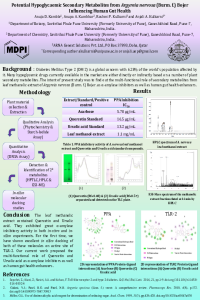
In the last few decades, natural products from plants have got immense importance in human health due to their therapeutic multi-functionality. They have also been reported to enhance human gut health, another important factor in the overall human health. Diabetes Mellitus Type 2 (DM 2) is now a global concern with 6.28% of the world's population affected by it. Many hypoglycemic drugs currently available in the market are either directly or indirectly based on a number of plant secondary metabolites. In the current study, we aimed to find out the hypoglycemic secondary metabolites from leaf methanolic extract of Argyreia nervosa (Burm. f.) Bojer (Family: Convolvulaceae). In the in vitro experiment, this extract showed good inhibitory activity against Porcine Pancreatic Alpha-amylase (PPA) with IC50 value of 1.1 mg/ml. Presence of Quercetin and Ursolic acid was identified in the leaf methanolic extract with HPTLC, HPLC and MS analysis. The calculated IC50 values against PPA, for standard Quercetin and Ursolic acid were 16.5 µg/ml and 13.2 µg/ml respectively. In silico studies used both of these compounds as ligands against PPA (PDB ID: 1OSE) in AutoDock 4.2.6. Significant binding energies of -9.89 kcal/mol and -8.96 kcal/mol were seen for Quercetin and Ursolic acid respectively; while Acarbose (drug used as positive control) had binding energy of -12.48 kcal/mol. Both Quercetin and Ursolic acid strongly interacted with the pivotal amino acid residues like Glu233, Asp197 and Asp300, present at the active site of PPA, which upholds our in vitro experimental results. Both the compounds have exhibited beneficial effects on human gut health in DM 2 and related complications. Docking results of them with few intestinal markers significant in gut health would also be discussed.
Keywords
Argyreia nervosa
Diabetes Mellitus Type 2
Quercetin
Ursolic acid
Human gut health
Molecular Docking
Manuscript
sciforum_068161.pdf
Poster
Biomedicine Conf-Kamble et al-PPT.pdf
Identification of potential protein biomarkers in a depressed Chinese Malaysian university student using liquid chromatography-tandem mass spectrometry
Modulation of HSP70 in the Pharmacological Correction of Nervous System Disorders after Prenatal Hypoxia