Event submissions
Published
 10.3390/HMAM2-14148 (registering DOI)
 This submission belongs to the session AMP. Advanced Manufacturing posters of the event Holography Meets Advanced Manufacturing
Published date
13 Mar, 2023
Academic Editor
'%3e%3cpath%20d='M12.6657%2010.9104C12.4185%2010.325%2012.0599%209.79327%2011.6097%209.34482C11.1609%208.89508%2010.6293%208.5365%2010.0442%208.28888C10.0389%208.28626%2010.0337%208.28495%2010.0285%208.28233C10.8446%207.69279%2011.3752%206.73249%2011.3752%205.64904C11.3752%203.8542%209.92103%202.39999%208.1262%202.39999C6.33136%202.39999%204.87715%203.8542%204.87715%205.64904C4.87715%206.73249%205.40774%207.69279%206.22393%208.28364C6.21869%208.28626%206.21345%208.28757%206.20821%208.29019C5.62129%208.5378%205.09463%208.89284%204.64265%209.34613C4.1929%209.79493%203.83432%2010.3266%203.58671%2010.9117C3.34345%2011.4845%203.21226%2012.0987%203.20023%2012.7209C3.19988%2012.7349%203.20233%2012.7488%203.20744%2012.7619C3.21255%2012.7749%203.22022%2012.7867%203.22998%2012.7968C3.23975%2012.8068%203.25142%2012.8147%203.26431%2012.8202C3.2772%2012.8256%203.29105%2012.8284%203.30504%2012.8284H4.09109C4.14874%2012.8284%204.19459%2012.7825%204.1959%2012.7262C4.2221%2011.7148%204.62823%2010.7676%205.34617%2010.0497C6.08899%209.30683%207.0755%208.89808%208.1262%208.89808C9.17689%208.89808%2010.1634%209.30683%2010.9062%2010.0497C11.6242%2010.7676%2012.0303%2011.7148%2012.0565%2012.7262C12.0578%2012.7838%2012.1037%2012.8284%2012.1613%2012.8284H12.9474C12.9613%2012.8284%2012.9752%2012.8256%2012.9881%2012.8202C13.001%2012.8147%2013.0126%2012.8068%2013.0224%2012.7968C13.0322%2012.7867%2013.0398%2012.7749%2013.0449%2012.7619C13.0501%2012.7488%2013.0525%2012.7349%2013.0522%2012.7209C13.0391%2012.0947%2012.9094%2011.4855%2012.6657%2010.9104ZM8.1262%207.9024C7.52486%207.9024%206.9589%207.6679%206.53312%207.24211C6.10733%206.81633%205.87283%206.25037%205.87283%205.64904C5.87283%205.0477%206.10733%204.48174%206.53312%204.05596C6.9589%203.63018%207.52486%203.39567%208.1262%203.39567C8.72753%203.39567%209.29349%203.63018%209.71927%204.05596C10.1451%204.48174%2010.3796%205.0477%2010.3796%205.64904C10.3796%206.25037%2010.1451%206.81633%209.71927%207.24211C9.29349%207.6679%208.72753%207.9024%208.1262%207.9024Z'%20fill='%235D1EE1'/%3e%3c/g%3e%3c/svg%3e) VIJAYAKUMAR ANAND
VIJAYAKUMAR ANANDCitation
Antonis Kordas, Phanee Manganas, Maria Farsari, Anthi Ranella, 3D scaffolds via Multi-Photon Polymerization as a co-culture system for application in peripheral nervous system regeneration., in Proceedings of Holography Meets Advanced Manufacturing, 20 February–22 February 2023, MDPI: Basel, Switzerland, doi: 10.3390/HMAM2-14148
Share
Email
Facebook
Twitter
LinkedIn
3D scaffolds via Multi-Photon Polymerization as a co-culture system for application in peripheral nervous system regeneration.
'%3e%3cpath%20d='M12.6647%2010.9104C12.4176%2010.325%2012.0589%209.7933%2011.6088%209.34485C11.16%208.89511%2010.6283%208.53653%2010.0432%208.28891C10.038%208.28629%2010.0327%208.28498%2010.0275%208.28236C10.8437%207.69282%2011.3743%206.73252%2011.3743%205.64907C11.3743%203.85423%209.92005%202.40002%208.12522%202.40002C6.33038%202.40002%204.87618%203.85423%204.87618%205.64907C4.87618%206.73252%205.40677%207.69282%206.22296%208.28367C6.21772%208.28629%206.21248%208.2876%206.20724%208.29022C5.62031%208.53783%205.09365%208.89287%204.64167%209.34616C4.19192%209.79496%203.83334%2010.3266%203.58573%2010.9117C3.34247%2011.4846%203.21128%2012.0987%203.19925%2012.721C3.1989%2012.735%203.20135%2012.7489%203.20646%2012.7619C3.21157%2012.7749%203.21924%2012.7868%203.22901%2012.7968C3.23877%2012.8068%203.25045%2012.8148%203.26334%2012.8202C3.27623%2012.8256%203.29007%2012.8284%203.30406%2012.8284H4.09012C4.14776%2012.8284%204.19362%2012.7825%204.19493%2012.7262C4.22113%2011.7148%204.62726%2010.7676%205.34519%2010.0497C6.08802%209.30686%207.07452%208.89811%208.12522%208.89811C9.17592%208.89811%2010.1624%209.30686%2010.9052%2010.0497C11.6232%2010.7676%2012.0293%2011.7148%2012.0555%2012.7262C12.0568%2012.7839%2012.1027%2012.8284%2012.1603%2012.8284H12.9464C12.9604%2012.8284%2012.9742%2012.8256%2012.9871%2012.8202C13%2012.8148%2013.0117%2012.8068%2013.0214%2012.7968C13.0312%2012.7868%2013.0389%2012.7749%2013.044%2012.7619C13.0491%2012.7489%2013.0515%2012.735%2013.0512%2012.721C13.0381%2012.0947%2012.9084%2011.4856%2012.6647%2010.9104ZM8.12522%207.90243C7.52388%207.90243%206.95792%207.66793%206.53214%207.24215C6.10636%206.81636%205.87185%206.2504%205.87185%205.64907C5.87185%205.04773%206.10636%204.48177%206.53214%204.05599C6.95792%203.63021%207.52388%203.3957%208.12522%203.3957C8.72655%203.3957%209.29252%203.63021%209.7183%204.05599C10.1441%204.48177%2010.3786%205.04773%2010.3786%205.64907C10.3786%206.2504%2010.1441%206.81636%209.7183%207.24215C9.29252%207.66793%208.72655%207.90243%208.12522%207.90243Z'%20fill='%235D1EE1'/%3e%3c/g%3e%3c/svg%3e)
Antonis Kordas 1,2
Phanee Manganas 1
Maria Farsari 1

Anthi Ranella 1
1. Institute of Electronic Structure and Laser, Foundation for Research and Technology-Hellas (FORTH-IESL), 100 Nikolaou Plastira Street, Heraklion, 70013, Greece
2. Department of Materials Science and Technology, University of Crete, Vassilika Vouton, Heraklion, 71409, Greece
Abstract
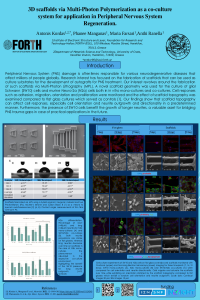
Multi-Photon Polymerization (MPP), has found application in the field of Tissue Engineering (TE), due to the ability of fabrication of high precision scaffolds that can be used as a cell culture substrate. Of great importance is the Peripheral Nervous System (PNS) Tissue Engineering and Regeneration which shows increasing potential as an alternative to established methods, namely surgery and grafts, that aim to counter PNS-related diseases. A femtosecond fiber laser operating at 780nm (pulse duration:120fs, repetition rate:80MHz) was utilized to fabricate a novel pyramid-shaped scaffold geometry (400μm×400μm×60μm) using an organic/inorganic hybrid material. The scaffolds were used as a substrate for the mono- and co-culture of murine neuronal N2a and glial Schwann (SW10) cells for 7, 14 and 21 days with flat glasses as controls. Comparison between scaffolds and controls revealed cell and neurite directionality that was highly influenced by the presence of scaffold topography vs the random orientation controls exhibited, due to the cell responses to the topographical cues provided. In addition, the co-culture system provided a favorable environment for longer neurite formation after 21 days compared to mono-cultures, showing a 2-fold increase in neurites longer than 40μm (31.4%±5.5% vs 15.4%±5.4% of total neurites respectively), indicating a possible synergistic effect of co-cultures and scaffold topography. These findings suggest the ability to control neurite length and directionality, which are crucial parameters in PNS TE, and could form the basis for the development of an in vitro model for the study of PNS-related diseases.
Keywords
Multi-photon polymerization (MPP)
Tissue regeneration
Peripheral Nervous System (PNS)
Co-culture system
Scaffold Topography
Cell Orientation
Neurite Directionality
Manuscript
manuscript.pdf
Poster
poster.pdf
Sapphire Diffractive Axicon milled with Femtosecond Laser Ablation for Imaging Applications
Investigation of Memristor-based neural networks on Pattern recognition