Event submissions
Published

This submission belongs to the session AM 1. Advanced Manufacturing 1 of the event Holography Meets Advanced Manufacturing
Published date
13 Mar, 2023
Academic Editor
'%3e%3cpath%20d='M12.6657%2010.9104C12.4185%2010.325%2012.0599%209.79327%2011.6097%209.34482C11.1609%208.89508%2010.6293%208.5365%2010.0442%208.28888C10.0389%208.28626%2010.0337%208.28495%2010.0285%208.28233C10.8446%207.69279%2011.3752%206.73249%2011.3752%205.64904C11.3752%203.8542%209.92103%202.39999%208.1262%202.39999C6.33136%202.39999%204.87715%203.8542%204.87715%205.64904C4.87715%206.73249%205.40774%207.69279%206.22393%208.28364C6.21869%208.28626%206.21345%208.28757%206.20821%208.29019C5.62129%208.5378%205.09463%208.89284%204.64265%209.34613C4.1929%209.79493%203.83432%2010.3266%203.58671%2010.9117C3.34345%2011.4845%203.21226%2012.0987%203.20023%2012.7209C3.19988%2012.7349%203.20233%2012.7488%203.20744%2012.7619C3.21255%2012.7749%203.22022%2012.7867%203.22998%2012.7968C3.23975%2012.8068%203.25142%2012.8147%203.26431%2012.8202C3.2772%2012.8256%203.29105%2012.8284%203.30504%2012.8284H4.09109C4.14874%2012.8284%204.19459%2012.7825%204.1959%2012.7262C4.2221%2011.7148%204.62823%2010.7676%205.34617%2010.0497C6.08899%209.30683%207.0755%208.89808%208.1262%208.89808C9.17689%208.89808%2010.1634%209.30683%2010.9062%2010.0497C11.6242%2010.7676%2012.0303%2011.7148%2012.0565%2012.7262C12.0578%2012.7838%2012.1037%2012.8284%2012.1613%2012.8284H12.9474C12.9613%2012.8284%2012.9752%2012.8256%2012.9881%2012.8202C13.001%2012.8147%2013.0126%2012.8068%2013.0224%2012.7968C13.0322%2012.7867%2013.0398%2012.7749%2013.0449%2012.7619C13.0501%2012.7488%2013.0525%2012.7349%2013.0522%2012.7209C13.0391%2012.0947%2012.9094%2011.4855%2012.6657%2010.9104ZM8.1262%207.9024C7.52486%207.9024%206.9589%207.6679%206.53312%207.24211C6.10733%206.81633%205.87283%206.25037%205.87283%205.64904C5.87283%205.0477%206.10733%204.48174%206.53312%204.05596C6.9589%203.63018%207.52486%203.39567%208.1262%203.39567C8.72753%203.39567%209.29349%203.63018%209.71927%204.05596C10.1451%204.48174%2010.3796%205.0477%2010.3796%205.64904C10.3796%206.25037%2010.1451%206.81633%209.71927%207.24211C9.29349%207.6679%208.72753%207.9024%208.1262%207.9024Z'%20fill='%235D1EE1'/%3e%3c/g%3e%3c/svg%3e) VIJAYAKUMAR ANAND
VIJAYAKUMAR ANANDCitation
Gayatri Routhu, Phalguni singh Ngangbam, Investigation of Memristor-based neural networks on Pattern recognition, in Proceedings of Holography Meets Advanced Manufacturing, 20 February–22 February 2023, MDPI: Basel, Switzerland, doi: 10.3390/HMAM2-14149
Share
Email
Facebook
Twitter
LinkedIn
Investigation of Memristor-based neural networks on Pattern recognition
'%3e%3cpath%20d='M12.6647%2010.9104C12.4176%2010.325%2012.0589%209.7933%2011.6088%209.34485C11.16%208.89511%2010.6283%208.53653%2010.0432%208.28891C10.038%208.28629%2010.0327%208.28498%2010.0275%208.28236C10.8437%207.69282%2011.3743%206.73252%2011.3743%205.64907C11.3743%203.85423%209.92005%202.40002%208.12522%202.40002C6.33038%202.40002%204.87618%203.85423%204.87618%205.64907C4.87618%206.73252%205.40677%207.69282%206.22296%208.28367C6.21772%208.28629%206.21248%208.2876%206.20724%208.29022C5.62031%208.53783%205.09365%208.89287%204.64167%209.34616C4.19192%209.79496%203.83334%2010.3266%203.58573%2010.9117C3.34247%2011.4846%203.21128%2012.0987%203.19925%2012.721C3.1989%2012.735%203.20135%2012.7489%203.20646%2012.7619C3.21157%2012.7749%203.21924%2012.7868%203.22901%2012.7968C3.23877%2012.8068%203.25045%2012.8148%203.26334%2012.8202C3.27623%2012.8256%203.29007%2012.8284%203.30406%2012.8284H4.09012C4.14776%2012.8284%204.19362%2012.7825%204.19493%2012.7262C4.22113%2011.7148%204.62726%2010.7676%205.34519%2010.0497C6.08802%209.30686%207.07452%208.89811%208.12522%208.89811C9.17592%208.89811%2010.1624%209.30686%2010.9052%2010.0497C11.6232%2010.7676%2012.0293%2011.7148%2012.0555%2012.7262C12.0568%2012.7839%2012.1027%2012.8284%2012.1603%2012.8284H12.9464C12.9604%2012.8284%2012.9742%2012.8256%2012.9871%2012.8202C13%2012.8148%2013.0117%2012.8068%2013.0214%2012.7968C13.0312%2012.7868%2013.0389%2012.7749%2013.044%2012.7619C13.0491%2012.7489%2013.0515%2012.735%2013.0512%2012.721C13.0381%2012.0947%2012.9084%2011.4856%2012.6647%2010.9104ZM8.12522%207.90243C7.52388%207.90243%206.95792%207.66793%206.53214%207.24215C6.10636%206.81636%205.87185%206.2504%205.87185%205.64907C5.87185%205.04773%206.10636%204.48177%206.53214%204.05599C6.95792%203.63021%207.52388%203.3957%208.12522%203.3957C8.72655%203.3957%209.29252%203.63021%209.7183%204.05599C10.1441%204.48177%2010.3786%205.04773%2010.3786%205.64907C10.3786%206.2504%2010.1441%206.81636%209.7183%207.24215C9.29252%207.66793%208.72655%207.90243%208.12522%207.90243Z'%20fill='%235D1EE1'/%3e%3c/g%3e%3c/svg%3e)
Gayatri Routhu 1
Phalguni singh Ngangbam 1
1. Department of Electronics and Communication Engineering, Koneru Lakshmaiah Education Foundation, KL Deemed to be university, Andhra Pradesh, India
Abstract
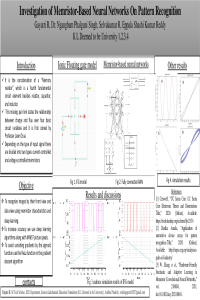
Mobile phones, laptops, computers, digital watches, and digital calculators are some of the most much-using products in our daily life. In the background, to make these gadgets work as per our desire there are many simple components necessary for electronics to function like resistors, capacitors, inductors, etc., these are three basic circuit elements. The Memristor is one such component. This paper provides simulation results of the memristor circuit and its V-I characteristics at different functions as an input signal. A well-trained ANN can able to recognize images with higher precision. To enhance the properties like accuracy, precision, and efficiency in recognition memristor characteristics are introduced to the neural network but previous devices experience some non-linearity issues causing conductance tuning problems. At the same time to be as advanceable in some applications, ANN requires a huge amount of vector-matrix multiplication based on in-depth network expansion. An ionic floating gate (IFG) device with the characteristics of a memristive device can solve these problems. This work proposes a fully connected ANN using the IFG model, the simulation results of the IFG model are given as synapses in deep learning. We use algorithms like the Gradient-descent model, Forward and Backward propagation for network building, and weight setting in neural networks to enhance their ability to recognize images. To be an activation function in the neural network ReLu function is used to avoid vanishing gradients. Here in this paper, we can see how images were recognized by their front view, top view, and side view.
Keywords
Memristor
Memristive device
Ionic Floating Gate (IFG)
Artificial neural network (ANN)
Gradient descent model
Forward and Backward propagation
ReLu function.
Manuscript
069768-Fullmanuscript.pdf
Poster
poster069768.pdf
3D scaffolds via Multi-Photon Polymerization as a co-culture system for application in peripheral nervous system regeneration.
Single Shot Lensless Interferenceless Phase Imaging of Biochemical Samples Using Synchrotron Near Infrared Beam