Event submissions
Published

This submission belongs to the session G. Water Quality and Advanced Water Treatment and Reuse of the event The 7th International Electronic Conference on Water Sciences
Published date
14 Mar, 2023
Academic Editor
'%3e%3cpath%20d='M12.6657%2010.9104C12.4185%2010.325%2012.0599%209.79327%2011.6097%209.34482C11.1609%208.89508%2010.6293%208.5365%2010.0442%208.28888C10.0389%208.28626%2010.0337%208.28495%2010.0285%208.28233C10.8446%207.69279%2011.3752%206.73249%2011.3752%205.64904C11.3752%203.8542%209.92103%202.39999%208.1262%202.39999C6.33136%202.39999%204.87715%203.8542%204.87715%205.64904C4.87715%206.73249%205.40774%207.69279%206.22393%208.28364C6.21869%208.28626%206.21345%208.28757%206.20821%208.29019C5.62129%208.5378%205.09463%208.89284%204.64265%209.34613C4.1929%209.79493%203.83432%2010.3266%203.58671%2010.9117C3.34345%2011.4845%203.21226%2012.0987%203.20023%2012.7209C3.19988%2012.7349%203.20233%2012.7488%203.20744%2012.7619C3.21255%2012.7749%203.22022%2012.7867%203.22998%2012.7968C3.23975%2012.8068%203.25142%2012.8147%203.26431%2012.8202C3.2772%2012.8256%203.29105%2012.8284%203.30504%2012.8284H4.09109C4.14874%2012.8284%204.19459%2012.7825%204.1959%2012.7262C4.2221%2011.7148%204.62823%2010.7676%205.34617%2010.0497C6.08899%209.30683%207.0755%208.89808%208.1262%208.89808C9.17689%208.89808%2010.1634%209.30683%2010.9062%2010.0497C11.6242%2010.7676%2012.0303%2011.7148%2012.0565%2012.7262C12.0578%2012.7838%2012.1037%2012.8284%2012.1613%2012.8284H12.9474C12.9613%2012.8284%2012.9752%2012.8256%2012.9881%2012.8202C13.001%2012.8147%2013.0126%2012.8068%2013.0224%2012.7968C13.0322%2012.7867%2013.0398%2012.7749%2013.0449%2012.7619C13.0501%2012.7488%2013.0525%2012.7349%2013.0522%2012.7209C13.0391%2012.0947%2012.9094%2011.4855%2012.6657%2010.9104ZM8.1262%207.9024C7.52486%207.9024%206.9589%207.6679%206.53312%207.24211C6.10733%206.81633%205.87283%206.25037%205.87283%205.64904C5.87283%205.0477%206.10733%204.48174%206.53312%204.05596C6.9589%203.63018%207.52486%203.39567%208.1262%203.39567C8.72753%203.39567%209.29349%203.63018%209.71927%204.05596C10.1451%204.48174%2010.3796%205.0477%2010.3796%205.64904C10.3796%206.25037%2010.1451%206.81633%209.71927%207.24211C9.29349%207.6679%208.72753%207.9024%208.1262%207.9024Z'%20fill='%235D1EE1'/%3e%3c/g%3e%3c/svg%3e) Carmen Teodosiu
Carmen TeodosiuCitation
Lucija Plantak, Anita Ptiček Siročić, Ivana Grčić, Ranko Biondić, DETECTION OF ORGANOPHOSPHORUS ESTERS (OPEs) IN GROUNDWATER, in Proceedings of The 7th International Electronic Conference on Water Sciences, 15 March–30 March 2023, MDPI: Basel, Switzerland, doi: 10.3390/ECWS-7-14169
Share
Email
Facebook
Twitter
LinkedIn
DETECTION OF ORGANOPHOSPHORUS ESTERS (OPEs) IN GROUNDWATER

Lucija Plantak 1

Anita Ptiček Siročić 1

Ivana Grčić 1

Ranko Biondić 1
1. Faculty of Geotechnical Engineering, University of Zagreb
Abstract
Emerging pollutants, in particular, organic pollutants in groundwater are not enough researched due to the absence of monitoring regulations, nevertheless, monitoring is on a voluntary base. Organophosphate esters (OPEs), triesters, are used as flame retardants and plasticizers to protect or enhance the properties of plastics, textiles, and many other materials. They are high-production volume chemicals with large variations in physical-chemical properties widely used in many human activities and can be detected in groundwater due to their insolubility in water, especially in wastewater. There are developed analytical methods for the determination of OPEs in water i.e., various extraction techniques followed the gas chromatography with mass spectrometry (GC-MS) and liquid chromatography with mass spectrometry (LC-MS). Sampling was carried out in groundwater from the karst aquifer Bokanjac – Poličnik near the city of Zadar, Croatia in order to detect some of the OPEs. To determine their continuous presence in the case study aquifer, samples were taken during the entire hydrological year, that is, once during each season through one year. Some of the OPEs were detected in samples of groundwater from the karst aquifer Bokanjac – Poličnik. Preparation of samples was made with the Solid Phase Extraction (SPE) method and analyzed with liquid chromatography with mass spectrometry and quadrupole time of flight (LC-MS/QTOF). In collected samples nine OPEs were identified with Water Screening Personal Compound Database and Library (PCDL): tris(2-butoxyethyl) phosphate - TBEP, tricresyl phosphate - TCP, triphenyl phosphate - TPPA, tris(1-chloro-2-propyl) phosphate - TCPP, (tris(2-chloroethyl) phosphate - TCEP, tris(1,3-dichloroisopropyl) phosphate - TDCPP, diethyl phthalate - DEP, tri-n-butyl phosphate - TBP, and di(2-ethylhexyl) adipate - DEHA.
Acknowledgment: KK.01.1.1.04.0006 - Otpad i Sunce u službi fotokatalitičke razgradnje mikroonečišćivala u vodama (OS-Mi) and KK.05.1.1.02.0022 – Upravljanje krškim priobalnim vodonosincima ugroženim klimatskim promjenama (UKV)
Keywords
Organic pollutants
Organophosphate esters
SPE
groundwater
karst aquifer
Manuscript
sciforum_068083.pdf
Poster
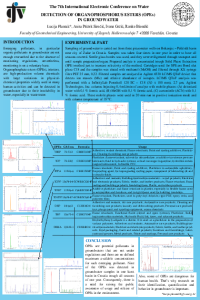
Plantak et al, OPEs.pdf
Daily Streamflow Modelling Using ML Based on Discharge and Rainfall Time Series in the Besós River Basin
Global Change Explorer – a web-based tool for investigating the complexities of global change