Event submissions
Published

This submission belongs to the session F. Hydrological Extremes, Hazards and Disasters of the event The 7th International Electronic Conference on Water Sciences
Published date
14 Mar, 2023
Academic Editor
'%3e%3cpath%20d='M12.6657%2010.9104C12.4185%2010.325%2012.0599%209.79327%2011.6097%209.34482C11.1609%208.89508%2010.6293%208.5365%2010.0442%208.28888C10.0389%208.28626%2010.0337%208.28495%2010.0285%208.28233C10.8446%207.69279%2011.3752%206.73249%2011.3752%205.64904C11.3752%203.8542%209.92103%202.39999%208.1262%202.39999C6.33136%202.39999%204.87715%203.8542%204.87715%205.64904C4.87715%206.73249%205.40774%207.69279%206.22393%208.28364C6.21869%208.28626%206.21345%208.28757%206.20821%208.29019C5.62129%208.5378%205.09463%208.89284%204.64265%209.34613C4.1929%209.79493%203.83432%2010.3266%203.58671%2010.9117C3.34345%2011.4845%203.21226%2012.0987%203.20023%2012.7209C3.19988%2012.7349%203.20233%2012.7488%203.20744%2012.7619C3.21255%2012.7749%203.22022%2012.7867%203.22998%2012.7968C3.23975%2012.8068%203.25142%2012.8147%203.26431%2012.8202C3.2772%2012.8256%203.29105%2012.8284%203.30504%2012.8284H4.09109C4.14874%2012.8284%204.19459%2012.7825%204.1959%2012.7262C4.2221%2011.7148%204.62823%2010.7676%205.34617%2010.0497C6.08899%209.30683%207.0755%208.89808%208.1262%208.89808C9.17689%208.89808%2010.1634%209.30683%2010.9062%2010.0497C11.6242%2010.7676%2012.0303%2011.7148%2012.0565%2012.7262C12.0578%2012.7838%2012.1037%2012.8284%2012.1613%2012.8284H12.9474C12.9613%2012.8284%2012.9752%2012.8256%2012.9881%2012.8202C13.001%2012.8147%2013.0126%2012.8068%2013.0224%2012.7968C13.0322%2012.7867%2013.0398%2012.7749%2013.0449%2012.7619C13.0501%2012.7488%2013.0525%2012.7349%2013.0522%2012.7209C13.0391%2012.0947%2012.9094%2011.4855%2012.6657%2010.9104ZM8.1262%207.9024C7.52486%207.9024%206.9589%207.6679%206.53312%207.24211C6.10733%206.81633%205.87283%206.25037%205.87283%205.64904C5.87283%205.0477%206.10733%204.48174%206.53312%204.05596C6.9589%203.63018%207.52486%203.39567%208.1262%203.39567C8.72753%203.39567%209.29349%203.63018%209.71927%204.05596C10.1451%204.48174%2010.3796%205.0477%2010.3796%205.64904C10.3796%206.25037%2010.1451%206.81633%209.71927%207.24211C9.29349%207.6679%208.72753%207.9024%208.1262%207.9024Z'%20fill='%235D1EE1'/%3e%3c/g%3e%3c/svg%3e) Silvia Kohnova
Silvia KohnovaCitation
Jaewoong Lee, Eric Jobiliong, Timothy Bastiaan, Darren Johanes Manua, Ezekhiel Taniara, Eden Steven, Enhancement of Atmospheric Water Harvesting via Salt-Infused Sponges and Peltier Devices, in Proceedings of The 7th International Electronic Conference on Water Sciences, 15 March–30 March 2023, MDPI: Basel, Switzerland, doi: 10.3390/ECWS-7-14177
Share
Email
Facebook
Twitter
LinkedIn
Enhancement of Atmospheric Water Harvesting via Salt-Infused Sponges and Peltier Devices
'%3e%3cpath%20d='M12.6647%2010.9104C12.4176%2010.325%2012.0589%209.7933%2011.6088%209.34485C11.16%208.89511%2010.6283%208.53653%2010.0432%208.28891C10.038%208.28629%2010.0327%208.28498%2010.0275%208.28236C10.8437%207.69282%2011.3743%206.73252%2011.3743%205.64907C11.3743%203.85423%209.92005%202.40002%208.12522%202.40002C6.33038%202.40002%204.87618%203.85423%204.87618%205.64907C4.87618%206.73252%205.40677%207.69282%206.22296%208.28367C6.21772%208.28629%206.21248%208.2876%206.20724%208.29022C5.62031%208.53783%205.09365%208.89287%204.64167%209.34616C4.19192%209.79496%203.83334%2010.3266%203.58573%2010.9117C3.34247%2011.4846%203.21128%2012.0987%203.19925%2012.721C3.1989%2012.735%203.20135%2012.7489%203.20646%2012.7619C3.21157%2012.7749%203.21924%2012.7868%203.22901%2012.7968C3.23877%2012.8068%203.25045%2012.8148%203.26334%2012.8202C3.27623%2012.8256%203.29007%2012.8284%203.30406%2012.8284H4.09012C4.14776%2012.8284%204.19362%2012.7825%204.19493%2012.7262C4.22113%2011.7148%204.62726%2010.7676%205.34519%2010.0497C6.08802%209.30686%207.07452%208.89811%208.12522%208.89811C9.17592%208.89811%2010.1624%209.30686%2010.9052%2010.0497C11.6232%2010.7676%2012.0293%2011.7148%2012.0555%2012.7262C12.0568%2012.7839%2012.1027%2012.8284%2012.1603%2012.8284H12.9464C12.9604%2012.8284%2012.9742%2012.8256%2012.9871%2012.8202C13%2012.8148%2013.0117%2012.8068%2013.0214%2012.7968C13.0312%2012.7868%2013.0389%2012.7749%2013.044%2012.7619C13.0491%2012.7489%2013.0515%2012.735%2013.0512%2012.721C13.0381%2012.0947%2012.9084%2011.4856%2012.6647%2010.9104ZM8.12522%207.90243C7.52388%207.90243%206.95792%207.66793%206.53214%207.24215C6.10636%206.81636%205.87185%206.2504%205.87185%205.64907C5.87185%205.04773%206.10636%204.48177%206.53214%204.05599C6.95792%203.63021%207.52388%203.3957%208.12522%203.3957C8.72655%203.3957%209.29252%203.63021%209.7183%204.05599C10.1441%204.48177%2010.3786%205.04773%2010.3786%205.64907C10.3786%206.2504%2010.1441%206.81636%209.7183%207.24215C9.29252%207.66793%208.72655%207.90243%208.12522%207.90243Z'%20fill='%235D1EE1'/%3e%3c/g%3e%3c/svg%3e)
Jaewoong Lee 1
Eric Jobiliong 2
Timothy Bastiaan 3
Darren Johanes Manua 1
Ezekhiel Taniara 3
Eden Steven 1,3
1. SPH Applied Science Academy, Sekolah Pelita Harapan Lippo Village, Tangerang, Indonesia 15810
2. Department of Industrial Engineering, Universitas Pelita Harapan, Tangerang, Indonesia 15810
3. Emmerich Research Center, Jakarta, Indonesia 14450
Abstract
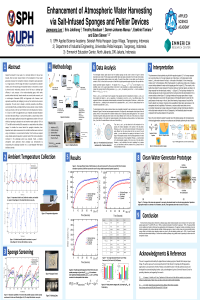
Despite the demand for clean water, it is commonly deficient. In the past two decades, there has been renewed interest in the development of clean water generation processes from atmospheric moisture. Atmospheric water generation is a 2-stage process; in the first stage, the moisture is accumulated in an absorber material, and in the second stage, the absorbed moisture is recovered to a vessel by thermal and/or mechanical processes. One of the keys to achieving high efficiency in such processes is the moisture-absorbing agent, which works passively without electricity. Several materials are currently under research, such as metal-organic frameworks (MOF) and hygroscopic salts. However, most approaches would likely be challenging to scale up from technical and economic perspectives. This work aims to develop a commonly accessible, cost-effective, environmentally friendly, and highly effective moisture absorber. Calcium chloride was chosen as the main salt of interest due to its deliquescence; however, it is known to suffer from agglomeration upon repeated absorption-desorption trials which decreases efficacy. To overcome this problem, a simple infusion of the salt into the sponges significantly reduced the agglomeration problem of the salt while also improving its absorption rate and maximum water uptake by ~30 % at 27°C and 80% relative humidity (RH) compared to a sample without the cellulose sponge. To elucidate the science behind this synergistic interaction, time-dependent water uptake measurements at controlled conditions were carried out using a microbalance in an environmental chamber. Then the data was analyzed using a double exponential equation. A physical model of the moisture absorption mechanism in the salt/sponge system was proposed. Finally, a complete atmospheric water generation device prototype was demonstrated by incorporating the salt/sponge absorber into a custom-designed Peltier-based distillation chamber.
Keywords
Moisture absorber
clean water generation
peltier distiller
Manuscript
sciforum_068285.pdf
Poster
Jaewoong_ECWS_Poster.pdf
Comparative Analysis of Photodegradation of Ibuprofen and Clotrimazole Water Pollutant using UVC Rays in presence and absence of ZnO Photocatalyst
REVIEW OF WATER DISTRIBUTION SYSTEM MODELLING BY EPANET 2.0 AND THE DECISION VARIABLES FOR THE OPTIMAL DESIGN.