Event submissions
Published
 10.3390/ECB2023-14208 (registering DOI)
 This submission belongs to the session S5. Wound Healing of the event The 2nd International Electronic Conference on Biomedicines
Published date
14 Mar, 2023
Academic Editor
'%3e%3cpath%20d='M12.6657%2010.9104C12.4185%2010.325%2012.0599%209.79327%2011.6097%209.34482C11.1609%208.89508%2010.6293%208.5365%2010.0442%208.28888C10.0389%208.28626%2010.0337%208.28495%2010.0285%208.28233C10.8446%207.69279%2011.3752%206.73249%2011.3752%205.64904C11.3752%203.8542%209.92103%202.39999%208.1262%202.39999C6.33136%202.39999%204.87715%203.8542%204.87715%205.64904C4.87715%206.73249%205.40774%207.69279%206.22393%208.28364C6.21869%208.28626%206.21345%208.28757%206.20821%208.29019C5.62129%208.5378%205.09463%208.89284%204.64265%209.34613C4.1929%209.79493%203.83432%2010.3266%203.58671%2010.9117C3.34345%2011.4845%203.21226%2012.0987%203.20023%2012.7209C3.19988%2012.7349%203.20233%2012.7488%203.20744%2012.7619C3.21255%2012.7749%203.22022%2012.7867%203.22998%2012.7968C3.23975%2012.8068%203.25142%2012.8147%203.26431%2012.8202C3.2772%2012.8256%203.29105%2012.8284%203.30504%2012.8284H4.09109C4.14874%2012.8284%204.19459%2012.7825%204.1959%2012.7262C4.2221%2011.7148%204.62823%2010.7676%205.34617%2010.0497C6.08899%209.30683%207.0755%208.89808%208.1262%208.89808C9.17689%208.89808%2010.1634%209.30683%2010.9062%2010.0497C11.6242%2010.7676%2012.0303%2011.7148%2012.0565%2012.7262C12.0578%2012.7838%2012.1037%2012.8284%2012.1613%2012.8284H12.9474C12.9613%2012.8284%2012.9752%2012.8256%2012.9881%2012.8202C13.001%2012.8147%2013.0126%2012.8068%2013.0224%2012.7968C13.0322%2012.7867%2013.0398%2012.7749%2013.0449%2012.7619C13.0501%2012.7488%2013.0525%2012.7349%2013.0522%2012.7209C13.0391%2012.0947%2012.9094%2011.4855%2012.6657%2010.9104ZM8.1262%207.9024C7.52486%207.9024%206.9589%207.6679%206.53312%207.24211C6.10733%206.81633%205.87283%206.25037%205.87283%205.64904C5.87283%205.0477%206.10733%204.48174%206.53312%204.05596C6.9589%203.63018%207.52486%203.39567%208.1262%203.39567C8.72753%203.39567%209.29349%203.63018%209.71927%204.05596C10.1451%204.48174%2010.3796%205.0477%2010.3796%205.64904C10.3796%206.25037%2010.1451%206.81633%209.71927%207.24211C9.29349%207.6679%208.72753%207.9024%208.1262%207.9024Z'%20fill='%235D1EE1'/%3e%3c/g%3e%3c/svg%3e) Stefano Bacci
Stefano BacciCitation
Marta O. Teixeira, Carla Silva, Joana C. Antunes, Helena P. Felgueiras, Biodegradable microfibers loaded with natural agents for infected wounds therapies, in Proceedings of The 2nd International Electronic Conference on Biomedicines, 1 March–31 March 2023, MDPI: Basel, Switzerland, doi: 10.3390/ECB2023-14208
Share
Email
Facebook
Twitter
LinkedIn
Biodegradable microfibers loaded with natural agents for infected wounds therapies
'%3e%3cpath%20d='M12.6647%2010.9104C12.4176%2010.325%2012.0589%209.7933%2011.6088%209.34485C11.16%208.89511%2010.6283%208.53653%2010.0432%208.28891C10.038%208.28629%2010.0327%208.28498%2010.0275%208.28236C10.8437%207.69282%2011.3743%206.73252%2011.3743%205.64907C11.3743%203.85423%209.92005%202.40002%208.12522%202.40002C6.33038%202.40002%204.87618%203.85423%204.87618%205.64907C4.87618%206.73252%205.40677%207.69282%206.22296%208.28367C6.21772%208.28629%206.21248%208.2876%206.20724%208.29022C5.62031%208.53783%205.09365%208.89287%204.64167%209.34616C4.19192%209.79496%203.83334%2010.3266%203.58573%2010.9117C3.34247%2011.4846%203.21128%2012.0987%203.19925%2012.721C3.1989%2012.735%203.20135%2012.7489%203.20646%2012.7619C3.21157%2012.7749%203.21924%2012.7868%203.22901%2012.7968C3.23877%2012.8068%203.25045%2012.8148%203.26334%2012.8202C3.27623%2012.8256%203.29007%2012.8284%203.30406%2012.8284H4.09012C4.14776%2012.8284%204.19362%2012.7825%204.19493%2012.7262C4.22113%2011.7148%204.62726%2010.7676%205.34519%2010.0497C6.08802%209.30686%207.07452%208.89811%208.12522%208.89811C9.17592%208.89811%2010.1624%209.30686%2010.9052%2010.0497C11.6232%2010.7676%2012.0293%2011.7148%2012.0555%2012.7262C12.0568%2012.7839%2012.1027%2012.8284%2012.1603%2012.8284H12.9464C12.9604%2012.8284%2012.9742%2012.8256%2012.9871%2012.8202C13%2012.8148%2013.0117%2012.8068%2013.0214%2012.7968C13.0312%2012.7868%2013.0389%2012.7749%2013.044%2012.7619C13.0491%2012.7489%2013.0515%2012.735%2013.0512%2012.721C13.0381%2012.0947%2012.9084%2011.4856%2012.6647%2010.9104ZM8.12522%207.90243C7.52388%207.90243%206.95792%207.66793%206.53214%207.24215C6.10636%206.81636%205.87185%206.2504%205.87185%205.64907C5.87185%205.04773%206.10636%204.48177%206.53214%204.05599C6.95792%203.63021%207.52388%203.3957%208.12522%203.3957C8.72655%203.3957%209.29252%203.63021%209.7183%204.05599C10.1441%204.48177%2010.3786%205.04773%2010.3786%205.64907C10.3786%206.2504%2010.1441%206.81636%209.7183%207.24215C9.29252%207.66793%208.72655%207.90243%208.12522%207.90243Z'%20fill='%235D1EE1'/%3e%3c/g%3e%3c/svg%3e)
Marta O. Teixeira 1

Carla Silva 2

Joana C. Antunes 1

Helena P. Felgueiras 1
1. University of Minho, Campus of Azurém
2. University of Minho, Campus of Gualtar
Abstract
The ever increasing bacterial resistance towards antibiotics has become a global concern that conditions and put the lives of many patients at risk. Natural extracts are emerging as potential alternatives to the use of antibiotics to fight infections, by exhibiting excellent antimicrobial and anti-inflammatory profiles. The biomolecules thymol, eugenol, carvacrol and propolis have been explored in the prevention/treatment of wound infections, revealing great effectiveness. Different fiber-based scaffolds have been employed in wound therapies because of their similarities to the fibrillar elements that make up the structure of the skin. In this study, we explored the antimicrobial profiles of selected natural extracts and their potential for incorporation into wet-spun fibers. In a first instance, the antibacterial potential of the former four extracts was examined against the Gram-positive bacteria Staphylococcus aureus and Staphylococcus epidermidis. Thymol was highlighted as the most effective from the group, registering minimal inhibitory concentrations (MIC) of 0.313 and 0.627 mg/mL against each bacterium, respectively. Propolis displayed MICs of 2.560 mg/mL, while carvacrol registered MICs of 2.560 and 5.120 mg/mL against S. aureus and S. epidermidis, respectively. On its turn, eugenol required the highest concentrations, 5.120 mg/mL, to induce the same effect as the other extracts. Thymol exhibits different mechanisms of action against bacteria: it can destroy the integrity of the cell membrane and/or destabilize the secondary structure of bacterial DNA, compromising the viability of the microorganism, which can explain its superior effectiveness compared to the remainder extracts. Subsequently, polycaprolactone (PCL) wet-spun fibers were produced and functionalized with thymol. Using the wet-spinning technique, 9 wt.% PCL in dimethylformamide was processed in the form of fibers at an extrusion rate of 0.1 mL/min directly into a distilled water (dH2O) coagulation bath. To generate modified fibers, the PCL solution was combined with thymol (dissolved in dimethyl sulfoxide) at 1.254 mg/mL (2×0.627 mg/mL; 2×MBC). Both PCL and PCL-thymol fibers presented a uniform and homogeneous appearance. Presence of thymol reduced the elongation at break (from 159.32 to 93.26%) and diameter of the fibers (from 247.49 to 146.99 µm). In a near future, individual PCL fibers loaded with thymol will be combined and knitted in the form of a dressing system with an effective antibacterial profile for potential uses in wound infection control.
Keywords
Wet-spinning fibers
natural-origin biomolecules
antibacterial activity
Manuscript
sciforum-069394 .pdf
Poster
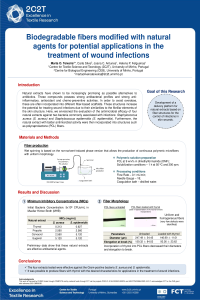
ECB 2023 Poster_Marta O. Teixeira.pdf
In-silico approach to assess the polyphenols from Krishna Tulsi (Ocimum tenuiflorum L.) for Keap1/Nrf2 receptor towards the treatment of Inflammatory Bowel Disease
Eco-friendly one-pot synthesis of zinc oxide nanoparticles using catkin extract of Piper longum: In-vitro antibacterial, antioxidant and antibiofilm potential against multi-drug resistant enteroaggregative E. coli