Event submissions
EventsThe 3rd International Electronic Conference on Cancers: New Targets for Cancer Therapies (IECC 2023)
Published
This submission belongs to the session S3. Novel Immunotherapy Targets of the event The 3rd International Electronic Conference on Cancers: New Targets for Cancer Therapies (IECC 2023)
Published date
16 Mar, 2023
Academic Editor
'%3e%3cpath%20d='M12.6657%2010.9104C12.4185%2010.325%2012.0599%209.79327%2011.6097%209.34482C11.1609%208.89508%2010.6293%208.5365%2010.0442%208.28888C10.0389%208.28626%2010.0337%208.28495%2010.0285%208.28233C10.8446%207.69279%2011.3752%206.73249%2011.3752%205.64904C11.3752%203.8542%209.92103%202.39999%208.1262%202.39999C6.33136%202.39999%204.87715%203.8542%204.87715%205.64904C4.87715%206.73249%205.40774%207.69279%206.22393%208.28364C6.21869%208.28626%206.21345%208.28757%206.20821%208.29019C5.62129%208.5378%205.09463%208.89284%204.64265%209.34613C4.1929%209.79493%203.83432%2010.3266%203.58671%2010.9117C3.34345%2011.4845%203.21226%2012.0987%203.20023%2012.7209C3.19988%2012.7349%203.20233%2012.7488%203.20744%2012.7619C3.21255%2012.7749%203.22022%2012.7867%203.22998%2012.7968C3.23975%2012.8068%203.25142%2012.8147%203.26431%2012.8202C3.2772%2012.8256%203.29105%2012.8284%203.30504%2012.8284H4.09109C4.14874%2012.8284%204.19459%2012.7825%204.1959%2012.7262C4.2221%2011.7148%204.62823%2010.7676%205.34617%2010.0497C6.08899%209.30683%207.0755%208.89808%208.1262%208.89808C9.17689%208.89808%2010.1634%209.30683%2010.9062%2010.0497C11.6242%2010.7676%2012.0303%2011.7148%2012.0565%2012.7262C12.0578%2012.7838%2012.1037%2012.8284%2012.1613%2012.8284H12.9474C12.9613%2012.8284%2012.9752%2012.8256%2012.9881%2012.8202C13.001%2012.8147%2013.0126%2012.8068%2013.0224%2012.7968C13.0322%2012.7867%2013.0398%2012.7749%2013.0449%2012.7619C13.0501%2012.7488%2013.0525%2012.7349%2013.0522%2012.7209C13.0391%2012.0947%2012.9094%2011.4855%2012.6657%2010.9104ZM8.1262%207.9024C7.52486%207.9024%206.9589%207.6679%206.53312%207.24211C6.10733%206.81633%205.87283%206.25037%205.87283%205.64904C5.87283%205.0477%206.10733%204.48174%206.53312%204.05596C6.9589%203.63018%207.52486%203.39567%208.1262%203.39567C8.72753%203.39567%209.29349%203.63018%209.71927%204.05596C10.1451%204.48174%2010.3796%205.0477%2010.3796%205.64904C10.3796%206.25037%2010.1451%206.81633%209.71927%207.24211C9.29349%207.6679%208.72753%207.9024%208.1262%207.9024Z'%20fill='%235D1EE1'/%3e%3c/g%3e%3c/svg%3e) Carlos Moreno
Carlos MorenoCitation
Mateusz Aleksander Gotowiec, Wiktor Paskal, Paweł Włodarski, Lentiviral transduction of rat adipose-derived stem cells for stable production of TRAIL in the tumour microenvironment in an in-vitro model of breast cancer, in Proceedings of The 3rd International Electronic Conference on Cancers: New Targets for Cancer Therapies (IECC 2023), 16 March–30 March 2023, MDPI: Basel, Switzerland
Share
Email
Facebook
Twitter
LinkedIn
Lentiviral transduction of rat adipose-derived stem cells for stable production of TRAIL in the tumour microenvironment in an in-vitro model of breast cancer

Mateusz Aleksander Gotowiec 1

Wiktor Paskal 1
'%3e%3cpath%20d='M12.6647%2010.9104C12.4176%2010.325%2012.0589%209.7933%2011.6088%209.34485C11.16%208.89511%2010.6283%208.53653%2010.0432%208.28891C10.038%208.28629%2010.0327%208.28498%2010.0275%208.28236C10.8437%207.69282%2011.3743%206.73252%2011.3743%205.64907C11.3743%203.85423%209.92005%202.40002%208.12522%202.40002C6.33038%202.40002%204.87618%203.85423%204.87618%205.64907C4.87618%206.73252%205.40677%207.69282%206.22296%208.28367C6.21772%208.28629%206.21248%208.2876%206.20724%208.29022C5.62031%208.53783%205.09365%208.89287%204.64167%209.34616C4.19192%209.79496%203.83334%2010.3266%203.58573%2010.9117C3.34247%2011.4846%203.21128%2012.0987%203.19925%2012.721C3.1989%2012.735%203.20135%2012.7489%203.20646%2012.7619C3.21157%2012.7749%203.21924%2012.7868%203.22901%2012.7968C3.23877%2012.8068%203.25045%2012.8148%203.26334%2012.8202C3.27623%2012.8256%203.29007%2012.8284%203.30406%2012.8284H4.09012C4.14776%2012.8284%204.19362%2012.7825%204.19493%2012.7262C4.22113%2011.7148%204.62726%2010.7676%205.34519%2010.0497C6.08802%209.30686%207.07452%208.89811%208.12522%208.89811C9.17592%208.89811%2010.1624%209.30686%2010.9052%2010.0497C11.6232%2010.7676%2012.0293%2011.7148%2012.0555%2012.7262C12.0568%2012.7839%2012.1027%2012.8284%2012.1603%2012.8284H12.9464C12.9604%2012.8284%2012.9742%2012.8256%2012.9871%2012.8202C13%2012.8148%2013.0117%2012.8068%2013.0214%2012.7968C13.0312%2012.7868%2013.0389%2012.7749%2013.044%2012.7619C13.0491%2012.7489%2013.0515%2012.735%2013.0512%2012.721C13.0381%2012.0947%2012.9084%2011.4856%2012.6647%2010.9104ZM8.12522%207.90243C7.52388%207.90243%206.95792%207.66793%206.53214%207.24215C6.10636%206.81636%205.87185%206.2504%205.87185%205.64907C5.87185%205.04773%206.10636%204.48177%206.53214%204.05599C6.95792%203.63021%207.52388%203.3957%208.12522%203.3957C8.72655%203.3957%209.29252%203.63021%209.7183%204.05599C10.1441%204.48177%2010.3786%205.04773%2010.3786%205.64907C10.3786%206.2504%2010.1441%206.81636%209.7183%207.24215C9.29252%207.66793%208.72655%207.90243%208.12522%207.90243Z'%20fill='%235D1EE1'/%3e%3c/g%3e%3c/svg%3e)
Paweł Włodarski 1
1. Department of Methodology, Medical University of Warsaw, Poland
Abstract
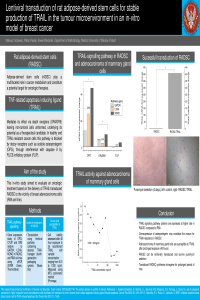
Adipose-derived stem cells (rADSC) play a multifaceted role in cancer metabolism and constitute a potential target for oncologic therapies. Local delivery of TNF-related apoptosis-inducing ligand (TRAIL) can limit tumour growth by selective binding to the death receptor (DR5) in cancer cells. In most healthy cells this pathway is blocked by decoy antagonists such as osteoprotegerin (OPG). This in-vitro study aimed to evaluate an oncologic treatment based on the delivery of TRAIL-transduced rADSC to the vicinity of breast adenocarcinoma cells.
A plasmid containing transgene was produced using the Cloning HD system(TakaraBio) based on Plvx-EF1a-IRES-PURO plasmid and amplified TRAIL gene from the Sprague-Dawley rat kidney. Lentiviral particles were produced using VSV-G Single Shots(TakaraBio) in HEK293T cells. Cytotoxicity of TRAIL against rADSC and RBA (rat adenocarcinoma of the mammary gland) was measured using MTS Assay. Quantitative PCR and Western Blot analyses were conducted to confirm transgene overexpression and measure OPG and DR5 expression in both cell lines. Direct cytotoxicity of RBA cells to transduced rADSC was measured using exposure to a supernatant of TRAIL-expressing rADSC. Data analysis was done using the student’s t-test.
Cells were successfully transduced, and TRAIL expression was 400-fold higher in transduced cells (P<0.01) than in controls. The expression of TRAIL-dependent receptors was higher in rADSC (OPG – 30-fold (P<0.01) and DR5 - 6-fold (P<0.05)). RBA cells were susceptible to exogenous TRAIL and the cell supernatant – IC50 was equal to 200 ng/ml, while rADSC were resistant to TRAIL.
The results show that TRAIL-transduced rADSC are cytotoxic against adenocarcinoma cells. Overexpression of TRAIL by rADSC also stimulates their growth leading to an increased cancer microenvironment penetration. Such active surveillance based on stable local production of anticancer cytokine can limit cancer recurrence when transplanted into the vicinity of cancer tissue.
Keywords
Mesenchymal Stem Cell
Breast Cancer
TRAIL
Gene Therapy
Manuscript
sciforum-069082.pdf
Poster
poster.pdf
A combination of Vitamin C with DNA methylation inhibitor Decitabine Preserves the Colon Immunogenicity and Overcomes the Chemoresistance
Amelioration of Glioblastoma multiforme by the combintion of Simulated microgravity and Oncolytic viral therapy.