Event submissions
EventsThe 3rd International Electronic Conference on Cancers: New Targets for Cancer Therapies (IECC 2023)
Published

This submission belongs to the session S4. Novel Approaches for ‘Undruggable’ Targets of the event The 3rd International Electronic Conference on Cancers: New Targets for Cancer Therapies (IECC 2023)
Published date
16 Mar, 2023
Academic Editor
'%3e%3cpath%20d='M12.6657%2010.9104C12.4185%2010.325%2012.0599%209.79327%2011.6097%209.34482C11.1609%208.89508%2010.6293%208.5365%2010.0442%208.28888C10.0389%208.28626%2010.0337%208.28495%2010.0285%208.28233C10.8446%207.69279%2011.3752%206.73249%2011.3752%205.64904C11.3752%203.8542%209.92103%202.39999%208.1262%202.39999C6.33136%202.39999%204.87715%203.8542%204.87715%205.64904C4.87715%206.73249%205.40774%207.69279%206.22393%208.28364C6.21869%208.28626%206.21345%208.28757%206.20821%208.29019C5.62129%208.5378%205.09463%208.89284%204.64265%209.34613C4.1929%209.79493%203.83432%2010.3266%203.58671%2010.9117C3.34345%2011.4845%203.21226%2012.0987%203.20023%2012.7209C3.19988%2012.7349%203.20233%2012.7488%203.20744%2012.7619C3.21255%2012.7749%203.22022%2012.7867%203.22998%2012.7968C3.23975%2012.8068%203.25142%2012.8147%203.26431%2012.8202C3.2772%2012.8256%203.29105%2012.8284%203.30504%2012.8284H4.09109C4.14874%2012.8284%204.19459%2012.7825%204.1959%2012.7262C4.2221%2011.7148%204.62823%2010.7676%205.34617%2010.0497C6.08899%209.30683%207.0755%208.89808%208.1262%208.89808C9.17689%208.89808%2010.1634%209.30683%2010.9062%2010.0497C11.6242%2010.7676%2012.0303%2011.7148%2012.0565%2012.7262C12.0578%2012.7838%2012.1037%2012.8284%2012.1613%2012.8284H12.9474C12.9613%2012.8284%2012.9752%2012.8256%2012.9881%2012.8202C13.001%2012.8147%2013.0126%2012.8068%2013.0224%2012.7968C13.0322%2012.7867%2013.0398%2012.7749%2013.0449%2012.7619C13.0501%2012.7488%2013.0525%2012.7349%2013.0522%2012.7209C13.0391%2012.0947%2012.9094%2011.4855%2012.6657%2010.9104ZM8.1262%207.9024C7.52486%207.9024%206.9589%207.6679%206.53312%207.24211C6.10733%206.81633%205.87283%206.25037%205.87283%205.64904C5.87283%205.0477%206.10733%204.48174%206.53312%204.05596C6.9589%203.63018%207.52486%203.39567%208.1262%203.39567C8.72753%203.39567%209.29349%203.63018%209.71927%204.05596C10.1451%204.48174%2010.3796%205.0477%2010.3796%205.64904C10.3796%206.25037%2010.1451%206.81633%209.71927%207.24211C9.29349%207.6679%208.72753%207.9024%208.1262%207.9024Z'%20fill='%235D1EE1'/%3e%3c/g%3e%3c/svg%3e) Carlos Moreno
Carlos MorenoCitation
Raj Sewduth, Tonci Ivanisevic, Anna Sablina, Novel therapeutic approaches for kras mutated lung cancer involving Lztr1 genetic alteration, in Proceedings of The 3rd International Electronic Conference on Cancers: New Targets for Cancer Therapies (IECC 2023), 16 March–30 March 2023, MDPI: Basel, Switzerland, doi: 10.3390/IECC2023-14221
Share
Email
Facebook
Twitter
LinkedIn
Novel therapeutic approaches for kras mutated lung cancer involving Lztr1 genetic alteration

Raj Sewduth 1
'%3e%3cpath%20d='M12.6647%2010.9104C12.4176%2010.325%2012.0589%209.7933%2011.6088%209.34485C11.16%208.89511%2010.6283%208.53653%2010.0432%208.28891C10.038%208.28629%2010.0327%208.28498%2010.0275%208.28236C10.8437%207.69282%2011.3743%206.73252%2011.3743%205.64907C11.3743%203.85423%209.92005%202.40002%208.12522%202.40002C6.33038%202.40002%204.87618%203.85423%204.87618%205.64907C4.87618%206.73252%205.40677%207.69282%206.22296%208.28367C6.21772%208.28629%206.21248%208.2876%206.20724%208.29022C5.62031%208.53783%205.09365%208.89287%204.64167%209.34616C4.19192%209.79496%203.83334%2010.3266%203.58573%2010.9117C3.34247%2011.4846%203.21128%2012.0987%203.19925%2012.721C3.1989%2012.735%203.20135%2012.7489%203.20646%2012.7619C3.21157%2012.7749%203.21924%2012.7868%203.22901%2012.7968C3.23877%2012.8068%203.25045%2012.8148%203.26334%2012.8202C3.27623%2012.8256%203.29007%2012.8284%203.30406%2012.8284H4.09012C4.14776%2012.8284%204.19362%2012.7825%204.19493%2012.7262C4.22113%2011.7148%204.62726%2010.7676%205.34519%2010.0497C6.08802%209.30686%207.07452%208.89811%208.12522%208.89811C9.17592%208.89811%2010.1624%209.30686%2010.9052%2010.0497C11.6232%2010.7676%2012.0293%2011.7148%2012.0555%2012.7262C12.0568%2012.7839%2012.1027%2012.8284%2012.1603%2012.8284H12.9464C12.9604%2012.8284%2012.9742%2012.8256%2012.9871%2012.8202C13%2012.8148%2013.0117%2012.8068%2013.0214%2012.7968C13.0312%2012.7868%2013.0389%2012.7749%2013.044%2012.7619C13.0491%2012.7489%2013.0515%2012.735%2013.0512%2012.721C13.0381%2012.0947%2012.9084%2011.4856%2012.6647%2010.9104ZM8.12522%207.90243C7.52388%207.90243%206.95792%207.66793%206.53214%207.24215C6.10636%206.81636%205.87185%206.2504%205.87185%205.64907C5.87185%205.04773%206.10636%204.48177%206.53214%204.05599C6.95792%203.63021%207.52388%203.3957%208.12522%203.3957C8.72655%203.3957%209.29252%203.63021%209.7183%204.05599C10.1441%204.48177%2010.3786%205.04773%2010.3786%205.64907C10.3786%206.2504%2010.1441%206.81636%209.7183%207.24215C9.29252%207.66793%208.72655%207.90243%208.12522%207.90243Z'%20fill='%235D1EE1'/%3e%3c/g%3e%3c/svg%3e)
Tonci Ivanisevic 1
Anna Sablina 1
1. VIB KU LEUVEN
Abstract
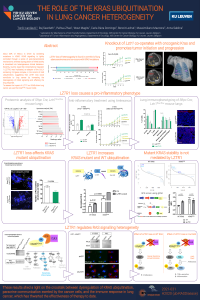
30% of Lung adenocarcinoma are driven by activating KRAS mutations. The treatment options for KRAS-mutant lung cancer are still limited, as a challenge for therapy is the high heterogeneity within KRAS mutant tumors. Co-existing genetic events alter RAS signaling, such as genetic alteration of the ubiquitin ligase leucine zipper-like transcriptional regulator 1 (LZTR1). LZTR1 is an adaptor of CUL3 E3 ligase, that controls the localization and expression levels of RAS proteins by regulating its ubiquitination. Recent studies demonstrated that the loss of LZTR1 leads to resistance to the tyrosine kinase inhibitor and the multi-kinase inhibitor, suggesting that LZTR1 loss might be associated with the drug resistance of KRAS-mutated lung tumors. TCGA analysis indicated that LZTR1 loss affected progression survival in KRAS mutant LUAD patients, with a significant co-occurrence of LZTR1 loss and KRAS mutations. While LZTR1 depletion in LUAD cell lines did not affect proliferation in cell culture, the knock-out (KO) of Lztr1 in a mouse model with Kras G12D oncogenic mutation caused a clear and significant acceleration of tumor progression in the Lztr1 loss groups, indicating that Lztr1 can affect tumor onset and progression. To study the alterations of the RAS pathway triggered by LZTR1 loss, we performed a global OMICS analysis on both in vitro and in vivo systems, identifying potential therapeutic targets. The characterization of immune populations in the tumors by flow cytometry also revealed changes in immune infiltrate in the KO mouse. We are now investigating how the changes caused by Lztr1 deletion on KRAS signaling heterogeneity within the tumor cells, can affect the tumor microenvironment composition. Our results suggest that dysregulation of KRAS function by Lztr1 deletion contributes to cancer progression by affecting tumor cell communication with the microenvironment. Our work could explain how Lztr1 loss can affect the drug response and lead to therapy resistance.
Keywords
Lung cancer
kras
lztr1
ubitiquitination
Manuscript
sciforum-069265.pdf
Poster
SEWDUTH poster IECC.pdf
The phenomenon of the cross-resistance of breast cancer to target and hormonal drugs: the role of epigenetic reconstruction
Screening of naphthalimides as antimetastatic agents