Event submissions
Published

This submission belongs to the session C. Water Resources Policy, Governance and Socioeconomic Aspects of the event The 7th International Electronic Conference on Water Sciences
Published date
16 Mar, 2023
Academic Editor
'%3e%3cpath%20d='M12.6657%2010.9104C12.4185%2010.325%2012.0599%209.79327%2011.6097%209.34482C11.1609%208.89508%2010.6293%208.5365%2010.0442%208.28888C10.0389%208.28626%2010.0337%208.28495%2010.0285%208.28233C10.8446%207.69279%2011.3752%206.73249%2011.3752%205.64904C11.3752%203.8542%209.92103%202.39999%208.1262%202.39999C6.33136%202.39999%204.87715%203.8542%204.87715%205.64904C4.87715%206.73249%205.40774%207.69279%206.22393%208.28364C6.21869%208.28626%206.21345%208.28757%206.20821%208.29019C5.62129%208.5378%205.09463%208.89284%204.64265%209.34613C4.1929%209.79493%203.83432%2010.3266%203.58671%2010.9117C3.34345%2011.4845%203.21226%2012.0987%203.20023%2012.7209C3.19988%2012.7349%203.20233%2012.7488%203.20744%2012.7619C3.21255%2012.7749%203.22022%2012.7867%203.22998%2012.7968C3.23975%2012.8068%203.25142%2012.8147%203.26431%2012.8202C3.2772%2012.8256%203.29105%2012.8284%203.30504%2012.8284H4.09109C4.14874%2012.8284%204.19459%2012.7825%204.1959%2012.7262C4.2221%2011.7148%204.62823%2010.7676%205.34617%2010.0497C6.08899%209.30683%207.0755%208.89808%208.1262%208.89808C9.17689%208.89808%2010.1634%209.30683%2010.9062%2010.0497C11.6242%2010.7676%2012.0303%2011.7148%2012.0565%2012.7262C12.0578%2012.7838%2012.1037%2012.8284%2012.1613%2012.8284H12.9474C12.9613%2012.8284%2012.9752%2012.8256%2012.9881%2012.8202C13.001%2012.8147%2013.0126%2012.8068%2013.0224%2012.7968C13.0322%2012.7867%2013.0398%2012.7749%2013.0449%2012.7619C13.0501%2012.7488%2013.0525%2012.7349%2013.0522%2012.7209C13.0391%2012.0947%2012.9094%2011.4855%2012.6657%2010.9104ZM8.1262%207.9024C7.52486%207.9024%206.9589%207.6679%206.53312%207.24211C6.10733%206.81633%205.87283%206.25037%205.87283%205.64904C5.87283%205.0477%206.10733%204.48174%206.53312%204.05596C6.9589%203.63018%207.52486%203.39567%208.1262%203.39567C8.72753%203.39567%209.29349%203.63018%209.71927%204.05596C10.1451%204.48174%2010.3796%205.0477%2010.3796%205.64904C10.3796%206.25037%2010.1451%206.81633%209.71927%207.24211C9.29349%207.6679%208.72753%207.9024%208.1262%207.9024Z'%20fill='%235D1EE1'/%3e%3c/g%3e%3c/svg%3e) ATHANASIOS LOUKAS
ATHANASIOS LOUKASCitation
Maria Karasani, Dionissis Latinopoulos, Nena Ioannidou, Mike Spiliotis, Ifigenia Kagalou, Bridging the gap between science and policy: a prerequisite for an effective water governance, in Proceedings of The 7th International Electronic Conference on Water Sciences, 15 March–30 March 2023, MDPI: Basel, Switzerland, doi: 10.3390/ECWS-7-14241
Share
Email
Facebook
Twitter
LinkedIn
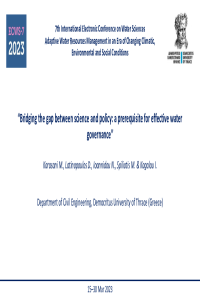
Bridging the gap between science and policy: a prerequisite for an effective water governance
'%3e%3cpath%20d='M12.6647%2010.9104C12.4176%2010.325%2012.0589%209.7933%2011.6088%209.34485C11.16%208.89511%2010.6283%208.53653%2010.0432%208.28891C10.038%208.28629%2010.0327%208.28498%2010.0275%208.28236C10.8437%207.69282%2011.3743%206.73252%2011.3743%205.64907C11.3743%203.85423%209.92005%202.40002%208.12522%202.40002C6.33038%202.40002%204.87618%203.85423%204.87618%205.64907C4.87618%206.73252%205.40677%207.69282%206.22296%208.28367C6.21772%208.28629%206.21248%208.2876%206.20724%208.29022C5.62031%208.53783%205.09365%208.89287%204.64167%209.34616C4.19192%209.79496%203.83334%2010.3266%203.58573%2010.9117C3.34247%2011.4846%203.21128%2012.0987%203.19925%2012.721C3.1989%2012.735%203.20135%2012.7489%203.20646%2012.7619C3.21157%2012.7749%203.21924%2012.7868%203.22901%2012.7968C3.23877%2012.8068%203.25045%2012.8148%203.26334%2012.8202C3.27623%2012.8256%203.29007%2012.8284%203.30406%2012.8284H4.09012C4.14776%2012.8284%204.19362%2012.7825%204.19493%2012.7262C4.22113%2011.7148%204.62726%2010.7676%205.34519%2010.0497C6.08802%209.30686%207.07452%208.89811%208.12522%208.89811C9.17592%208.89811%2010.1624%209.30686%2010.9052%2010.0497C11.6232%2010.7676%2012.0293%2011.7148%2012.0555%2012.7262C12.0568%2012.7839%2012.1027%2012.8284%2012.1603%2012.8284H12.9464C12.9604%2012.8284%2012.9742%2012.8256%2012.9871%2012.8202C13%2012.8148%2013.0117%2012.8068%2013.0214%2012.7968C13.0312%2012.7868%2013.0389%2012.7749%2013.044%2012.7619C13.0491%2012.7489%2013.0515%2012.735%2013.0512%2012.721C13.0381%2012.0947%2012.9084%2011.4856%2012.6647%2010.9104ZM8.12522%207.90243C7.52388%207.90243%206.95792%207.66793%206.53214%207.24215C6.10636%206.81636%205.87185%206.2504%205.87185%205.64907C5.87185%205.04773%206.10636%204.48177%206.53214%204.05599C6.95792%203.63021%207.52388%203.3957%208.12522%203.3957C8.72655%203.3957%209.29252%203.63021%209.7183%204.05599C10.1441%204.48177%2010.3786%205.04773%2010.3786%205.64907C10.3786%206.2504%2010.1441%206.81636%209.7183%207.24215C9.29252%207.66793%208.72655%207.90243%208.12522%207.90243Z'%20fill='%235D1EE1'/%3e%3c/g%3e%3c/svg%3e)
Maria Karasani 1

Dionissis Latinopoulos 1
Nena Ioannidou 1

Mike Spiliotis 1

Ifigenia Kagalou 1
1. Dept. of Civil Engineering, School of Engineering, Democritus University of Thrace
Abstract
Water governance describes the legislation, policies, regulation and institutional frameworks related to the management of water resources. Water governance in the EU is enshrined in the WFD having the basin as a basic spatial unit. The need for the engagement of stakeholders is one of the governance cornerstones guarantying solution co-creation and measures acceptance. Thus, the inclusion of the interests of scientific and non-scientific groups in decision-making through valuations of local ecosystem services is crucial. Although it is documented that a good governance scenario is developed with the contribution of the stakeholders, a number of studies do not include a participatory bottom-up approach.
The object of our paper is to examine the contribution of the participatory bottom-up approach in the effectiveness of local water resource management.
Under the framework of the Eye4water project which aims to strengthen the local water management practices in the Lissos river basin (Thrace, NE Greece) a participatory assessment of local river basin was applied, through a process of jointly identifying and evaluating the main water- related issues. Firstly, we identified the social system engaged to the Lissos river basin through stakeholder’s mapping. Secondly, based on a criteria selection (inclusiveness, gender-equality, critical water users, equal representation) three groups of stakeholders were organized and invited in a workshop. Each of the group was guided by two facilitators. The participants had the opportunity to answer in opened and closed questions, focused on the local characteristic of the basin.
Our preliminary results show that mutual learning should be encouraged across different target groups at multiple levels. A clear signal from the discussion is that the current management is insufficient without clear objectives. Well recognized threats as water pollution, flood’s risk, groundwater lowering are present while biodiversity issues are quite under lighten.
Keywords
water policy
participatory
river basin
management
Manuscript
sciforum-068556.pdf
Poster
Presentation Karasani et al 7 ECWS.pdf
Correlation between land transformation and climate change with flooding vulnerability: Nature Based Solutions (NBS) applied in a Mediterranean case study
A GIS-based fuzzy hierarchical modeling for flood susceptibility mapping: A case study in Ontario, Canada