Event submissions
Published

This submission belongs to the session H. Urban and Agricultural Water Systems of the event The 7th International Electronic Conference on Water Sciences
Published date
16 Mar, 2023
Academic Editor
'%3e%3cpath%20d='M12.6657%2010.9104C12.4185%2010.325%2012.0599%209.79327%2011.6097%209.34482C11.1609%208.89508%2010.6293%208.5365%2010.0442%208.28888C10.0389%208.28626%2010.0337%208.28495%2010.0285%208.28233C10.8446%207.69279%2011.3752%206.73249%2011.3752%205.64904C11.3752%203.8542%209.92103%202.39999%208.1262%202.39999C6.33136%202.39999%204.87715%203.8542%204.87715%205.64904C4.87715%206.73249%205.40774%207.69279%206.22393%208.28364C6.21869%208.28626%206.21345%208.28757%206.20821%208.29019C5.62129%208.5378%205.09463%208.89284%204.64265%209.34613C4.1929%209.79493%203.83432%2010.3266%203.58671%2010.9117C3.34345%2011.4845%203.21226%2012.0987%203.20023%2012.7209C3.19988%2012.7349%203.20233%2012.7488%203.20744%2012.7619C3.21255%2012.7749%203.22022%2012.7867%203.22998%2012.7968C3.23975%2012.8068%203.25142%2012.8147%203.26431%2012.8202C3.2772%2012.8256%203.29105%2012.8284%203.30504%2012.8284H4.09109C4.14874%2012.8284%204.19459%2012.7825%204.1959%2012.7262C4.2221%2011.7148%204.62823%2010.7676%205.34617%2010.0497C6.08899%209.30683%207.0755%208.89808%208.1262%208.89808C9.17689%208.89808%2010.1634%209.30683%2010.9062%2010.0497C11.6242%2010.7676%2012.0303%2011.7148%2012.0565%2012.7262C12.0578%2012.7838%2012.1037%2012.8284%2012.1613%2012.8284H12.9474C12.9613%2012.8284%2012.9752%2012.8256%2012.9881%2012.8202C13.001%2012.8147%2013.0126%2012.8068%2013.0224%2012.7968C13.0322%2012.7867%2013.0398%2012.7749%2013.0449%2012.7619C13.0501%2012.7488%2013.0525%2012.7349%2013.0522%2012.7209C13.0391%2012.0947%2012.9094%2011.4855%2012.6657%2010.9104ZM8.1262%207.9024C7.52486%207.9024%206.9589%207.6679%206.53312%207.24211C6.10733%206.81633%205.87283%206.25037%205.87283%205.64904C5.87283%205.0477%206.10733%204.48174%206.53312%204.05596C6.9589%203.63018%207.52486%203.39567%208.1262%203.39567C8.72753%203.39567%209.29349%203.63018%209.71927%204.05596C10.1451%204.48174%2010.3796%205.0477%2010.3796%205.64904C10.3796%206.25037%2010.1451%206.81633%209.71927%207.24211C9.29349%207.6679%208.72753%207.9024%208.1262%207.9024Z'%20fill='%235D1EE1'/%3e%3c/g%3e%3c/svg%3e) ATHANASIOS LOUKAS
ATHANASIOS LOUKASCitation
Samy A. Anwar, Irida Lazić, Estimating the potential evapotranspiration of Egypt using a high-resolution regional climate model and a high-resolution reanalysis dataset, in Proceedings of The 7th International Electronic Conference on Water Sciences, 15 March–30 March 2023, MDPI: Basel, Switzerland, doi: 10.3390/ECWS-7-14253
Share
Email
Facebook
Twitter
LinkedIn
Estimating the potential evapotranspiration of Egypt using a high-resolution regional climate model and a high-resolution reanalysis dataset

Samy A. Anwar 1
'%3e%3cpath%20d='M12.6647%2010.9104C12.4176%2010.325%2012.0589%209.7933%2011.6088%209.34485C11.16%208.89511%2010.6283%208.53653%2010.0432%208.28891C10.038%208.28629%2010.0327%208.28498%2010.0275%208.28236C10.8437%207.69282%2011.3743%206.73252%2011.3743%205.64907C11.3743%203.85423%209.92005%202.40002%208.12522%202.40002C6.33038%202.40002%204.87618%203.85423%204.87618%205.64907C4.87618%206.73252%205.40677%207.69282%206.22296%208.28367C6.21772%208.28629%206.21248%208.2876%206.20724%208.29022C5.62031%208.53783%205.09365%208.89287%204.64167%209.34616C4.19192%209.79496%203.83334%2010.3266%203.58573%2010.9117C3.34247%2011.4846%203.21128%2012.0987%203.19925%2012.721C3.1989%2012.735%203.20135%2012.7489%203.20646%2012.7619C3.21157%2012.7749%203.21924%2012.7868%203.22901%2012.7968C3.23877%2012.8068%203.25045%2012.8148%203.26334%2012.8202C3.27623%2012.8256%203.29007%2012.8284%203.30406%2012.8284H4.09012C4.14776%2012.8284%204.19362%2012.7825%204.19493%2012.7262C4.22113%2011.7148%204.62726%2010.7676%205.34519%2010.0497C6.08802%209.30686%207.07452%208.89811%208.12522%208.89811C9.17592%208.89811%2010.1624%209.30686%2010.9052%2010.0497C11.6232%2010.7676%2012.0293%2011.7148%2012.0555%2012.7262C12.0568%2012.7839%2012.1027%2012.8284%2012.1603%2012.8284H12.9464C12.9604%2012.8284%2012.9742%2012.8256%2012.9871%2012.8202C13%2012.8148%2013.0117%2012.8068%2013.0214%2012.7968C13.0312%2012.7868%2013.0389%2012.7749%2013.044%2012.7619C13.0491%2012.7489%2013.0515%2012.735%2013.0512%2012.721C13.0381%2012.0947%2012.9084%2011.4856%2012.6647%2010.9104ZM8.12522%207.90243C7.52388%207.90243%206.95792%207.66793%206.53214%207.24215C6.10636%206.81636%205.87185%206.2504%205.87185%205.64907C5.87185%205.04773%206.10636%204.48177%206.53214%204.05599C6.95792%203.63021%207.52388%203.3957%208.12522%203.3957C8.72655%203.3957%209.29252%203.63021%209.7183%204.05599C10.1441%204.48177%2010.3786%205.04773%2010.3786%205.64907C10.3786%206.2504%2010.1441%206.81636%209.7183%207.24215C9.29252%207.66793%208.72655%207.90243%208.12522%207.90243Z'%20fill='%235D1EE1'/%3e%3c/g%3e%3c/svg%3e)
Irida Lazić 2
1. Egyptian Meteorological Authority, Qobry EL-Kobba, Cairo, Egypt, P.O. Box 11784
2. Faculty of Physics, Institute for Meteorology, University of Belgrade, Dobračina 16, 11000 Belgrade, Serbia
Abstract
Station observation is a good data source to monitor the potential evapotranspiration (PET) of a specific site particularly for the purpose of crop irrigation activities; however it represents only the site geographic characteristics and provides real time or historical records. Hence, there was an urgent need to find a promising tool and a simple empirical to predict/project the PET in locations where station observation is not available. The Hargreaves–Samani method (HS) method is recommended after the Penman-Monteith equation. Also, it can operate on daily and monthly time scales. To handle this issue, the regional climate model (RegCM4) was used to compute the PET using the HS. ERA-Interim reanalysis of 1.5 degrees (EIN15) was used to downscale the RegCM4 with 25 km grid spacing over Egypt for the period 1979-2017. A comparison was conducted between the original HS formula and its calibrated version with respect to the high-resolution ERA5-land derived reanalysis product (hereafter ERA5). Results showed that calibrating the HS coefficients indicates a considerable improvement in estimating the PET (relative to the original equation) when it is compared with ERA5. Such improvement is confirmed by a significant low mean bias. Therefore, the RegCM4 can be used to estimate the PET using a calibrated version of the HS equation either for making a daily forecast (e.g., for 5 days in advance) or projecting the future PET under different global warming scenarios.
Keywords
Egypt
ERA-Interim
Regional climate model
Potential evapotranspiration
ERA5
Manuscript
sciforum-068894.pdf
Poster
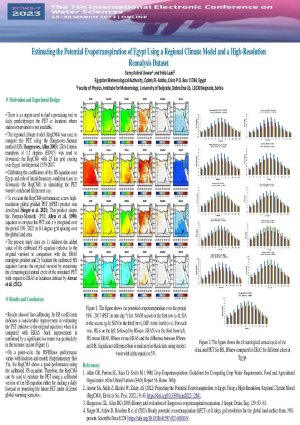
sciforum-068894-poster.pdf
Quantifying of Cynobacterial Cholorphyll-A as an Indicator of Water Quality in Two Wetlands Using Multi-Temporal Sentinel-2 Images
Modeling soil erodibility by water (rainfall/irrigation) on tillage and no tillage plots of a Helianthus crop using soil analysis, field measurements, GIS and kriging geostatistical models