Event submissions
Published

This submission belongs to the session S4. Medicinally Active Plants and Phytochemicals of the event The 2nd International Electronic Conference on Biomedicines
Published date
21 Mar, 2023
Academic Editor
'%3e%3cpath%20d='M12.6657%2010.9104C12.4185%2010.325%2012.0599%209.79327%2011.6097%209.34482C11.1609%208.89508%2010.6293%208.5365%2010.0442%208.28888C10.0389%208.28626%2010.0337%208.28495%2010.0285%208.28233C10.8446%207.69279%2011.3752%206.73249%2011.3752%205.64904C11.3752%203.8542%209.92103%202.39999%208.1262%202.39999C6.33136%202.39999%204.87715%203.8542%204.87715%205.64904C4.87715%206.73249%205.40774%207.69279%206.22393%208.28364C6.21869%208.28626%206.21345%208.28757%206.20821%208.29019C5.62129%208.5378%205.09463%208.89284%204.64265%209.34613C4.1929%209.79493%203.83432%2010.3266%203.58671%2010.9117C3.34345%2011.4845%203.21226%2012.0987%203.20023%2012.7209C3.19988%2012.7349%203.20233%2012.7488%203.20744%2012.7619C3.21255%2012.7749%203.22022%2012.7867%203.22998%2012.7968C3.23975%2012.8068%203.25142%2012.8147%203.26431%2012.8202C3.2772%2012.8256%203.29105%2012.8284%203.30504%2012.8284H4.09109C4.14874%2012.8284%204.19459%2012.7825%204.1959%2012.7262C4.2221%2011.7148%204.62823%2010.7676%205.34617%2010.0497C6.08899%209.30683%207.0755%208.89808%208.1262%208.89808C9.17689%208.89808%2010.1634%209.30683%2010.9062%2010.0497C11.6242%2010.7676%2012.0303%2011.7148%2012.0565%2012.7262C12.0578%2012.7838%2012.1037%2012.8284%2012.1613%2012.8284H12.9474C12.9613%2012.8284%2012.9752%2012.8256%2012.9881%2012.8202C13.001%2012.8147%2013.0126%2012.8068%2013.0224%2012.7968C13.0322%2012.7867%2013.0398%2012.7749%2013.0449%2012.7619C13.0501%2012.7488%2013.0525%2012.7349%2013.0522%2012.7209C13.0391%2012.0947%2012.9094%2011.4855%2012.6657%2010.9104ZM8.1262%207.9024C7.52486%207.9024%206.9589%207.6679%206.53312%207.24211C6.10733%206.81633%205.87283%206.25037%205.87283%205.64904C5.87283%205.0477%206.10733%204.48174%206.53312%204.05596C6.9589%203.63018%207.52486%203.39567%208.1262%203.39567C8.72753%203.39567%209.29349%203.63018%209.71927%204.05596C10.1451%204.48174%2010.3796%205.0477%2010.3796%205.64904C10.3796%206.25037%2010.1451%206.81633%209.71927%207.24211C9.29349%207.6679%208.72753%207.9024%208.1262%207.9024Z'%20fill='%235D1EE1'/%3e%3c/g%3e%3c/svg%3e) Ryota Niikura
Ryota NiikuraCitation
Varsha Unni, Padikkamannil Abishad, Pokkittath Radhakrishnan Arya, Mohan Bibin, Sanis Juliet, Lijo John, Prejit Nambiar, Valil Kunjukunju Vinod, Asha Karthikeyan, Nitin Vasantrao Kurkure, Sukhadeo Baliram Barbuddhe, Deepak Bhiwa Rawool, Jess Vergis, Eco-friendly one-pot synthesis of zinc oxide nanoparticles using catkin extract of Piper longum: In-vitro antibacterial, antioxidant and antibiofilm potential against multi-drug resistant enteroaggregative E. coli, in Proceedings of The 2nd International Electronic Conference on Biomedicines, 1 March–31 March 2023, MDPI: Basel, Switzerland, doi: 10.3390/ECB2023-14269
Share
Email
Facebook
Twitter
LinkedIn
Eco-friendly one-pot synthesis of zinc oxide nanoparticles using catkin extract of Piper longum: In-vitro antibacterial, antioxidant and antibiofilm potential against multi-drug resistant enteroaggregative E. coli
'%3e%3cpath%20d='M12.6647%2010.9104C12.4176%2010.325%2012.0589%209.7933%2011.6088%209.34485C11.16%208.89511%2010.6283%208.53653%2010.0432%208.28891C10.038%208.28629%2010.0327%208.28498%2010.0275%208.28236C10.8437%207.69282%2011.3743%206.73252%2011.3743%205.64907C11.3743%203.85423%209.92005%202.40002%208.12522%202.40002C6.33038%202.40002%204.87618%203.85423%204.87618%205.64907C4.87618%206.73252%205.40677%207.69282%206.22296%208.28367C6.21772%208.28629%206.21248%208.2876%206.20724%208.29022C5.62031%208.53783%205.09365%208.89287%204.64167%209.34616C4.19192%209.79496%203.83334%2010.3266%203.58573%2010.9117C3.34247%2011.4846%203.21128%2012.0987%203.19925%2012.721C3.1989%2012.735%203.20135%2012.7489%203.20646%2012.7619C3.21157%2012.7749%203.21924%2012.7868%203.22901%2012.7968C3.23877%2012.8068%203.25045%2012.8148%203.26334%2012.8202C3.27623%2012.8256%203.29007%2012.8284%203.30406%2012.8284H4.09012C4.14776%2012.8284%204.19362%2012.7825%204.19493%2012.7262C4.22113%2011.7148%204.62726%2010.7676%205.34519%2010.0497C6.08802%209.30686%207.07452%208.89811%208.12522%208.89811C9.17592%208.89811%2010.1624%209.30686%2010.9052%2010.0497C11.6232%2010.7676%2012.0293%2011.7148%2012.0555%2012.7262C12.0568%2012.7839%2012.1027%2012.8284%2012.1603%2012.8284H12.9464C12.9604%2012.8284%2012.9742%2012.8256%2012.9871%2012.8202C13%2012.8148%2013.0117%2012.8068%2013.0214%2012.7968C13.0312%2012.7868%2013.0389%2012.7749%2013.044%2012.7619C13.0491%2012.7489%2013.0515%2012.735%2013.0512%2012.721C13.0381%2012.0947%2012.9084%2011.4856%2012.6647%2010.9104ZM8.12522%207.90243C7.52388%207.90243%206.95792%207.66793%206.53214%207.24215C6.10636%206.81636%205.87185%206.2504%205.87185%205.64907C5.87185%205.04773%206.10636%204.48177%206.53214%204.05599C6.95792%203.63021%207.52388%203.3957%208.12522%203.3957C8.72655%203.3957%209.29252%203.63021%209.7183%204.05599C10.1441%204.48177%2010.3786%205.04773%2010.3786%205.64907C10.3786%206.2504%2010.1441%206.81636%209.7183%207.24215C9.29252%207.66793%208.72655%207.90243%208.12522%207.90243Z'%20fill='%235D1EE1'/%3e%3c/g%3e%3c/svg%3e)
Varsha Unni 1
Padikkamannil Abishad 2
Pokkittath Radhakrishnan Arya 2
Mohan Bibin 2
Sanis Juliet 2
Lijo John 2
Prejit Nambiar 2
Valil Kunjukunju Vinod 2
Asha Karthikeyan 2
Nitin Vasantrao Kurkure 3
Sukhadeo Baliram Barbuddhe 4
Deepak Bhiwa Rawool 4
Jess Vergis 1
1. College of Veterinary and Animal Sciences, Pookode, Kerala, India
2. College of Veterinary and Animal Sciences, Pookode, KVASU, Wayanad- 673 576, India
3. Nagpur Veterinary College, Nagpur- 440 006, India
4. ICAR- National Research Centre on Meat, Hyderabad- 500 092, India
Abstract
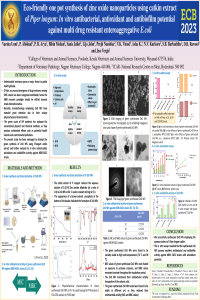
Enteroaggregative Escherichia coli (EAEC) is an emerging bacterial pathogen implicated in gastrointestinal illnesses world-wide and has been documented as one of the foremost causes of acute and persistent diarrhea in children and adults. Of late, an unusual emergence of multi-drug resistance among EAEC strains has been recognized globally; hence the emphasis has been given to adjuvant therapies to combat this nagging public health threat. Nanotechnology has recently received much interest in the wake of antimicrobial resistance (AMR) and is seen to be a promising interventional tool for treating drug-resistant infections. This study assessed the antibacterial efficacy of green synthesized ZnO NPs using aqueous extract of Piper longum catkin against multi-drug resistant strains of enteroaggregative Escherichia coli (MDR-EAEC). Initially, the synthesis of ZnO NPs was confirmed by UV- Vis spectroscopy and Fourier transform infra- red spectroscopy (FTIR) analysis. The TGA/DTA revealed thermal stability of ZnO NPs, while a hexagonal wurtzite crystalline structure was exhibited by PXRD analysis, which was further confirmed by SEM and TEM. The minimum inhibitory concentration as well as minimum bactericidal concentration of bio-fabricated ZnO NPs determined by microbroth dilution technique against MDR-EAEC (n= 3) strains revealed 125 μg/mL and 250 μg/mL, respectively. In addition, ZnO NPs were tested variably stable (high-end temperatures, physiological concentration of salts, proteases and varying pH) and safe (chicken RBCs, HEK cell lines, gut lactobacilli). The green synthesized ZnO NPs exhibited a concentration- dependent antioxidant activity as evidenced by ABTS assay and reducing power assay. Furthermore, the green synthesized ZnO NPs inhibited the biofilm forming ability of the tested MDR-EAEC strains. Overall, this study demonstrated an eco- friendly one-pot synthesis of ZnO NPs, which could be employed as a potential antimicrobial alternative candidate against MDR-EAEC strains.
Keywords
Antimicrobial resistance
Enteroaggregative Escherichia coli
Green synthesis
Nanoparticle
Zinc Oxide
Manuscript
sciforum-069430.pdf
Poster
Poster.pdf
Biodegradable microfibers loaded with natural agents for infected wounds therapies
A new murine highly localized high-dose muscle radiation model as a tool to develop innovative countermeasures to treat radio-induced muscular lesions: preliminary studies