Event submissions
Published
This submission belongs to the session S4. Medicinally Active Plants and Phytochemicals of the event The 2nd International Electronic Conference on Biomedicines
Published date
21 Apr, 2023
Academic Editor
'%3e%3cpath%20d='M12.6657%2010.9104C12.4185%2010.325%2012.0599%209.79327%2011.6097%209.34482C11.1609%208.89508%2010.6293%208.5365%2010.0442%208.28888C10.0389%208.28626%2010.0337%208.28495%2010.0285%208.28233C10.8446%207.69279%2011.3752%206.73249%2011.3752%205.64904C11.3752%203.8542%209.92103%202.39999%208.1262%202.39999C6.33136%202.39999%204.87715%203.8542%204.87715%205.64904C4.87715%206.73249%205.40774%207.69279%206.22393%208.28364C6.21869%208.28626%206.21345%208.28757%206.20821%208.29019C5.62129%208.5378%205.09463%208.89284%204.64265%209.34613C4.1929%209.79493%203.83432%2010.3266%203.58671%2010.9117C3.34345%2011.4845%203.21226%2012.0987%203.20023%2012.7209C3.19988%2012.7349%203.20233%2012.7488%203.20744%2012.7619C3.21255%2012.7749%203.22022%2012.7867%203.22998%2012.7968C3.23975%2012.8068%203.25142%2012.8147%203.26431%2012.8202C3.2772%2012.8256%203.29105%2012.8284%203.30504%2012.8284H4.09109C4.14874%2012.8284%204.19459%2012.7825%204.1959%2012.7262C4.2221%2011.7148%204.62823%2010.7676%205.34617%2010.0497C6.08899%209.30683%207.0755%208.89808%208.1262%208.89808C9.17689%208.89808%2010.1634%209.30683%2010.9062%2010.0497C11.6242%2010.7676%2012.0303%2011.7148%2012.0565%2012.7262C12.0578%2012.7838%2012.1037%2012.8284%2012.1613%2012.8284H12.9474C12.9613%2012.8284%2012.9752%2012.8256%2012.9881%2012.8202C13.001%2012.8147%2013.0126%2012.8068%2013.0224%2012.7968C13.0322%2012.7867%2013.0398%2012.7749%2013.0449%2012.7619C13.0501%2012.7488%2013.0525%2012.7349%2013.0522%2012.7209C13.0391%2012.0947%2012.9094%2011.4855%2012.6657%2010.9104ZM8.1262%207.9024C7.52486%207.9024%206.9589%207.6679%206.53312%207.24211C6.10733%206.81633%205.87283%206.25037%205.87283%205.64904C5.87283%205.0477%206.10733%204.48174%206.53312%204.05596C6.9589%203.63018%207.52486%203.39567%208.1262%203.39567C8.72753%203.39567%209.29349%203.63018%209.71927%204.05596C10.1451%204.48174%2010.3796%205.0477%2010.3796%205.64904C10.3796%206.25037%2010.1451%206.81633%209.71927%207.24211C9.29349%207.6679%208.72753%207.9024%208.1262%207.9024Z'%20fill='%235D1EE1'/%3e%3c/g%3e%3c/svg%3e) Shaker Mousa
Shaker MousaCitation
Silvia Navarro-Orcajada, Irene Conesa, Francisco José Vidal-Sánchez, Adrián Matencio, Francisco García-Carmona, José Manuel López-Nicolás, Effect of cyclodextrins on the ORAC method for measuring the bioactivity of phytochemicals, in Proceedings of The 2nd International Electronic Conference on Biomedicines, 1 March–31 March 2023, MDPI: Basel, Switzerland
Share
Email
Facebook
Twitter
LinkedIn
Effect of cyclodextrins on the ORAC method for measuring the bioactivity of phytochemicals
'%3e%3cpath%20d='M12.6647%2010.9104C12.4176%2010.325%2012.0589%209.7933%2011.6088%209.34485C11.16%208.89511%2010.6283%208.53653%2010.0432%208.28891C10.038%208.28629%2010.0327%208.28498%2010.0275%208.28236C10.8437%207.69282%2011.3743%206.73252%2011.3743%205.64907C11.3743%203.85423%209.92005%202.40002%208.12522%202.40002C6.33038%202.40002%204.87618%203.85423%204.87618%205.64907C4.87618%206.73252%205.40677%207.69282%206.22296%208.28367C6.21772%208.28629%206.21248%208.2876%206.20724%208.29022C5.62031%208.53783%205.09365%208.89287%204.64167%209.34616C4.19192%209.79496%203.83334%2010.3266%203.58573%2010.9117C3.34247%2011.4846%203.21128%2012.0987%203.19925%2012.721C3.1989%2012.735%203.20135%2012.7489%203.20646%2012.7619C3.21157%2012.7749%203.21924%2012.7868%203.22901%2012.7968C3.23877%2012.8068%203.25045%2012.8148%203.26334%2012.8202C3.27623%2012.8256%203.29007%2012.8284%203.30406%2012.8284H4.09012C4.14776%2012.8284%204.19362%2012.7825%204.19493%2012.7262C4.22113%2011.7148%204.62726%2010.7676%205.34519%2010.0497C6.08802%209.30686%207.07452%208.89811%208.12522%208.89811C9.17592%208.89811%2010.1624%209.30686%2010.9052%2010.0497C11.6232%2010.7676%2012.0293%2011.7148%2012.0555%2012.7262C12.0568%2012.7839%2012.1027%2012.8284%2012.1603%2012.8284H12.9464C12.9604%2012.8284%2012.9742%2012.8256%2012.9871%2012.8202C13%2012.8148%2013.0117%2012.8068%2013.0214%2012.7968C13.0312%2012.7868%2013.0389%2012.7749%2013.044%2012.7619C13.0491%2012.7489%2013.0515%2012.735%2013.0512%2012.721C13.0381%2012.0947%2012.9084%2011.4856%2012.6647%2010.9104ZM8.12522%207.90243C7.52388%207.90243%206.95792%207.66793%206.53214%207.24215C6.10636%206.81636%205.87185%206.2504%205.87185%205.64907C5.87185%205.04773%206.10636%204.48177%206.53214%204.05599C6.95792%203.63021%207.52388%203.3957%208.12522%203.3957C8.72655%203.3957%209.29252%203.63021%209.7183%204.05599C10.1441%204.48177%2010.3786%205.04773%2010.3786%205.64907C10.3786%206.2504%2010.1441%206.81636%209.7183%207.24215C9.29252%207.66793%208.72655%207.90243%208.12522%207.90243Z'%20fill='%235D1EE1'/%3e%3c/g%3e%3c/svg%3e)
Silvia Navarro-Orcajada 1
Irene Conesa 1
Francisco José Vidal-Sánchez 1

Adrián Matencio 2
Francisco García-Carmona 1

José Manuel López-Nicolás 1
1. Universidad de Murcia
2. Università di Torino
Abstract
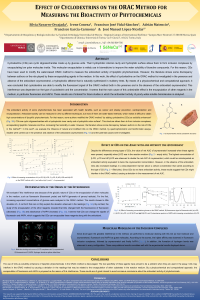
Cyclodextrins are cyclic oligosaccharides made up by glucose units. Their hydrophobic internal cavity and hydrophilic surface allows them to form inclusion complexes by encapsulating low polar molecules inside. This molecular encapsulation is widely use in biomedicine to improve the water solubility of bioactive compounds. For this reason, cyclodextrins have been used to modify the water-based ORAC method to measure the antioxidant activity of lipophilic phytochemicals. However, the literature shows some discrepancy between authors on the role played by these encapsulating agents in the medium. In this work, the effect of cyclodextrins on the ORAC method is investigated in the presence and absence of the antioxidant oxyresveratrol, a hydrophobic stilbene that is naturally synthesised in mulberry trees. By means of a physicochemical and computational approach, it was concluded that cyclodextrins are able to modify the fluorescent signal of the ORAC method both in the presence and in the absence of the antioxidant oxyresveratrol. This interference was dependent on the type of cyclodextrin and the concentration. It seems that the main cause of this undesirable effect is the encapsulation of other reagents in the medium, in particular fluorescein and AAPH. These results are of interest for future studies in which the antioxidant activity of poorly water-soluble biomolecules is analysed.
Keywords
Antioxidant
Solubility
ORAC
Cyclodextrin
Encapsulation
Interference
Manuscript
msf-sciforum-069477-done.pdf
Poster
Poster ECB2023 (S).pdf
Profiling of antibacterial compounds from selective medicinal mangrove species
Stilbenes: a review of their physicochemical properties, biological activities, molecular encapsulation and structural modifications