Event submissions
Published
This submission belongs to the session S4. Medicinally Active Plants and Phytochemicals of the event The 2nd International Electronic Conference on Biomedicines
Published date
21 Apr, 2023
Academic Editor
'%3e%3cpath%20d='M12.6657%2010.9104C12.4185%2010.325%2012.0599%209.79327%2011.6097%209.34482C11.1609%208.89508%2010.6293%208.5365%2010.0442%208.28888C10.0389%208.28626%2010.0337%208.28495%2010.0285%208.28233C10.8446%207.69279%2011.3752%206.73249%2011.3752%205.64904C11.3752%203.8542%209.92103%202.39999%208.1262%202.39999C6.33136%202.39999%204.87715%203.8542%204.87715%205.64904C4.87715%206.73249%205.40774%207.69279%206.22393%208.28364C6.21869%208.28626%206.21345%208.28757%206.20821%208.29019C5.62129%208.5378%205.09463%208.89284%204.64265%209.34613C4.1929%209.79493%203.83432%2010.3266%203.58671%2010.9117C3.34345%2011.4845%203.21226%2012.0987%203.20023%2012.7209C3.19988%2012.7349%203.20233%2012.7488%203.20744%2012.7619C3.21255%2012.7749%203.22022%2012.7867%203.22998%2012.7968C3.23975%2012.8068%203.25142%2012.8147%203.26431%2012.8202C3.2772%2012.8256%203.29105%2012.8284%203.30504%2012.8284H4.09109C4.14874%2012.8284%204.19459%2012.7825%204.1959%2012.7262C4.2221%2011.7148%204.62823%2010.7676%205.34617%2010.0497C6.08899%209.30683%207.0755%208.89808%208.1262%208.89808C9.17689%208.89808%2010.1634%209.30683%2010.9062%2010.0497C11.6242%2010.7676%2012.0303%2011.7148%2012.0565%2012.7262C12.0578%2012.7838%2012.1037%2012.8284%2012.1613%2012.8284H12.9474C12.9613%2012.8284%2012.9752%2012.8256%2012.9881%2012.8202C13.001%2012.8147%2013.0126%2012.8068%2013.0224%2012.7968C13.0322%2012.7867%2013.0398%2012.7749%2013.0449%2012.7619C13.0501%2012.7488%2013.0525%2012.7349%2013.0522%2012.7209C13.0391%2012.0947%2012.9094%2011.4855%2012.6657%2010.9104ZM8.1262%207.9024C7.52486%207.9024%206.9589%207.6679%206.53312%207.24211C6.10733%206.81633%205.87283%206.25037%205.87283%205.64904C5.87283%205.0477%206.10733%204.48174%206.53312%204.05596C6.9589%203.63018%207.52486%203.39567%208.1262%203.39567C8.72753%203.39567%209.29349%203.63018%209.71927%204.05596C10.1451%204.48174%2010.3796%205.0477%2010.3796%205.64904C10.3796%206.25037%2010.1451%206.81633%209.71927%207.24211C9.29349%207.6679%208.72753%207.9024%208.1262%207.9024Z'%20fill='%235D1EE1'/%3e%3c/g%3e%3c/svg%3e) Shaker Mousa
Shaker MousaCitation
Irene Conesa Valverde, Silvia Navarro-Orcajada, Francisco José Vidal-Sánchez, Adrián Matencio, Francisco García Carmona, José Manuel López-Nicolás, Study of the antioxidant activity, solubility, stability and cyclodextrin complexation of gnetol., in Proceedings of The 2nd International Electronic Conference on Biomedicines, 1 March–31 March 2023, MDPI: Basel, Switzerland
Share
Email
Facebook
Twitter
LinkedIn
Study of the antioxidant activity, solubility, stability and cyclodextrin complexation of gnetol.
'%3e%3cpath%20d='M12.6647%2010.9104C12.4176%2010.325%2012.0589%209.7933%2011.6088%209.34485C11.16%208.89511%2010.6283%208.53653%2010.0432%208.28891C10.038%208.28629%2010.0327%208.28498%2010.0275%208.28236C10.8437%207.69282%2011.3743%206.73252%2011.3743%205.64907C11.3743%203.85423%209.92005%202.40002%208.12522%202.40002C6.33038%202.40002%204.87618%203.85423%204.87618%205.64907C4.87618%206.73252%205.40677%207.69282%206.22296%208.28367C6.21772%208.28629%206.21248%208.2876%206.20724%208.29022C5.62031%208.53783%205.09365%208.89287%204.64167%209.34616C4.19192%209.79496%203.83334%2010.3266%203.58573%2010.9117C3.34247%2011.4846%203.21128%2012.0987%203.19925%2012.721C3.1989%2012.735%203.20135%2012.7489%203.20646%2012.7619C3.21157%2012.7749%203.21924%2012.7868%203.22901%2012.7968C3.23877%2012.8068%203.25045%2012.8148%203.26334%2012.8202C3.27623%2012.8256%203.29007%2012.8284%203.30406%2012.8284H4.09012C4.14776%2012.8284%204.19362%2012.7825%204.19493%2012.7262C4.22113%2011.7148%204.62726%2010.7676%205.34519%2010.0497C6.08802%209.30686%207.07452%208.89811%208.12522%208.89811C9.17592%208.89811%2010.1624%209.30686%2010.9052%2010.0497C11.6232%2010.7676%2012.0293%2011.7148%2012.0555%2012.7262C12.0568%2012.7839%2012.1027%2012.8284%2012.1603%2012.8284H12.9464C12.9604%2012.8284%2012.9742%2012.8256%2012.9871%2012.8202C13%2012.8148%2013.0117%2012.8068%2013.0214%2012.7968C13.0312%2012.7868%2013.0389%2012.7749%2013.044%2012.7619C13.0491%2012.7489%2013.0515%2012.735%2013.0512%2012.721C13.0381%2012.0947%2012.9084%2011.4856%2012.6647%2010.9104ZM8.12522%207.90243C7.52388%207.90243%206.95792%207.66793%206.53214%207.24215C6.10636%206.81636%205.87185%206.2504%205.87185%205.64907C5.87185%205.04773%206.10636%204.48177%206.53214%204.05599C6.95792%203.63021%207.52388%203.3957%208.12522%203.3957C8.72655%203.3957%209.29252%203.63021%209.7183%204.05599C10.1441%204.48177%2010.3786%205.04773%2010.3786%205.64907C10.3786%206.2504%2010.1441%206.81636%209.7183%207.24215C9.29252%207.66793%208.72655%207.90243%208.12522%207.90243Z'%20fill='%235D1EE1'/%3e%3c/g%3e%3c/svg%3e)
Irene Conesa Valverde 1
Silvia Navarro-Orcajada 1
Francisco José Vidal-Sánchez 2

Adrián Matencio 3
Francisco García Carmona 1

José Manuel López-Nicolás 1
1. Departamento de Bioquímica y Biología molecular-A, Facultad de Biología, Universidad de Murcia - Regional Campus of International Excellence “Campus Mare Nostrum”, E-30100 Murcia, Spain
2. Departamento de Bioquímica y Biología molecular-A, Facultad de Biología, Universidad de Murcia - Campus Regional de Excelencia Internacional “Campus Mare Nostrum”, E-30100 Murcia, España
3. Dipartimento Di Chemica, Università di Torino, via P. Giuria 7, 10125, Torino, Italy
Abstract
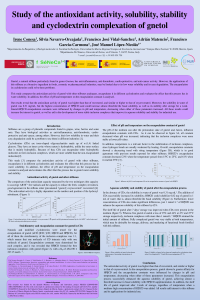
Gnetol, a natural stilbene particularly found in genus Gnetum, has anti-inflammatory, anti-thrombotic, cardio-protective, and anti-cancer activity. However, the applications of this stilbene as a bioactive ingredient in foods, cosmetic or pharmaceutical industries, may be limited due to its low water solubility and its easy degradation. The encapsulation in cyclodextrins could solve these problems.
This study compares the antioxidant activity of gnetol with other stilbenes analogues, encapsulates it in different cyclodextrins and evaluates the effect that this process has in water solubility. In addition, the effect of pH and temperature on the encapsulation constant is analysed.
Our results reveal that the antioxidant activity of gnetol was higher than that of resveratrol, and similar or higher to that of oxyresveratrol. Moreover, the solubility in water of gnetol was 0.31 mg/mL, but the highest concentration of HPβCD used could increase almost threefold the basal solubility, as well as its stability after storage for a week. Gnetol-HPβCD encapsulation constants were influenced by changes in pH and temperature, decreasing when either of these parameters increased. All these results could increase the interest in gnetol, as well as aid in the development of more stable inclusion complexes that improve its aqueous solubility and stability for industrial use.
Acknowledgements: This research was funded by the Spanish Ministry of Science and Innovation (PID2021-122896NB-100 (MC/AEI/FEDER, UE), by University of Murcia [Murcia-Españia) (FPU-UMU), by Eundacio Séneca (Murcia-España) (21269/FP1/19), by Ministry of Universities (España) (FPU) and by Ministry dell' Universita e della Ricecca. (Italia) (1052/2021).
Keywords
Gnetol
antioxidant activity
molecular encapsulation
cyclodextrin
solubility
Manuscript
sciforum_069475_original_Irene_Conesa_MDPI_2023 - Copy.pdf
Poster
Irene Conesa Valverde_Poster.pdf
Stilbenes: a review of their physicochemical properties, biological activities, molecular encapsulation and structural modifications
A SYSTEMATIC REVIEW: AYURVEDIC HERBAL MEDICINE FOR WOMEN WITH POLYCYSTIC OVARY SYNDROME