Event submissions
Published
This submission belongs to the session I. Optical and Photonic Biosensors of the event The 3rd International Electronic Conference on Biosensors
Published date
03 May, 2023
Academic Editor
'%3e%3cpath%20d='M12.6657%2010.9104C12.4185%2010.325%2012.0599%209.79327%2011.6097%209.34482C11.1609%208.89508%2010.6293%208.5365%2010.0442%208.28888C10.0389%208.28626%2010.0337%208.28495%2010.0285%208.28233C10.8446%207.69279%2011.3752%206.73249%2011.3752%205.64904C11.3752%203.8542%209.92103%202.39999%208.1262%202.39999C6.33136%202.39999%204.87715%203.8542%204.87715%205.64904C4.87715%206.73249%205.40774%207.69279%206.22393%208.28364C6.21869%208.28626%206.21345%208.28757%206.20821%208.29019C5.62129%208.5378%205.09463%208.89284%204.64265%209.34613C4.1929%209.79493%203.83432%2010.3266%203.58671%2010.9117C3.34345%2011.4845%203.21226%2012.0987%203.20023%2012.7209C3.19988%2012.7349%203.20233%2012.7488%203.20744%2012.7619C3.21255%2012.7749%203.22022%2012.7867%203.22998%2012.7968C3.23975%2012.8068%203.25142%2012.8147%203.26431%2012.8202C3.2772%2012.8256%203.29105%2012.8284%203.30504%2012.8284H4.09109C4.14874%2012.8284%204.19459%2012.7825%204.1959%2012.7262C4.2221%2011.7148%204.62823%2010.7676%205.34617%2010.0497C6.08899%209.30683%207.0755%208.89808%208.1262%208.89808C9.17689%208.89808%2010.1634%209.30683%2010.9062%2010.0497C11.6242%2010.7676%2012.0303%2011.7148%2012.0565%2012.7262C12.0578%2012.7838%2012.1037%2012.8284%2012.1613%2012.8284H12.9474C12.9613%2012.8284%2012.9752%2012.8256%2012.9881%2012.8202C13.001%2012.8147%2013.0126%2012.8068%2013.0224%2012.7968C13.0322%2012.7867%2013.0398%2012.7749%2013.0449%2012.7619C13.0501%2012.7488%2013.0525%2012.7349%2013.0522%2012.7209C13.0391%2012.0947%2012.9094%2011.4855%2012.6657%2010.9104ZM8.1262%207.9024C7.52486%207.9024%206.9589%207.6679%206.53312%207.24211C6.10733%206.81633%205.87283%206.25037%205.87283%205.64904C5.87283%205.0477%206.10733%204.48174%206.53312%204.05596C6.9589%203.63018%207.52486%203.39567%208.1262%203.39567C8.72753%203.39567%209.29349%203.63018%209.71927%204.05596C10.1451%204.48174%2010.3796%205.0477%2010.3796%205.64904C10.3796%206.25037%2010.1451%206.81633%209.71927%207.24211C9.29349%207.6679%208.72753%207.9024%208.1262%207.9024Z'%20fill='%235D1EE1'/%3e%3c/g%3e%3c/svg%3e) Shaopeng Wang
Shaopeng WangCitation
Cosimo Trono, Sara Tombelli, Simone Berneschi, Ambra Giannetti, Francesco Baldini, Donato Calabria, Massimo Guardigli, Mara Mirasoli, On-fiber chemiluminescence biosensing system, in Proceedings of The 3rd International Electronic Conference on Biosensors, 8 May–21 May 2023, MDPI: Basel, Switzerland
Share
Email
Facebook
Twitter
LinkedIn
On-fiber chemiluminescence biosensing system

Cosimo Trono 1

Sara Tombelli 1

Simone Berneschi 1

Ambra Giannetti 1

Francesco Baldini 1

Donato Calabria 2
'%3e%3cpath%20d='M12.6647%2010.9104C12.4176%2010.325%2012.0589%209.7933%2011.6088%209.34485C11.16%208.89511%2010.6283%208.53653%2010.0432%208.28891C10.038%208.28629%2010.0327%208.28498%2010.0275%208.28236C10.8437%207.69282%2011.3743%206.73252%2011.3743%205.64907C11.3743%203.85423%209.92005%202.40002%208.12522%202.40002C6.33038%202.40002%204.87618%203.85423%204.87618%205.64907C4.87618%206.73252%205.40677%207.69282%206.22296%208.28367C6.21772%208.28629%206.21248%208.2876%206.20724%208.29022C5.62031%208.53783%205.09365%208.89287%204.64167%209.34616C4.19192%209.79496%203.83334%2010.3266%203.58573%2010.9117C3.34247%2011.4846%203.21128%2012.0987%203.19925%2012.721C3.1989%2012.735%203.20135%2012.7489%203.20646%2012.7619C3.21157%2012.7749%203.21924%2012.7868%203.22901%2012.7968C3.23877%2012.8068%203.25045%2012.8148%203.26334%2012.8202C3.27623%2012.8256%203.29007%2012.8284%203.30406%2012.8284H4.09012C4.14776%2012.8284%204.19362%2012.7825%204.19493%2012.7262C4.22113%2011.7148%204.62726%2010.7676%205.34519%2010.0497C6.08802%209.30686%207.07452%208.89811%208.12522%208.89811C9.17592%208.89811%2010.1624%209.30686%2010.9052%2010.0497C11.6232%2010.7676%2012.0293%2011.7148%2012.0555%2012.7262C12.0568%2012.7839%2012.1027%2012.8284%2012.1603%2012.8284H12.9464C12.9604%2012.8284%2012.9742%2012.8256%2012.9871%2012.8202C13%2012.8148%2013.0117%2012.8068%2013.0214%2012.7968C13.0312%2012.7868%2013.0389%2012.7749%2013.044%2012.7619C13.0491%2012.7489%2013.0515%2012.735%2013.0512%2012.721C13.0381%2012.0947%2012.9084%2011.4856%2012.6647%2010.9104ZM8.12522%207.90243C7.52388%207.90243%206.95792%207.66793%206.53214%207.24215C6.10636%206.81636%205.87185%206.2504%205.87185%205.64907C5.87185%205.04773%206.10636%204.48177%206.53214%204.05599C6.95792%203.63021%207.52388%203.3957%208.12522%203.3957C8.72655%203.3957%209.29252%203.63021%209.7183%204.05599C10.1441%204.48177%2010.3786%205.04773%2010.3786%205.64907C10.3786%206.2504%2010.1441%206.81636%209.7183%207.24215C9.29252%207.66793%208.72655%207.90243%208.12522%207.90243Z'%20fill='%235D1EE1'/%3e%3c/g%3e%3c/svg%3e)
Massimo Guardigli 2

Mara Mirasoli 2
1. Institute of Applied Physics “Nello Carrara”, National Research Council
2. Department of Chemistry “Giacomo Ciamician”, Alma Mater Studiorum—University of Bologna
Abstract
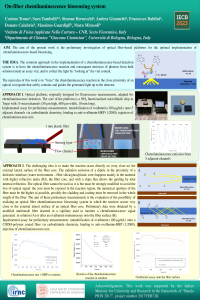
The aim of the present work is the preliminary investigation of a platform for the optimal implementation of chemiluminescence (CL) based biosensing. Among all the optical strategies for biosensing, CL offers many positive features, such as high sensitivity of detection even in low volumes, no need for any external light source and simple instrumentation required for its measurement, which make it particularly suited for the development of ultrasensitive assays in a portable format for point-of-care (POC) settings. Nevertheless, the analytical performance of most of these portable devices is mainly limited by an inefficient optical coupling between the biosensor compartment where photon emission occurs (e.g., microfluidic chip) and the photodetector. While the principally exploited strategy is to place the CL chamber as close as possible to the photon detector, this leads to an ideal maximum photon collection efficiency of 50%, which however is usually much lower, due to several factors, such as reflection phenomena at interfaces between different materials. Therefore, a large fraction of emitted photons is lost, leading to lower assay sensitivity. Very recently, there was a growing interest in optical fiber CL-based biosensors where the fiber plays a crucial role both in the transduction and transportation of the generated light. Despite the recent interesting results on CL optical fiber immunosensors, it must be emphasized that an accurate and deep analysis of the optical properties of the interaction between the CL signal and the dielectric guide has not been fully addressed so far. The aim of this work is the realization of an optimized optical fiber CL biosensing system in which the reaction occurs very close to the external lateral surface of an optical fiber core. Preliminary data were obtained by a modified multimode fiber inserted in a capillary used to monitor a CL signal generated after an ovalbumin immunoassay.
Acknowledgments. This work was supported by the Italian Ministry for University and Research in the framework of “Bando PRIN 2017”, project number 2017YER72K.
Keywords
Fiber biosensing
chemiluminescence
ovalbumin
Manuscript
sciforum-071337.pdf
Poster
Poster Trono Chemiluminescence IECB2023.pdf
Elaboration and characterization of enzymatic biosensor for quaternary ammonium compounds
Electrochemical Sensing of Food Allergen Lysozyme based on Aptamer-Molecularly Imprinted Polymer Hybrid Platform