Event submissions
Published
This submission belongs to the session I. Poster of the event The 4th International Online Conference on Nanomaterials
Published date
05 May, 2023
Academic Editor
'%3e%3cpath%20d='M12.6657%2010.9104C12.4185%2010.325%2012.0599%209.79327%2011.6097%209.34482C11.1609%208.89508%2010.6293%208.5365%2010.0442%208.28888C10.0389%208.28626%2010.0337%208.28495%2010.0285%208.28233C10.8446%207.69279%2011.3752%206.73249%2011.3752%205.64904C11.3752%203.8542%209.92103%202.39999%208.1262%202.39999C6.33136%202.39999%204.87715%203.8542%204.87715%205.64904C4.87715%206.73249%205.40774%207.69279%206.22393%208.28364C6.21869%208.28626%206.21345%208.28757%206.20821%208.29019C5.62129%208.5378%205.09463%208.89284%204.64265%209.34613C4.1929%209.79493%203.83432%2010.3266%203.58671%2010.9117C3.34345%2011.4845%203.21226%2012.0987%203.20023%2012.7209C3.19988%2012.7349%203.20233%2012.7488%203.20744%2012.7619C3.21255%2012.7749%203.22022%2012.7867%203.22998%2012.7968C3.23975%2012.8068%203.25142%2012.8147%203.26431%2012.8202C3.2772%2012.8256%203.29105%2012.8284%203.30504%2012.8284H4.09109C4.14874%2012.8284%204.19459%2012.7825%204.1959%2012.7262C4.2221%2011.7148%204.62823%2010.7676%205.34617%2010.0497C6.08899%209.30683%207.0755%208.89808%208.1262%208.89808C9.17689%208.89808%2010.1634%209.30683%2010.9062%2010.0497C11.6242%2010.7676%2012.0303%2011.7148%2012.0565%2012.7262C12.0578%2012.7838%2012.1037%2012.8284%2012.1613%2012.8284H12.9474C12.9613%2012.8284%2012.9752%2012.8256%2012.9881%2012.8202C13.001%2012.8147%2013.0126%2012.8068%2013.0224%2012.7968C13.0322%2012.7867%2013.0398%2012.7749%2013.0449%2012.7619C13.0501%2012.7488%2013.0525%2012.7349%2013.0522%2012.7209C13.0391%2012.0947%2012.9094%2011.4855%2012.6657%2010.9104ZM8.1262%207.9024C7.52486%207.9024%206.9589%207.6679%206.53312%207.24211C6.10733%206.81633%205.87283%206.25037%205.87283%205.64904C5.87283%205.0477%206.10733%204.48174%206.53312%204.05596C6.9589%203.63018%207.52486%203.39567%208.1262%203.39567C8.72753%203.39567%209.29349%203.63018%209.71927%204.05596C10.1451%204.48174%2010.3796%205.0477%2010.3796%205.64904C10.3796%206.25037%2010.1451%206.81633%209.71927%207.24211C9.29349%207.6679%208.72753%207.9024%208.1262%207.9024Z'%20fill='%235D1EE1'/%3e%3c/g%3e%3c/svg%3e) Antonio Di Bartolomeo
Antonio Di BartolomeoCitation
Biltu Mahato, Stepan V. Lomov, Sergey G. Abaimov, Toughening and Self-diagnostic Carbon Nanotubes Interleave Manufactured from Industrial Masterbatch, in Proceedings of The 4th International Online Conference on Nanomaterials, 5 May–19 May 2023, MDPI: Basel, Switzerland
Share
Email
Facebook
Twitter
LinkedIn
Toughening and Self-diagnostic Carbon Nanotubes Interleave Manufactured from Industrial Masterbatch

Biltu Mahato 1
'%3e%3cpath%20d='M12.6647%2010.9104C12.4176%2010.325%2012.0589%209.7933%2011.6088%209.34485C11.16%208.89511%2010.6283%208.53653%2010.0432%208.28891C10.038%208.28629%2010.0327%208.28498%2010.0275%208.28236C10.8437%207.69282%2011.3743%206.73252%2011.3743%205.64907C11.3743%203.85423%209.92005%202.40002%208.12522%202.40002C6.33038%202.40002%204.87618%203.85423%204.87618%205.64907C4.87618%206.73252%205.40677%207.69282%206.22296%208.28367C6.21772%208.28629%206.21248%208.2876%206.20724%208.29022C5.62031%208.53783%205.09365%208.89287%204.64167%209.34616C4.19192%209.79496%203.83334%2010.3266%203.58573%2010.9117C3.34247%2011.4846%203.21128%2012.0987%203.19925%2012.721C3.1989%2012.735%203.20135%2012.7489%203.20646%2012.7619C3.21157%2012.7749%203.21924%2012.7868%203.22901%2012.7968C3.23877%2012.8068%203.25045%2012.8148%203.26334%2012.8202C3.27623%2012.8256%203.29007%2012.8284%203.30406%2012.8284H4.09012C4.14776%2012.8284%204.19362%2012.7825%204.19493%2012.7262C4.22113%2011.7148%204.62726%2010.7676%205.34519%2010.0497C6.08802%209.30686%207.07452%208.89811%208.12522%208.89811C9.17592%208.89811%2010.1624%209.30686%2010.9052%2010.0497C11.6232%2010.7676%2012.0293%2011.7148%2012.0555%2012.7262C12.0568%2012.7839%2012.1027%2012.8284%2012.1603%2012.8284H12.9464C12.9604%2012.8284%2012.9742%2012.8256%2012.9871%2012.8202C13%2012.8148%2013.0117%2012.8068%2013.0214%2012.7968C13.0312%2012.7868%2013.0389%2012.7749%2013.044%2012.7619C13.0491%2012.7489%2013.0515%2012.735%2013.0512%2012.721C13.0381%2012.0947%2012.9084%2011.4856%2012.6647%2010.9104ZM8.12522%207.90243C7.52388%207.90243%206.95792%207.66793%206.53214%207.24215C6.10636%206.81636%205.87185%206.2504%205.87185%205.64907C5.87185%205.04773%206.10636%204.48177%206.53214%204.05599C6.95792%203.63021%207.52388%203.3957%208.12522%203.3957C8.72655%203.3957%209.29252%203.63021%209.7183%204.05599C10.1441%204.48177%2010.3786%205.04773%2010.3786%205.64907C10.3786%206.2504%2010.1441%206.81636%209.7183%207.24215C9.29252%207.66793%208.72655%207.90243%208.12522%207.90243Z'%20fill='%235D1EE1'/%3e%3c/g%3e%3c/svg%3e)
Stepan V. Lomov 1

Sergey G. Abaimov 1
1. Skolkovo Institute of Science and Technology
Abstract
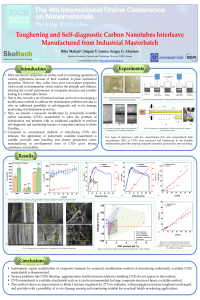
Fiber reinforced composites are used in increasing quantities in various applications because of their excellent in-plane mechanical properties. However, they suffer from poor out-of-plane properties, which result in delamination in service either from impacts, external loadings, or manufacturing defects. Delamination reduces the strength and stiffness, affecting the overall performance of composite structure and possibly leading to a catastrophic failure. Due to this, recently a lot of interest has been received in developing a modification method to address the delamination problem. These modifications may be of micro- or nanoscale with a possibility of self-diagnostic and in-situ damage monitoring.
In this research, nanoscale modification with industrially available CNT masterbatch is explored to solve the problem of delamination and perform self-diagnostic and monitoring of glass fiber reinforced polymer (GFRP) composite laminate. Compared to conventional methods of introducing CNT into laminate, the application of industrially available masterbatch is scalable, so that it is useful for large composite structures.
Two types of CNT interleaves with a CNT content of 0.6 wt% and 7.5 wt% were produced. The 0.6 wt% interleave has a detrimental effect of ~80% on Mode I initiation and propagation fracture toughness. Whereas, the 7.5 wt% interleave shows an improvement of 27% in initiation and 0.5% in propagation fracture toughness. The R-curves for base and modified laminates will be compared and presented. The addition of CNT interleaves turns unconductive GFRP into a conductive laminate and hence, can be used for self-diagnostics of damage. In-situ damage sensing tests were performed by simultaneously measuring the 2-wire resistance of sample during the double cantilever beam test. The self-diagnostics damage sensing capability of laminates with both kinds of interleaves will be discussed.
Hence, addition of CNT interleaves improves the fracture toughness and adds a new functionality for self-diagnostic of the GFRP laminate.
Keywords
CNT interleaves
Fracture toughness
Self-diagnostic
R-curve
Poster
Mahato_IOCN_Poster.pdf
Study of the influence of process parameters on the morphology of ZnO nanostructures
Separating Curing and Temperature Effects on the Temperature Coefficient of Resistance for a Single-Walled Carbon Nanotube Nanocomposite