Event submissions
Published
This submission belongs to the session I. Poster of the event The 4th International Online Conference on Nanomaterials
Published date
05 May, 2023
Academic Editor
'%3e%3cpath%20d='M12.6657%2010.9104C12.4185%2010.325%2012.0599%209.79327%2011.6097%209.34482C11.1609%208.89508%2010.6293%208.5365%2010.0442%208.28888C10.0389%208.28626%2010.0337%208.28495%2010.0285%208.28233C10.8446%207.69279%2011.3752%206.73249%2011.3752%205.64904C11.3752%203.8542%209.92103%202.39999%208.1262%202.39999C6.33136%202.39999%204.87715%203.8542%204.87715%205.64904C4.87715%206.73249%205.40774%207.69279%206.22393%208.28364C6.21869%208.28626%206.21345%208.28757%206.20821%208.29019C5.62129%208.5378%205.09463%208.89284%204.64265%209.34613C4.1929%209.79493%203.83432%2010.3266%203.58671%2010.9117C3.34345%2011.4845%203.21226%2012.0987%203.20023%2012.7209C3.19988%2012.7349%203.20233%2012.7488%203.20744%2012.7619C3.21255%2012.7749%203.22022%2012.7867%203.22998%2012.7968C3.23975%2012.8068%203.25142%2012.8147%203.26431%2012.8202C3.2772%2012.8256%203.29105%2012.8284%203.30504%2012.8284H4.09109C4.14874%2012.8284%204.19459%2012.7825%204.1959%2012.7262C4.2221%2011.7148%204.62823%2010.7676%205.34617%2010.0497C6.08899%209.30683%207.0755%208.89808%208.1262%208.89808C9.17689%208.89808%2010.1634%209.30683%2010.9062%2010.0497C11.6242%2010.7676%2012.0303%2011.7148%2012.0565%2012.7262C12.0578%2012.7838%2012.1037%2012.8284%2012.1613%2012.8284H12.9474C12.9613%2012.8284%2012.9752%2012.8256%2012.9881%2012.8202C13.001%2012.8147%2013.0126%2012.8068%2013.0224%2012.7968C13.0322%2012.7867%2013.0398%2012.7749%2013.0449%2012.7619C13.0501%2012.7488%2013.0525%2012.7349%2013.0522%2012.7209C13.0391%2012.0947%2012.9094%2011.4855%2012.6657%2010.9104ZM8.1262%207.9024C7.52486%207.9024%206.9589%207.6679%206.53312%207.24211C6.10733%206.81633%205.87283%206.25037%205.87283%205.64904C5.87283%205.0477%206.10733%204.48174%206.53312%204.05596C6.9589%203.63018%207.52486%203.39567%208.1262%203.39567C8.72753%203.39567%209.29349%203.63018%209.71927%204.05596C10.1451%204.48174%2010.3796%205.0477%2010.3796%205.64904C10.3796%206.25037%2010.1451%206.81633%209.71927%207.24211C9.29349%207.6679%208.72753%207.9024%208.1262%207.9024Z'%20fill='%235D1EE1'/%3e%3c/g%3e%3c/svg%3e) Antonio Di Bartolomeo
Antonio Di BartolomeoCitation
Vladimir A. Shipelin, Ekaterina А. Skiba, Nadezhda A. Shavyrkina, Alexander G. Masyutin, Vera V. Budaeva, Ivan V. Gmoshinski, Gennady V. Sakovich, Sergey A. Khotimchenko, Bacterial Nanocellulose Obtained Using Medusomyces gisevii SA-12: in Vivo Evaluation of Allergenic and Sensitizing Properties upon Oral Administration, in Proceedings of The 4th International Online Conference on Nanomaterials, 5 May–19 May 2023, MDPI: Basel, Switzerland
Share
Email
Facebook
Twitter
LinkedIn
Bacterial Nanocellulose Obtained Using Medusomyces gisevii SA-12: in Vivo Evaluation of Allergenic and Sensitizing Properties upon Oral Administration

Vladimir A. Shipelin 1,2,3

Ekaterina А. Skiba 4

Nadezhda A. Shavyrkina 4
'%3e%3cpath%20d='M12.6647%2010.9104C12.4176%2010.325%2012.0589%209.7933%2011.6088%209.34485C11.16%208.89511%2010.6283%208.53653%2010.0432%208.28891C10.038%208.28629%2010.0327%208.28498%2010.0275%208.28236C10.8437%207.69282%2011.3743%206.73252%2011.3743%205.64907C11.3743%203.85423%209.92005%202.40002%208.12522%202.40002C6.33038%202.40002%204.87618%203.85423%204.87618%205.64907C4.87618%206.73252%205.40677%207.69282%206.22296%208.28367C6.21772%208.28629%206.21248%208.2876%206.20724%208.29022C5.62031%208.53783%205.09365%208.89287%204.64167%209.34616C4.19192%209.79496%203.83334%2010.3266%203.58573%2010.9117C3.34247%2011.4846%203.21128%2012.0987%203.19925%2012.721C3.1989%2012.735%203.20135%2012.7489%203.20646%2012.7619C3.21157%2012.7749%203.21924%2012.7868%203.22901%2012.7968C3.23877%2012.8068%203.25045%2012.8148%203.26334%2012.8202C3.27623%2012.8256%203.29007%2012.8284%203.30406%2012.8284H4.09012C4.14776%2012.8284%204.19362%2012.7825%204.19493%2012.7262C4.22113%2011.7148%204.62726%2010.7676%205.34519%2010.0497C6.08802%209.30686%207.07452%208.89811%208.12522%208.89811C9.17592%208.89811%2010.1624%209.30686%2010.9052%2010.0497C11.6232%2010.7676%2012.0293%2011.7148%2012.0555%2012.7262C12.0568%2012.7839%2012.1027%2012.8284%2012.1603%2012.8284H12.9464C12.9604%2012.8284%2012.9742%2012.8256%2012.9871%2012.8202C13%2012.8148%2013.0117%2012.8068%2013.0214%2012.7968C13.0312%2012.7868%2013.0389%2012.7749%2013.044%2012.7619C13.0491%2012.7489%2013.0515%2012.735%2013.0512%2012.721C13.0381%2012.0947%2012.9084%2011.4856%2012.6647%2010.9104ZM8.12522%207.90243C7.52388%207.90243%206.95792%207.66793%206.53214%207.24215C6.10636%206.81636%205.87185%206.2504%205.87185%205.64907C5.87185%205.04773%206.10636%204.48177%206.53214%204.05599C6.95792%203.63021%207.52388%203.3957%208.12522%203.3957C8.72655%203.3957%209.29252%203.63021%209.7183%204.05599C10.1441%204.48177%2010.3786%205.04773%2010.3786%205.64907C10.3786%206.2504%2010.1441%206.81636%209.7183%207.24215C9.29252%207.66793%208.72655%207.90243%208.12522%207.90243Z'%20fill='%235D1EE1'/%3e%3c/g%3e%3c/svg%3e)
Alexander G. Masyutin 5

Vera V. Budaeva 4
Ivan V. Gmoshinski 1
Gennady V. Sakovich 4
Sergey A. Khotimchenko 1
1. Federal Research Centre of Nutrition and Biotechnology, Moscow, Russia
2. Academic Department of Innovational Materials and Technologies Chemistry, Plekhanov Russian University
of Economics, Moscow, Russia
3. Peoples' Friendship University of Russia, Moscow, Russia
4. Institute for Problems of Chemical and Energetic Technologies, Siberian Branch of the Russian Academy of Sciences (IPCET SB RAS), Biysk, Russia
5. Department of Biology, Lomonosov Moscow State University
Abstract
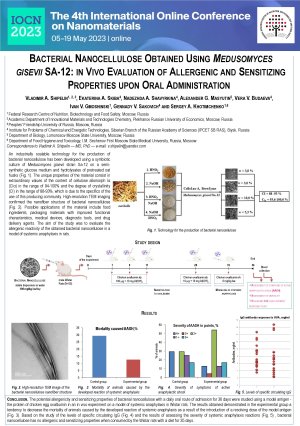
An industrially scalable technology for the production of bacterial nanocellulose has been developed using a symbiotic culture of Medusomyces gisevii strain Sa-12 on a semi-synthetic glucose medium and hydrolysates of pretreated oat husks. The unique properties of the material consist in extraordinary values of the content of cellulose allomorph Iα (CIα) in the range of 94-100% and the degree of crystallinity (CI) in the range of 88-93%, which is due to the specifics of the use of this producing community. Possible applications of the material include food ingredients, packaging materials with improved functional characteristics, medical devices, diagnostic tools, and drug delivery agents. The potential allergenicity and sensitizing properties of bacterial nanocellulose following a daily oral intake for 35 days were studied using a model antigen - the protein of chicken egg ovalbumin in an in vivo experiment on a model of systemic anaphylaxis in Wistar rats. The results obtained demonstrated in the experimental group a tendency to decrease the mortality of animals caused by the developed reaction of systemic anaphylaxis as a result of the introduction of a resolving dose of the model antigen. Based on the study of the levels of specific circulating IgG and the results of assessing the severity of systemic anaphylaxis reactions, bacterial nanocellulose has no allergenic and sensitizing properties when consumed by the Wistar rats with a diet for 35 days.
Keywords
Bacterial nanocellulose
Medusomyces Gisevii
in vivo
rats
allergenicity
sensitizing properties
oral intake
antibody
system anaphylaxis
Manuscript
Shipelin et al.pdf
Poster
Shipelin et al.pdf
Using EpiDermTM to evaluate the toxic effects of P25 Degussa nanoparticles on skin barrier
The Effect of Nickel Nanoparticles Administered Orally on the Content of Trace Elements in the Internal Organs of Rats