Event submissions
Published

This submission belongs to the session A. Synthesis, Characterization, and Properties of Nanomaterials of the event The 4th International Online Conference on Nanomaterials
Published date
05 May, 2023
Academic Editor
'%3e%3cpath%20d='M12.6657%2010.9104C12.4185%2010.325%2012.0599%209.79327%2011.6097%209.34482C11.1609%208.89508%2010.6293%208.5365%2010.0442%208.28888C10.0389%208.28626%2010.0337%208.28495%2010.0285%208.28233C10.8446%207.69279%2011.3752%206.73249%2011.3752%205.64904C11.3752%203.8542%209.92103%202.39999%208.1262%202.39999C6.33136%202.39999%204.87715%203.8542%204.87715%205.64904C4.87715%206.73249%205.40774%207.69279%206.22393%208.28364C6.21869%208.28626%206.21345%208.28757%206.20821%208.29019C5.62129%208.5378%205.09463%208.89284%204.64265%209.34613C4.1929%209.79493%203.83432%2010.3266%203.58671%2010.9117C3.34345%2011.4845%203.21226%2012.0987%203.20023%2012.7209C3.19988%2012.7349%203.20233%2012.7488%203.20744%2012.7619C3.21255%2012.7749%203.22022%2012.7867%203.22998%2012.7968C3.23975%2012.8068%203.25142%2012.8147%203.26431%2012.8202C3.2772%2012.8256%203.29105%2012.8284%203.30504%2012.8284H4.09109C4.14874%2012.8284%204.19459%2012.7825%204.1959%2012.7262C4.2221%2011.7148%204.62823%2010.7676%205.34617%2010.0497C6.08899%209.30683%207.0755%208.89808%208.1262%208.89808C9.17689%208.89808%2010.1634%209.30683%2010.9062%2010.0497C11.6242%2010.7676%2012.0303%2011.7148%2012.0565%2012.7262C12.0578%2012.7838%2012.1037%2012.8284%2012.1613%2012.8284H12.9474C12.9613%2012.8284%2012.9752%2012.8256%2012.9881%2012.8202C13.001%2012.8147%2013.0126%2012.8068%2013.0224%2012.7968C13.0322%2012.7867%2013.0398%2012.7749%2013.0449%2012.7619C13.0501%2012.7488%2013.0525%2012.7349%2013.0522%2012.7209C13.0391%2012.0947%2012.9094%2011.4855%2012.6657%2010.9104ZM8.1262%207.9024C7.52486%207.9024%206.9589%207.6679%206.53312%207.24211C6.10733%206.81633%205.87283%206.25037%205.87283%205.64904C5.87283%205.0477%206.10733%204.48174%206.53312%204.05596C6.9589%203.63018%207.52486%203.39567%208.1262%203.39567C8.72753%203.39567%209.29349%203.63018%209.71927%204.05596C10.1451%204.48174%2010.3796%205.0477%2010.3796%205.64904C10.3796%206.25037%2010.1451%206.81633%209.71927%207.24211C9.29349%207.6679%208.72753%207.9024%208.1262%207.9024Z'%20fill='%235D1EE1'/%3e%3c/g%3e%3c/svg%3e) José Luis Arias Mediano
José Luis Arias MedianoCitation
Yasmin J, Gracie P.J, Geetha D, Investigation of Transition metal ion Cu²⁺ and Mg²⁺ Doped Zinc Aluminate (ZnAl₂O₄) and their Structural, Spectral, Optical, and Dielectric study for Storage applications., in Proceedings of The 4th International Online Conference on Nanomaterials, 5 May–19 May 2023, MDPI: Basel, Switzerland, doi: 10.3390/IOCN2023-14478
Share
Email
Facebook
Twitter
LinkedIn
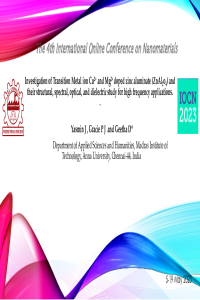
Investigation of Transition metal ion Cu2+ and Mg2+ Doped Zinc Aluminate (ZnAl2O4) and their Structural, Spectral, Optical, and Dielectric study for Storage applications.
'%3e%3cpath%20d='M12.6647%2010.9104C12.4176%2010.325%2012.0589%209.7933%2011.6088%209.34485C11.16%208.89511%2010.6283%208.53653%2010.0432%208.28891C10.038%208.28629%2010.0327%208.28498%2010.0275%208.28236C10.8437%207.69282%2011.3743%206.73252%2011.3743%205.64907C11.3743%203.85423%209.92005%202.40002%208.12522%202.40002C6.33038%202.40002%204.87618%203.85423%204.87618%205.64907C4.87618%206.73252%205.40677%207.69282%206.22296%208.28367C6.21772%208.28629%206.21248%208.2876%206.20724%208.29022C5.62031%208.53783%205.09365%208.89287%204.64167%209.34616C4.19192%209.79496%203.83334%2010.3266%203.58573%2010.9117C3.34247%2011.4846%203.21128%2012.0987%203.19925%2012.721C3.1989%2012.735%203.20135%2012.7489%203.20646%2012.7619C3.21157%2012.7749%203.21924%2012.7868%203.22901%2012.7968C3.23877%2012.8068%203.25045%2012.8148%203.26334%2012.8202C3.27623%2012.8256%203.29007%2012.8284%203.30406%2012.8284H4.09012C4.14776%2012.8284%204.19362%2012.7825%204.19493%2012.7262C4.22113%2011.7148%204.62726%2010.7676%205.34519%2010.0497C6.08802%209.30686%207.07452%208.89811%208.12522%208.89811C9.17592%208.89811%2010.1624%209.30686%2010.9052%2010.0497C11.6232%2010.7676%2012.0293%2011.7148%2012.0555%2012.7262C12.0568%2012.7839%2012.1027%2012.8284%2012.1603%2012.8284H12.9464C12.9604%2012.8284%2012.9742%2012.8256%2012.9871%2012.8202C13%2012.8148%2013.0117%2012.8068%2013.0214%2012.7968C13.0312%2012.7868%2013.0389%2012.7749%2013.044%2012.7619C13.0491%2012.7489%2013.0515%2012.735%2013.0512%2012.721C13.0381%2012.0947%2012.9084%2011.4856%2012.6647%2010.9104ZM8.12522%207.90243C7.52388%207.90243%206.95792%207.66793%206.53214%207.24215C6.10636%206.81636%205.87185%206.2504%205.87185%205.64907C5.87185%205.04773%206.10636%204.48177%206.53214%204.05599C6.95792%203.63021%207.52388%203.3957%208.12522%203.3957C8.72655%203.3957%209.29252%203.63021%209.7183%204.05599C10.1441%204.48177%2010.3786%205.04773%2010.3786%205.64907C10.3786%206.2504%2010.1441%206.81636%209.7183%207.24215C9.29252%207.66793%208.72655%207.90243%208.12522%207.90243Z'%20fill='%235D1EE1'/%3e%3c/g%3e%3c/svg%3e)
Yasmin J 1
Gracie P.J 1
Geetha D 1
1. Department of Applied Sciences and Humanities, Anna University(MIT), Chennai
Abstract
Spinel bimetallic oxides nanomaterials have attracted attention due to their unique crystal structure, excellent optical and dielectric properties, high chemical and thermal stability, low surface acidity, etc. As a typical spinel semiconductor with wide band gap (Eg = 3.8 eV), Zinc aluminate (ZnAl2O4) has been widely investigated in the field of catalysis, hydrogen storage, sense, display. It has also attracted attention as a phosphor carrier material for use in thin-film electroluminescent displays, mechano-optical voltage sensors and voltage visualization devices. Herein, Zn1-xCu0xAl2O4 (x = 0.00 and 0.10) has been synthesized through the sol–gel auto combustion technique. The structural, spectral, optical, morphological and dielectric properties of the synthesized nanoparticles were analyzed. The X-ray diffraction analysis revealed the single phase spinel structure. The crystallite size in the range of 55-65 nm was ascertained by the Scherrer formula. The substitution of copper and magnesium in Zinc spinel aluminates was found to have a significant effect on crystallite size, lattice strain, micro-strain and dislocation density. Transition metal ion doped aluminates samples evinced a decrease in the optical band gap energy from Eg = 3.36 to 3.20 eV. Surface morphology of the materials has been studied through the HRSEM-EDX analysis. The dielectric properties were explored in the frequency range 1 Hz to 10 MHz. Impedance study revealed the grain boundaries to be dominant as a function of Cu2+ and Mg2+ content. Inverse relation of ac frequency with the dielectric constant exposed the existence of Maxwell–Wagner type interfacial polarization. The conducting and resistive grain boundaries play a vital role in understanding the dielectric relaxation in the material. From the observed electrical parameters, it can be propounded that the prepared spinels hold semiconducting nature and can be employed as a dielectric in low-frequency devices. They also serve as potential candidate in optoelectronics, magnetic and catalysis applications.
Keywords
Spinel
doped Zinc aluminate
sol–gel
X-ray diffraction
dielectric
impedance
Manuscript
sciforum-069571.pdf
Poster
IOCN ppt-revised.pdf
An investigation of the optimal conditions for the green synthesis of silver nanoparticles using an aqueous extract from the plant Agrimonia eupatoria L.
APPLICATION OF COVALENT ORGANIC FRAMEWORKS (COFS) IN CYCLIC CARBONATE PRODUCTION BY A GREEN WAY: AN OVERWIEW