Event submissions
Published

This submission belongs to the session F. Nanomedicine and Nanobiotechnology of the event The 4th International Online Conference on Nanomaterials
Published date
05 May, 2023
Academic Editor
'%3e%3cpath%20d='M12.6657%2010.9104C12.4185%2010.325%2012.0599%209.79327%2011.6097%209.34482C11.1609%208.89508%2010.6293%208.5365%2010.0442%208.28888C10.0389%208.28626%2010.0337%208.28495%2010.0285%208.28233C10.8446%207.69279%2011.3752%206.73249%2011.3752%205.64904C11.3752%203.8542%209.92103%202.39999%208.1262%202.39999C6.33136%202.39999%204.87715%203.8542%204.87715%205.64904C4.87715%206.73249%205.40774%207.69279%206.22393%208.28364C6.21869%208.28626%206.21345%208.28757%206.20821%208.29019C5.62129%208.5378%205.09463%208.89284%204.64265%209.34613C4.1929%209.79493%203.83432%2010.3266%203.58671%2010.9117C3.34345%2011.4845%203.21226%2012.0987%203.20023%2012.7209C3.19988%2012.7349%203.20233%2012.7488%203.20744%2012.7619C3.21255%2012.7749%203.22022%2012.7867%203.22998%2012.7968C3.23975%2012.8068%203.25142%2012.8147%203.26431%2012.8202C3.2772%2012.8256%203.29105%2012.8284%203.30504%2012.8284H4.09109C4.14874%2012.8284%204.19459%2012.7825%204.1959%2012.7262C4.2221%2011.7148%204.62823%2010.7676%205.34617%2010.0497C6.08899%209.30683%207.0755%208.89808%208.1262%208.89808C9.17689%208.89808%2010.1634%209.30683%2010.9062%2010.0497C11.6242%2010.7676%2012.0303%2011.7148%2012.0565%2012.7262C12.0578%2012.7838%2012.1037%2012.8284%2012.1613%2012.8284H12.9474C12.9613%2012.8284%2012.9752%2012.8256%2012.9881%2012.8202C13.001%2012.8147%2013.0126%2012.8068%2013.0224%2012.7968C13.0322%2012.7867%2013.0398%2012.7749%2013.0449%2012.7619C13.0501%2012.7488%2013.0525%2012.7349%2013.0522%2012.7209C13.0391%2012.0947%2012.9094%2011.4855%2012.6657%2010.9104ZM8.1262%207.9024C7.52486%207.9024%206.9589%207.6679%206.53312%207.24211C6.10733%206.81633%205.87283%206.25037%205.87283%205.64904C5.87283%205.0477%206.10733%204.48174%206.53312%204.05596C6.9589%203.63018%207.52486%203.39567%208.1262%203.39567C8.72753%203.39567%209.29349%203.63018%209.71927%204.05596C10.1451%204.48174%2010.3796%205.0477%2010.3796%205.64904C10.3796%206.25037%2010.1451%206.81633%209.71927%207.24211C9.29349%207.6679%208.72753%207.9024%208.1262%207.9024Z'%20fill='%235D1EE1'/%3e%3c/g%3e%3c/svg%3e) Aurélien Deniaud
Aurélien DeniaudCitation
Nguyen Huu Tung, Murashova Nataliya Mikhailovna, Microemulsions in the systems with lecithin and oils from tropical plants for drug delivery, in Proceedings of The 4th International Online Conference on Nanomaterials, 5 May–19 May 2023, MDPI: Basel, Switzerland, doi: 10.3390/IOCN2023-14496
Share
Email
Facebook
Twitter
LinkedIn
Microemulsions in the systems with lecithin and oils from tropical plants for drug delivery
'%3e%3cpath%20d='M12.6647%2010.9104C12.4176%2010.325%2012.0589%209.7933%2011.6088%209.34485C11.16%208.89511%2010.6283%208.53653%2010.0432%208.28891C10.038%208.28629%2010.0327%208.28498%2010.0275%208.28236C10.8437%207.69282%2011.3743%206.73252%2011.3743%205.64907C11.3743%203.85423%209.92005%202.40002%208.12522%202.40002C6.33038%202.40002%204.87618%203.85423%204.87618%205.64907C4.87618%206.73252%205.40677%207.69282%206.22296%208.28367C6.21772%208.28629%206.21248%208.2876%206.20724%208.29022C5.62031%208.53783%205.09365%208.89287%204.64167%209.34616C4.19192%209.79496%203.83334%2010.3266%203.58573%2010.9117C3.34247%2011.4846%203.21128%2012.0987%203.19925%2012.721C3.1989%2012.735%203.20135%2012.7489%203.20646%2012.7619C3.21157%2012.7749%203.21924%2012.7868%203.22901%2012.7968C3.23877%2012.8068%203.25045%2012.8148%203.26334%2012.8202C3.27623%2012.8256%203.29007%2012.8284%203.30406%2012.8284H4.09012C4.14776%2012.8284%204.19362%2012.7825%204.19493%2012.7262C4.22113%2011.7148%204.62726%2010.7676%205.34519%2010.0497C6.08802%209.30686%207.07452%208.89811%208.12522%208.89811C9.17592%208.89811%2010.1624%209.30686%2010.9052%2010.0497C11.6232%2010.7676%2012.0293%2011.7148%2012.0555%2012.7262C12.0568%2012.7839%2012.1027%2012.8284%2012.1603%2012.8284H12.9464C12.9604%2012.8284%2012.9742%2012.8256%2012.9871%2012.8202C13%2012.8148%2013.0117%2012.8068%2013.0214%2012.7968C13.0312%2012.7868%2013.0389%2012.7749%2013.044%2012.7619C13.0491%2012.7489%2013.0515%2012.735%2013.0512%2012.721C13.0381%2012.0947%2012.9084%2011.4856%2012.6647%2010.9104ZM8.12522%207.90243C7.52388%207.90243%206.95792%207.66793%206.53214%207.24215C6.10636%206.81636%205.87185%206.2504%205.87185%205.64907C5.87185%205.04773%206.10636%204.48177%206.53214%204.05599C6.95792%203.63021%207.52388%203.3957%208.12522%203.3957C8.72655%203.3957%209.29252%203.63021%209.7183%204.05599C10.1441%204.48177%2010.3786%205.04773%2010.3786%205.64907C10.3786%206.2504%2010.1441%206.81636%209.7183%207.24215C9.29252%207.66793%208.72655%207.90243%208.12522%207.90243Z'%20fill='%235D1EE1'/%3e%3c/g%3e%3c/svg%3e)
Nguyen Huu Tung 1
Murashova Nataliya Mikhailovna 1
1. Department of Nanomaterials and Nanotechnology, Mendeleev University of Chemical Technology of Russia, Miusskaya sq., 9, Moscow, Russia, 125047
Abstract
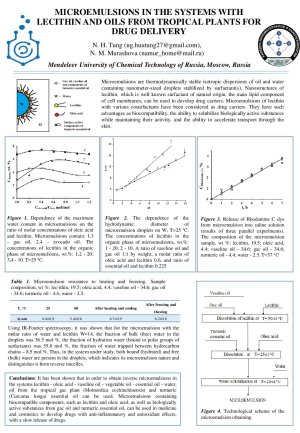
Microemulsions are thermodynamically stable dispersions of oil and water containing nanometer-sized droplets stabilized by a surfactant. Microemulsions containing biocompatible surfactants, such as lecithin, are promising carriers for drug delivery. It has been shown that oil from the tropical plant gac (Momordica cochinchinensis) and turmeric essential oil can be used to obtain reverse microemulsions in the systems lecithin - oleic acid - vaseline oil - vegetable oil - essential oil - water. At least 6.5 wt.% of water can be introduced into the microemulsion at a lecithin concentration in the organic phase of 20 wt.%, a ratio of vaseline oil and gac oil 1:1 by weight and a molar ratio of oleic acid and lecithin from 0.2 to 0.8. Depending on the concentration of water and lecithin, the hydrodynamic diameter of microemulsion droplets varies in the range from 3 to 21 nm; a linear dependence of the diameter on W is shown. Both after heating to 60 ºС and cooling, and after freezing at -20 ºС and subsequent thawing, the structure of the microemulsion was restored, the droplet size practically did not change. Using IR-Fourier spectroscopy, it was shown that for the microemulsion with the molar ratio of water and lecithin W=14, the fraction of bulk (free) water in the droplets was 36.5 mol %, the fraction of hydration water (bound to polar groups of surfactants) was 55.0 mol %, the fraction of water trapped between hydrocarbon chains – 8.5 mol.%. The resulting reverse microemulsions are characterized by a low rate of release of water-soluble substances: in 6 hours, approximately 3,2% of the dye Rhodamine C was released, which allows the development of drugs with a sustained release of medicinal substances.
Keywords
inverse microemulsions
lecithin
vegetable oils
essential oils
nanostructured drug carriers
Manuscript
materproc-070285-done.pdf
Poster
Poster IOCN 23 - Nguyen Huu Tung.pdf
Decellularized extracellular matrix Polycaprolactone/Chitosan composite nanofibrous scaffolds for periodontal tissue engineering
PCL NANOMODIFIED COATING FOR THE PROTECTION OF THERMOCHROMIC PRINTS ON PACKAGING