Event submissions
Published

This submission belongs to the session F. Nanomedicine and Nanobiotechnology of the event The 4th International Online Conference on Nanomaterials
Published date
05 May, 2023
Academic Editor
'%3e%3cpath%20d='M12.6657%2010.9104C12.4185%2010.325%2012.0599%209.79327%2011.6097%209.34482C11.1609%208.89508%2010.6293%208.5365%2010.0442%208.28888C10.0389%208.28626%2010.0337%208.28495%2010.0285%208.28233C10.8446%207.69279%2011.3752%206.73249%2011.3752%205.64904C11.3752%203.8542%209.92103%202.39999%208.1262%202.39999C6.33136%202.39999%204.87715%203.8542%204.87715%205.64904C4.87715%206.73249%205.40774%207.69279%206.22393%208.28364C6.21869%208.28626%206.21345%208.28757%206.20821%208.29019C5.62129%208.5378%205.09463%208.89284%204.64265%209.34613C4.1929%209.79493%203.83432%2010.3266%203.58671%2010.9117C3.34345%2011.4845%203.21226%2012.0987%203.20023%2012.7209C3.19988%2012.7349%203.20233%2012.7488%203.20744%2012.7619C3.21255%2012.7749%203.22022%2012.7867%203.22998%2012.7968C3.23975%2012.8068%203.25142%2012.8147%203.26431%2012.8202C3.2772%2012.8256%203.29105%2012.8284%203.30504%2012.8284H4.09109C4.14874%2012.8284%204.19459%2012.7825%204.1959%2012.7262C4.2221%2011.7148%204.62823%2010.7676%205.34617%2010.0497C6.08899%209.30683%207.0755%208.89808%208.1262%208.89808C9.17689%208.89808%2010.1634%209.30683%2010.9062%2010.0497C11.6242%2010.7676%2012.0303%2011.7148%2012.0565%2012.7262C12.0578%2012.7838%2012.1037%2012.8284%2012.1613%2012.8284H12.9474C12.9613%2012.8284%2012.9752%2012.8256%2012.9881%2012.8202C13.001%2012.8147%2013.0126%2012.8068%2013.0224%2012.7968C13.0322%2012.7867%2013.0398%2012.7749%2013.0449%2012.7619C13.0501%2012.7488%2013.0525%2012.7349%2013.0522%2012.7209C13.0391%2012.0947%2012.9094%2011.4855%2012.6657%2010.9104ZM8.1262%207.9024C7.52486%207.9024%206.9589%207.6679%206.53312%207.24211C6.10733%206.81633%205.87283%206.25037%205.87283%205.64904C5.87283%205.0477%206.10733%204.48174%206.53312%204.05596C6.9589%203.63018%207.52486%203.39567%208.1262%203.39567C8.72753%203.39567%209.29349%203.63018%209.71927%204.05596C10.1451%204.48174%2010.3796%205.0477%2010.3796%205.64904C10.3796%206.25037%2010.1451%206.81633%209.71927%207.24211C9.29349%207.6679%208.72753%207.9024%208.1262%207.9024Z'%20fill='%235D1EE1'/%3e%3c/g%3e%3c/svg%3e) Bogdan Stefan Vasile
Bogdan Stefan VasileCitation
Samuel Longoria-García, Celia Nohemi Sanchez-Dominguez, Margarita Sánchez-Domínguez, Jesús Rolando Delgado-Balderas, Hugo Leonid Gallardo-Blanco, pMyc and pMax Peptides Nanosystems for a Prostate Cancer Treatment, In Vitro Assays, in Proceedings of The 4th International Online Conference on Nanomaterials, 5 May–19 May 2023, MDPI: Basel, Switzerland, doi: 10.3390/IOCN2023-14501
Share
Email
Facebook
Twitter
LinkedIn
pMyc and pMax Peptides Nanosystems for a Prostate Cancer Treatment, In Vitro Assays
'%3e%3cpath%20d='M12.6647%2010.9104C12.4176%2010.325%2012.0589%209.7933%2011.6088%209.34485C11.16%208.89511%2010.6283%208.53653%2010.0432%208.28891C10.038%208.28629%2010.0327%208.28498%2010.0275%208.28236C10.8437%207.69282%2011.3743%206.73252%2011.3743%205.64907C11.3743%203.85423%209.92005%202.40002%208.12522%202.40002C6.33038%202.40002%204.87618%203.85423%204.87618%205.64907C4.87618%206.73252%205.40677%207.69282%206.22296%208.28367C6.21772%208.28629%206.21248%208.2876%206.20724%208.29022C5.62031%208.53783%205.09365%208.89287%204.64167%209.34616C4.19192%209.79496%203.83334%2010.3266%203.58573%2010.9117C3.34247%2011.4846%203.21128%2012.0987%203.19925%2012.721C3.1989%2012.735%203.20135%2012.7489%203.20646%2012.7619C3.21157%2012.7749%203.21924%2012.7868%203.22901%2012.7968C3.23877%2012.8068%203.25045%2012.8148%203.26334%2012.8202C3.27623%2012.8256%203.29007%2012.8284%203.30406%2012.8284H4.09012C4.14776%2012.8284%204.19362%2012.7825%204.19493%2012.7262C4.22113%2011.7148%204.62726%2010.7676%205.34519%2010.0497C6.08802%209.30686%207.07452%208.89811%208.12522%208.89811C9.17592%208.89811%2010.1624%209.30686%2010.9052%2010.0497C11.6232%2010.7676%2012.0293%2011.7148%2012.0555%2012.7262C12.0568%2012.7839%2012.1027%2012.8284%2012.1603%2012.8284H12.9464C12.9604%2012.8284%2012.9742%2012.8256%2012.9871%2012.8202C13%2012.8148%2013.0117%2012.8068%2013.0214%2012.7968C13.0312%2012.7868%2013.0389%2012.7749%2013.044%2012.7619C13.0491%2012.7489%2013.0515%2012.735%2013.0512%2012.721C13.0381%2012.0947%2012.9084%2011.4856%2012.6647%2010.9104ZM8.12522%207.90243C7.52388%207.90243%206.95792%207.66793%206.53214%207.24215C6.10636%206.81636%205.87185%206.2504%205.87185%205.64907C5.87185%205.04773%206.10636%204.48177%206.53214%204.05599C6.95792%203.63021%207.52388%203.3957%208.12522%203.3957C8.72655%203.3957%209.29252%203.63021%209.7183%204.05599C10.1441%204.48177%2010.3786%205.04773%2010.3786%205.64907C10.3786%206.2504%2010.1441%206.81636%209.7183%207.24215C9.29252%207.66793%208.72655%207.90243%208.12522%207.90243Z'%20fill='%235D1EE1'/%3e%3c/g%3e%3c/svg%3e)
Samuel Longoria-García 1

Celia Nohemi Sanchez-Dominguez 1

Margarita Sánchez-Domínguez 2
Jesús Rolando Delgado-Balderas 3

Hugo Leonid Gallardo-Blanco 4
1. Universidad Autónoma de Nuevo León, Facultad de Medicina, Departamento de Bioquímica y Medicina Molecular. Av. Dr. José Eleuterio González 235, Mitras Centro, 64460 Monterrey, N.L.
2. Grupo de Química Coloidal e Interfacial Aplicada a Nanociencia y Formulaciones, Centro de Investigación en Materiales Avanzados, Unidad Monterrey, Alianza Norte 202, 66000 Apodaca, Nuevo Leon, Mexico
Group of Colloidal and Interfacial Chemistry Applied
3. Delee, Corp; Universidad Autónoma de Nuevo León, Facultad de Ciencias Químicas. Avenida Universidad s/n, Cd. Universitaria, Ciudad Universitaria, 66455 San Nicolás de los Garza, N.L.
4. Universidad Autónoma de Nuevo León, Hospital Universitario "José Eleuterio González", Av. Dr. José Eleuterio González 235, Mitras Centro, 64460 Monterrey, N.L.
Abstract
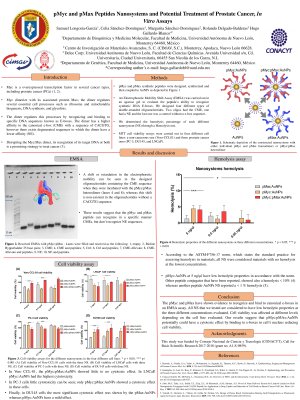
The Myc transcription factor and its associated Max protein have an essential role in developing several types of cancers, including prostate cancer. They act through the dimerization into a Myc-Max heterodimer and the binding to specific DNA sequences known as enhancer box (E-box). Disrupting the Myc- Max heterodimer interaction or its binding to canonical E-box sequences (CME) to disrupt gene transcription is a promising strategy to treat cancer. Using computational biology tools, we designed pMyc and pMax peptides from Myc and Max reference sequences and evaluated their ability to bind specifically CME through an electrophoretic mobility shift assay (EMSA). We then coupled them to AuNPs and evaluated the hemocompatibility and the cytotoxic effect in three different prostate adenocarcinoma cell lines (LNCaP, PC-3, and DU145) and a non-cancerous cell line (Vero CCL-81). The EMSA results suggest that the pMyc-pMax dimers bind to CMEs. Through UV-Vis absorption spectra, we determined peptide conjugation to the AuNPs. The hemolysis test showed little hemolytic activity for the nanosystems (NS) at the concentrations (5, 0.5, and 0.05 ng/ µL) evaluated. Cell viability assays showed mixed results depending on which cell line was being evaluated. Overall, results suggest that NS with pMyc and pMax peptides might be suitable for further research regarding Myc-driven prostate adenocarcinomas.
Keywords
Myc
nanomedicine
prostate cancer
nanosystems
Manuscript
materproc-070319-done.pdf
Poster
POSTER - pMyc and pMax Peptides Nanosystems and Potential Treatment of Prostate Cancer, In Vitro Assays.pdf
Study of photoresistor fabrication based on mercury chalcogenides applying various ligand exchanges
Aptamer-Conjugated Gold Nanoparticles Targeting Human Epidermal Growth Factor Receptor 2 (HER2) for Cancer Theranostic, In Vitro Assays.