Event submissions
Published

This submission belongs to the session E. Microfabrication and Printing Techniques in Biosensors of the event The 3rd International Electronic Conference on Biosensors
Published date
08 May, 2023
Academic Editor
'%3e%3cpath%20d='M12.6657%2010.9104C12.4185%2010.325%2012.0599%209.79327%2011.6097%209.34482C11.1609%208.89508%2010.6293%208.5365%2010.0442%208.28888C10.0389%208.28626%2010.0337%208.28495%2010.0285%208.28233C10.8446%207.69279%2011.3752%206.73249%2011.3752%205.64904C11.3752%203.8542%209.92103%202.39999%208.1262%202.39999C6.33136%202.39999%204.87715%203.8542%204.87715%205.64904C4.87715%206.73249%205.40774%207.69279%206.22393%208.28364C6.21869%208.28626%206.21345%208.28757%206.20821%208.29019C5.62129%208.5378%205.09463%208.89284%204.64265%209.34613C4.1929%209.79493%203.83432%2010.3266%203.58671%2010.9117C3.34345%2011.4845%203.21226%2012.0987%203.20023%2012.7209C3.19988%2012.7349%203.20233%2012.7488%203.20744%2012.7619C3.21255%2012.7749%203.22022%2012.7867%203.22998%2012.7968C3.23975%2012.8068%203.25142%2012.8147%203.26431%2012.8202C3.2772%2012.8256%203.29105%2012.8284%203.30504%2012.8284H4.09109C4.14874%2012.8284%204.19459%2012.7825%204.1959%2012.7262C4.2221%2011.7148%204.62823%2010.7676%205.34617%2010.0497C6.08899%209.30683%207.0755%208.89808%208.1262%208.89808C9.17689%208.89808%2010.1634%209.30683%2010.9062%2010.0497C11.6242%2010.7676%2012.0303%2011.7148%2012.0565%2012.7262C12.0578%2012.7838%2012.1037%2012.8284%2012.1613%2012.8284H12.9474C12.9613%2012.8284%2012.9752%2012.8256%2012.9881%2012.8202C13.001%2012.8147%2013.0126%2012.8068%2013.0224%2012.7968C13.0322%2012.7867%2013.0398%2012.7749%2013.0449%2012.7619C13.0501%2012.7488%2013.0525%2012.7349%2013.0522%2012.7209C13.0391%2012.0947%2012.9094%2011.4855%2012.6657%2010.9104ZM8.1262%207.9024C7.52486%207.9024%206.9589%207.6679%206.53312%207.24211C6.10733%206.81633%205.87283%206.25037%205.87283%205.64904C5.87283%205.0477%206.10733%204.48174%206.53312%204.05596C6.9589%203.63018%207.52486%203.39567%208.1262%203.39567C8.72753%203.39567%209.29349%203.63018%209.71927%204.05596C10.1451%204.48174%2010.3796%205.0477%2010.3796%205.64904C10.3796%206.25037%2010.1451%206.81633%209.71927%207.24211C9.29349%207.6679%208.72753%207.9024%208.1262%207.9024Z'%20fill='%235D1EE1'/%3e%3c/g%3e%3c/svg%3e) Sara Tombelli
Sara TombelliCitation
Nathalia Oezau Gomes, Rafaella T. Paschoalin, Stanley Bilatto, Amanda R. Sorigotti, Cristiane S. Farinas, Luiz Henrique C. Mattoso, Sergio A. S. Machado, Osvaldo N Oliveira, Jr, Paulo Augusto Raymundo Pereira, Biodegradable Mats for the design of bifunctional biosensors for Glucose detectionin urine, in Proceedings of The 3rd International Electronic Conference on Biosensors, 8 May–21 May 2023, MDPI: Basel, Switzerland, doi: 10.3390/IECB2023-14580
Share
Email
Facebook
Twitter
LinkedIn
Biodegradable Mats for the design of bifunctional biosensors for Glucose detection
in urine
in urine
'%3e%3cpath%20d='M12.6647%2010.9104C12.4176%2010.325%2012.0589%209.7933%2011.6088%209.34485C11.16%208.89511%2010.6283%208.53653%2010.0432%208.28891C10.038%208.28629%2010.0327%208.28498%2010.0275%208.28236C10.8437%207.69282%2011.3743%206.73252%2011.3743%205.64907C11.3743%203.85423%209.92005%202.40002%208.12522%202.40002C6.33038%202.40002%204.87618%203.85423%204.87618%205.64907C4.87618%206.73252%205.40677%207.69282%206.22296%208.28367C6.21772%208.28629%206.21248%208.2876%206.20724%208.29022C5.62031%208.53783%205.09365%208.89287%204.64167%209.34616C4.19192%209.79496%203.83334%2010.3266%203.58573%2010.9117C3.34247%2011.4846%203.21128%2012.0987%203.19925%2012.721C3.1989%2012.735%203.20135%2012.7489%203.20646%2012.7619C3.21157%2012.7749%203.21924%2012.7868%203.22901%2012.7968C3.23877%2012.8068%203.25045%2012.8148%203.26334%2012.8202C3.27623%2012.8256%203.29007%2012.8284%203.30406%2012.8284H4.09012C4.14776%2012.8284%204.19362%2012.7825%204.19493%2012.7262C4.22113%2011.7148%204.62726%2010.7676%205.34519%2010.0497C6.08802%209.30686%207.07452%208.89811%208.12522%208.89811C9.17592%208.89811%2010.1624%209.30686%2010.9052%2010.0497C11.6232%2010.7676%2012.0293%2011.7148%2012.0555%2012.7262C12.0568%2012.7839%2012.1027%2012.8284%2012.1603%2012.8284H12.9464C12.9604%2012.8284%2012.9742%2012.8256%2012.9871%2012.8202C13%2012.8148%2013.0117%2012.8068%2013.0214%2012.7968C13.0312%2012.7868%2013.0389%2012.7749%2013.044%2012.7619C13.0491%2012.7489%2013.0515%2012.735%2013.0512%2012.721C13.0381%2012.0947%2012.9084%2011.4856%2012.6647%2010.9104ZM8.12522%207.90243C7.52388%207.90243%206.95792%207.66793%206.53214%207.24215C6.10636%206.81636%205.87185%206.2504%205.87185%205.64907C5.87185%205.04773%206.10636%204.48177%206.53214%204.05599C6.95792%203.63021%207.52388%203.3957%208.12522%203.3957C8.72655%203.3957%209.29252%203.63021%209.7183%204.05599C10.1441%204.48177%2010.3786%205.04773%2010.3786%205.64907C10.3786%206.2504%2010.1441%206.81636%209.7183%207.24215C9.29252%207.66793%208.72655%207.90243%208.12522%207.90243Z'%20fill='%235D1EE1'/%3e%3c/g%3e%3c/svg%3e)
Nathalia Oezau Gomes 1
Rafaella T. Paschoalin 2
Stanley Bilatto 3
Amanda R. Sorigotti 4
Cristiane S. Farinas 5

Luiz Henrique C. Mattoso 6
Sergio A. S. Machado 7
Osvaldo N Oliveira, Jr 8

Paulo Augusto Raymundo Pereira 8
1. São Carlos Institute of Chemistry,
University of São Paulo, 13566-590 São Carlos, São Paulo,
Brazi
2. − São Carlos Institute of Physics,
University of São Paulo, 13560-970 São Carlos, São Paulo,
Brazil
3. Nanotechnology National Laboratory for
Agribusiness (LNNA), Embrapa Instrumentation, 13560-
970 São Carlos, São Paulo, Brazil;
4. Nanotechnology National Laboratory
for Agribusiness (LNNA), Embrapa Instrumentation, 13560-
970 São Carlos, São Paulo, Brazi
5. Nanotechnology National Laboratory
for Agribusiness (LNNA), Embrapa Instrumentation, 13560-
970 São Carlos, São Paulo, Brazil
6. Nanotechnology National
Laboratory for Agribusiness (LNNA), Embrapa
Instrumentation, 13560-970 São Carlos, São Paulo, Brazil
7. São Carlos Institute of Chemistry,
University of São Paulo, 13566-590 São Carlos, São Paulo,
Brazil
8. São Carlos Institute of Physics,
University of São Paulo, 13560-970 São Carlos, São Paulo,
Brazil;
Abstract
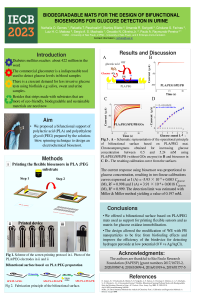
Sustainable materials for the design of smart sensors are an emergent technology and desirable to minimize electronics' environmental impact. Herein, we proposed a bifunctional substrate of polylactic acid (PLA) and polyethylene glycol (PEG) prepared by the solution-blow spinning technique to design an electrochemical biosensor. The PLA/PEG nanofibers are degradable, free of waste, low-cost, and considered a sustainable material, making promising for electrochemical biosensors projection. The substrate was namely bifunctional because they were employed as support for screen-printed carbon electrodes (SPCE) and a matrix for covalently bounded glucose oxidase (GOx). The GOx was incorporated directly on PLA/PEG surface and was responsible to hydrogen peroxide production which is detected on the SPCE surface. Prussian Blue nanoparticles (PB) were electrodeposited on the SPCE surface to decrease the reduction potential of the hydrogen peroxide, allowing to perform the chronoamperometric measurements with a low applied potential of 0 V vs. Ag/AgCl directly in undiluted human urine and yielding a high selectivity toward interferent compounds. The current signals of amperometric response increased linearly between 0.5 and 5.5 mM of glucose at the linear regression of 1.9 × 10⁻⁶ + 18.1 × 10⁻⁴ Cglucose (M), R2 = 0.998 and the detection limit estimated was 0.197 mM. The flexible, bifunctional platform showed a stable signal for 60 days, which is maybe because of the GOx immobilization on the PLA/PEG surface. The glucose biosensor was statistically equivalent to the commercial colorimetric kit. The use of PLA/PEG mat and the bifunctional architecture is an affordable and sustainable alternative for the design of a new generation of biosensors for clinical analyses.
Keywords
glucose
biosensor
screen-printed electrodes
Prussian blue
urine
non-invasive.
Manuscript
sciforum-071328.pdf
Poster
Poster+Presentation.pdf
Characterization of Spinal cord stimulation electrode for chronic implant in Animal Models
Nanoparticle/DNAzyme based biosensors for heavy-metal ion detection: Effect of DNAzyme surface modifications on device sensitivity