Event submissions
Published

This submission belongs to the session S4. Chemical Processes and Systems of the event The 2nd International Electronic Conference on Processes
Published date
17 May, 2023
Academic Editor
'%3e%3cpath%20d='M12.6657%2010.9104C12.4185%2010.325%2012.0599%209.79327%2011.6097%209.34482C11.1609%208.89508%2010.6293%208.5365%2010.0442%208.28888C10.0389%208.28626%2010.0337%208.28495%2010.0285%208.28233C10.8446%207.69279%2011.3752%206.73249%2011.3752%205.64904C11.3752%203.8542%209.92103%202.39999%208.1262%202.39999C6.33136%202.39999%204.87715%203.8542%204.87715%205.64904C4.87715%206.73249%205.40774%207.69279%206.22393%208.28364C6.21869%208.28626%206.21345%208.28757%206.20821%208.29019C5.62129%208.5378%205.09463%208.89284%204.64265%209.34613C4.1929%209.79493%203.83432%2010.3266%203.58671%2010.9117C3.34345%2011.4845%203.21226%2012.0987%203.20023%2012.7209C3.19988%2012.7349%203.20233%2012.7488%203.20744%2012.7619C3.21255%2012.7749%203.22022%2012.7867%203.22998%2012.7968C3.23975%2012.8068%203.25142%2012.8147%203.26431%2012.8202C3.2772%2012.8256%203.29105%2012.8284%203.30504%2012.8284H4.09109C4.14874%2012.8284%204.19459%2012.7825%204.1959%2012.7262C4.2221%2011.7148%204.62823%2010.7676%205.34617%2010.0497C6.08899%209.30683%207.0755%208.89808%208.1262%208.89808C9.17689%208.89808%2010.1634%209.30683%2010.9062%2010.0497C11.6242%2010.7676%2012.0303%2011.7148%2012.0565%2012.7262C12.0578%2012.7838%2012.1037%2012.8284%2012.1613%2012.8284H12.9474C12.9613%2012.8284%2012.9752%2012.8256%2012.9881%2012.8202C13.001%2012.8147%2013.0126%2012.8068%2013.0224%2012.7968C13.0322%2012.7867%2013.0398%2012.7749%2013.0449%2012.7619C13.0501%2012.7488%2013.0525%2012.7349%2013.0522%2012.7209C13.0391%2012.0947%2012.9094%2011.4855%2012.6657%2010.9104ZM8.1262%207.9024C7.52486%207.9024%206.9589%207.6679%206.53312%207.24211C6.10733%206.81633%205.87283%206.25037%205.87283%205.64904C5.87283%205.0477%206.10733%204.48174%206.53312%204.05596C6.9589%203.63018%207.52486%203.39567%208.1262%203.39567C8.72753%203.39567%209.29349%203.63018%209.71927%204.05596C10.1451%204.48174%2010.3796%205.0477%2010.3796%205.64904C10.3796%206.25037%2010.1451%206.81633%209.71927%207.24211C9.29349%207.6679%208.72753%207.9024%208.1262%207.9024Z'%20fill='%235D1EE1'/%3e%3c/g%3e%3c/svg%3e) Pamela Li
Pamela LiCitation
Borislav Barbov, Katerina Zaharieva, Petya Karakashkova, Hristo Penchev, Liliya Tsvetanova, Silvia Dimova, Preparation and catalytic study of Mn-NaX, Cu-NaX and Ag-/AgNPs-NaX zeolites, in Proceedings of The 2nd International Electronic Conference on Processes, 17 May–31 May 2023, MDPI: Basel, Switzerland, doi: 10.3390/ECP2023-14649
Share
Email
Facebook
Twitter
LinkedIn
Preparation and catalytic study of Mn-NaX, Cu-NaX and Ag-/AgNPs-NaX zeolites
'%3e%3cpath%20d='M12.6647%2010.9104C12.4176%2010.325%2012.0589%209.7933%2011.6088%209.34485C11.16%208.89511%2010.6283%208.53653%2010.0432%208.28891C10.038%208.28629%2010.0327%208.28498%2010.0275%208.28236C10.8437%207.69282%2011.3743%206.73252%2011.3743%205.64907C11.3743%203.85423%209.92005%202.40002%208.12522%202.40002C6.33038%202.40002%204.87618%203.85423%204.87618%205.64907C4.87618%206.73252%205.40677%207.69282%206.22296%208.28367C6.21772%208.28629%206.21248%208.2876%206.20724%208.29022C5.62031%208.53783%205.09365%208.89287%204.64167%209.34616C4.19192%209.79496%203.83334%2010.3266%203.58573%2010.9117C3.34247%2011.4846%203.21128%2012.0987%203.19925%2012.721C3.1989%2012.735%203.20135%2012.7489%203.20646%2012.7619C3.21157%2012.7749%203.21924%2012.7868%203.22901%2012.7968C3.23877%2012.8068%203.25045%2012.8148%203.26334%2012.8202C3.27623%2012.8256%203.29007%2012.8284%203.30406%2012.8284H4.09012C4.14776%2012.8284%204.19362%2012.7825%204.19493%2012.7262C4.22113%2011.7148%204.62726%2010.7676%205.34519%2010.0497C6.08802%209.30686%207.07452%208.89811%208.12522%208.89811C9.17592%208.89811%2010.1624%209.30686%2010.9052%2010.0497C11.6232%2010.7676%2012.0293%2011.7148%2012.0555%2012.7262C12.0568%2012.7839%2012.1027%2012.8284%2012.1603%2012.8284H12.9464C12.9604%2012.8284%2012.9742%2012.8256%2012.9871%2012.8202C13%2012.8148%2013.0117%2012.8068%2013.0214%2012.7968C13.0312%2012.7868%2013.0389%2012.7749%2013.044%2012.7619C13.0491%2012.7489%2013.0515%2012.735%2013.0512%2012.721C13.0381%2012.0947%2012.9084%2011.4856%2012.6647%2010.9104ZM8.12522%207.90243C7.52388%207.90243%206.95792%207.66793%206.53214%207.24215C6.10636%206.81636%205.87185%206.2504%205.87185%205.64907C5.87185%205.04773%206.10636%204.48177%206.53214%204.05599C6.95792%203.63021%207.52388%203.3957%208.12522%203.3957C8.72655%203.3957%209.29252%203.63021%209.7183%204.05599C10.1441%204.48177%2010.3786%205.04773%2010.3786%205.64907C10.3786%206.2504%2010.1441%206.81636%209.7183%207.24215C9.29252%207.66793%208.72655%207.90243%208.12522%207.90243Z'%20fill='%235D1EE1'/%3e%3c/g%3e%3c/svg%3e)
Borislav Barbov 1

Katerina Zaharieva 1
Petya Karakashkova 2

Hristo Penchev 3
Liliya Tsvetanova 1
Silvia Dimova 3
1. Institute of Mineralogy and Crystallography “Аkad. I. Kostov”, Bulgarian Academy of Sciences, “Akad. G. Bonchev” St., Bl. 107, Sofia, Bulgaria
2. Institute of Catalysis, Bulgarian Academy of Sciences, “Acad. G. Bonchev” St., Block 11, Sofia, Bulgaria
3. Institute of Polymers, Bulgarian Academy of Sciences, “Akad. G. Bonchev” St., Bl.103A, Sofia, Bulgaria
Abstract
Zeolites are crystalline aluminosilicates with uniform pores, cavities and channels and find application in various industries due to their catalytic, sorption and ion exchange properties [1]. The hydrothermal synthesis is perspective method for obtaining of zeolites [2].
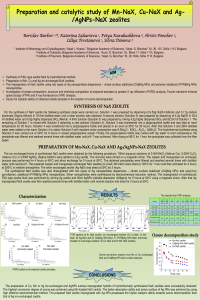
FAU-type zeolite NaX was successfully obtained using hydrothermal synthesis at 90oC for 6 hours. The Mn and Cu ion exchanged NaX zeolites were obtained using 0.4M MnCl2 and 0.1M CuCl2 solutions. After the ion exchange the zeolite powders were thermally treated at 300oC. As well as Ag ion exchanged zeolite NaX and zeolite impregnated with two types of Ag nanoparticles dispersions – citrate surface stabilized (citAg) and polymer stabilized (pAg) nanoparticles. Silver nanoparticles were synthesized by electrochemical reduction method. The changes in phase and chemical composition and structure of obtained zeolite powders before and after ion exchange or impregnation were investigated by Powder X-ray analysis, Infrared spectroscopy and X-ray fluorescence (XRF) analysis. The XRF results determined that NaX zeolite; Mn, Cu, Ag ion exchanged and impregnated with two types Ag nanoparticles zeolite have the elemental composition: Na (16.49; 2.24; 2.48; 11.37; 12.44; 15.54), Al (29.22; 24.80; 23.46; 23.67; 29.08; 28.99), Si (53.91; 40.18; 33.44; 38.04; 57.51; 54.66), Mn (32.67), Cu (34.13), Ag (26.85; 0.53; 0.53) mass%, respectively. The catalytic ability of the prepared Mn, Cu-exchanged NaX and Ag nanoparticles impregnated zeolites were tested in the reaction of ozone decomposition. The results show that Mn, Cu-exchanged NaX and impregnated with Ag demonstrated catalytic ability towards ozone decomposition in comparison with pure zeolite (non-catalytic activity).
References
[1] S. Chandrasekhar, P.N. Pramada, Sintering behaviour of ammonium exchanged low silica zeolites synthesised by two different routes, Ceramics International 27 (3) (2001) 351-361.
[2] C.S. Cundy, P.A. Cox, The Hydrothermal Synthesis of Zeolites: History and Development from the Earliest Days to the Present Time, Chem. Rev., 103 (2003) 663-701.
Keywords
NaX zeolite
ion exchange
silver nanoparticles
ozone decomposition
Manuscript
engproc-070871-done.pdf
Poster
Poster.pdf
Decarbonization challenges and opportunities of power sector in Uzbekistan: A simulation of Turakurgan natural gas-fired combined cycle power plant with exhaust gas recirculation
Macrophytic Vegetation of River Ethiope at Umuaja, Ukwani Local Government Area of Delta State, Nigeria