Event submissions
Published

This submission belongs to the session S3. Food Processes of the event The 2nd International Electronic Conference on Processes
Published date
17 May, 2023
Academic Editor
'%3e%3cpath%20d='M12.6657%2010.9104C12.4185%2010.325%2012.0599%209.79327%2011.6097%209.34482C11.1609%208.89508%2010.6293%208.5365%2010.0442%208.28888C10.0389%208.28626%2010.0337%208.28495%2010.0285%208.28233C10.8446%207.69279%2011.3752%206.73249%2011.3752%205.64904C11.3752%203.8542%209.92103%202.39999%208.1262%202.39999C6.33136%202.39999%204.87715%203.8542%204.87715%205.64904C4.87715%206.73249%205.40774%207.69279%206.22393%208.28364C6.21869%208.28626%206.21345%208.28757%206.20821%208.29019C5.62129%208.5378%205.09463%208.89284%204.64265%209.34613C4.1929%209.79493%203.83432%2010.3266%203.58671%2010.9117C3.34345%2011.4845%203.21226%2012.0987%203.20023%2012.7209C3.19988%2012.7349%203.20233%2012.7488%203.20744%2012.7619C3.21255%2012.7749%203.22022%2012.7867%203.22998%2012.7968C3.23975%2012.8068%203.25142%2012.8147%203.26431%2012.8202C3.2772%2012.8256%203.29105%2012.8284%203.30504%2012.8284H4.09109C4.14874%2012.8284%204.19459%2012.7825%204.1959%2012.7262C4.2221%2011.7148%204.62823%2010.7676%205.34617%2010.0497C6.08899%209.30683%207.0755%208.89808%208.1262%208.89808C9.17689%208.89808%2010.1634%209.30683%2010.9062%2010.0497C11.6242%2010.7676%2012.0303%2011.7148%2012.0565%2012.7262C12.0578%2012.7838%2012.1037%2012.8284%2012.1613%2012.8284H12.9474C12.9613%2012.8284%2012.9752%2012.8256%2012.9881%2012.8202C13.001%2012.8147%2013.0126%2012.8068%2013.0224%2012.7968C13.0322%2012.7867%2013.0398%2012.7749%2013.0449%2012.7619C13.0501%2012.7488%2013.0525%2012.7349%2013.0522%2012.7209C13.0391%2012.0947%2012.9094%2011.4855%2012.6657%2010.9104ZM8.1262%207.9024C7.52486%207.9024%206.9589%207.6679%206.53312%207.24211C6.10733%206.81633%205.87283%206.25037%205.87283%205.64904C5.87283%205.0477%206.10733%204.48174%206.53312%204.05596C6.9589%203.63018%207.52486%203.39567%208.1262%203.39567C8.72753%203.39567%209.29349%203.63018%209.71927%204.05596C10.1451%204.48174%2010.3796%205.0477%2010.3796%205.64904C10.3796%206.25037%2010.1451%206.81633%209.71927%207.24211C9.29349%207.6679%208.72753%207.9024%208.1262%207.9024Z'%20fill='%235D1EE1'/%3e%3c/g%3e%3c/svg%3e) Chi-Fai Chau
Chi-Fai ChauCitation
A. Pérez-Vázquez, P. Barciela, M. Carpena, P. Donn, S. Seyyede-Mansour, Hui Cao, M. Fraga-Corral, Paz Otero, J. Simal-Gandara, M.A. Prieto, L. Cassani, Supercritical fluid extraction as a potential extraction technique for the food industry, in Proceedings of The 2nd International Electronic Conference on Processes, 17 May–31 May 2023, MDPI: Basel, Switzerland, doi: 10.3390/ECP2023-14674
Share
Email
Facebook
Twitter
LinkedIn
Supercritical fluid extraction as a potential extraction technique for the food industry
'%3e%3cpath%20d='M12.6647%2010.9104C12.4176%2010.325%2012.0589%209.7933%2011.6088%209.34485C11.16%208.89511%2010.6283%208.53653%2010.0432%208.28891C10.038%208.28629%2010.0327%208.28498%2010.0275%208.28236C10.8437%207.69282%2011.3743%206.73252%2011.3743%205.64907C11.3743%203.85423%209.92005%202.40002%208.12522%202.40002C6.33038%202.40002%204.87618%203.85423%204.87618%205.64907C4.87618%206.73252%205.40677%207.69282%206.22296%208.28367C6.21772%208.28629%206.21248%208.2876%206.20724%208.29022C5.62031%208.53783%205.09365%208.89287%204.64167%209.34616C4.19192%209.79496%203.83334%2010.3266%203.58573%2010.9117C3.34247%2011.4846%203.21128%2012.0987%203.19925%2012.721C3.1989%2012.735%203.20135%2012.7489%203.20646%2012.7619C3.21157%2012.7749%203.21924%2012.7868%203.22901%2012.7968C3.23877%2012.8068%203.25045%2012.8148%203.26334%2012.8202C3.27623%2012.8256%203.29007%2012.8284%203.30406%2012.8284H4.09012C4.14776%2012.8284%204.19362%2012.7825%204.19493%2012.7262C4.22113%2011.7148%204.62726%2010.7676%205.34519%2010.0497C6.08802%209.30686%207.07452%208.89811%208.12522%208.89811C9.17592%208.89811%2010.1624%209.30686%2010.9052%2010.0497C11.6232%2010.7676%2012.0293%2011.7148%2012.0555%2012.7262C12.0568%2012.7839%2012.1027%2012.8284%2012.1603%2012.8284H12.9464C12.9604%2012.8284%2012.9742%2012.8256%2012.9871%2012.8202C13%2012.8148%2013.0117%2012.8068%2013.0214%2012.7968C13.0312%2012.7868%2013.0389%2012.7749%2013.044%2012.7619C13.0491%2012.7489%2013.0515%2012.735%2013.0512%2012.721C13.0381%2012.0947%2012.9084%2011.4856%2012.6647%2010.9104ZM8.12522%207.90243C7.52388%207.90243%206.95792%207.66793%206.53214%207.24215C6.10636%206.81636%205.87185%206.2504%205.87185%205.64907C5.87185%205.04773%206.10636%204.48177%206.53214%204.05599C6.95792%203.63021%207.52388%203.3957%208.12522%203.3957C8.72655%203.3957%209.29252%203.63021%209.7183%204.05599C10.1441%204.48177%2010.3786%205.04773%2010.3786%205.64907C10.3786%206.2504%2010.1441%206.81636%209.7183%207.24215C9.29252%207.66793%208.72655%207.90243%208.12522%207.90243Z'%20fill='%235D1EE1'/%3e%3c/g%3e%3c/svg%3e)
A. Pérez-Vázquez 1

P. Barciela 1

M. Carpena 1
P. Donn 1
S. Seyyede-Mansour 1
Hui Cao 1
M. Fraga-Corral 1,2

Paz Otero 1,2

J. Simal-Gandara 1

M.A. Prieto 1,2

L. Cassani 1,3
1. 1Universidade de Vigo, Nutrition and Bromatology Group, Department of Analytical Chemistry and Food Science, Faculty of Science, E32004 Ourense, Spain.
2. 2 Centro de Investigação de Montanha (CIMO), Instituto Politécnico de Bragança, Campus de Santa Apolonia, 5300-253 Bragança, Portugal.
3. 3 Instituto de Investigaciones en Ciencia y Tecnología de Materiales, Consejo Nacional de Investigaciones Científicas y Técnicas (INTEMA-CONICET), Colón 10850, Mar del Plata (7600), Argentina
Abstract
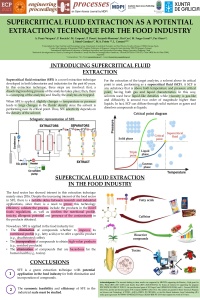
Supercritical fluid extraction (SFE) is a non-conventional extraction technique that that has the potential to be used in the food industry because it can recover both polar and non-polar compounds. This technique is carried out above the critical point of the extraction solvent, allowing for the control and manipulation of different properties such as diffusivity, viscosity, and density. This is possible due to the fluid's changes in pressure and temperature, which cause variations in selectivity and power. This eco-friendly extraction technique has several advantages, including high selectivity due to changes in pressure and temperature, as well as changes in the solvent’s polarity, by adding co-solvents. Thus, optimizing operational conditions is a critical step in achieving the highest yield recovery of the target compound. In this way, the main variables to be considered are temperature, pressure, time, and solvent extraction, and both diffusion and solubilization are processes that have a significant influence on the extraction. SFE has already been used in the food industry due to the benefits of this technique and its suitability for both polar and non-polar compound extraction. For example, the food industry employs this extraction technique in a variety of products, including decaffeinated coffee and tea, low fat products (such as, butter and meat products), and enriched flavor distillated drinks. Furthermore, this technique has been studied for the extraction of bioactive compounds that can be incorporated into food products to increase their nutritional value. Additionally, SFE has the potential to remove toxic compounds such as pesticides in fruits and vegetables and toxins in sea products. The goal of this work is to compile the most recent data on SFE applications in the food industry, thereby providing insight into SFE feasibility in a large-scale process.
Keywords
green extraction technique
supercritical fluid
critical point
bioactive compounds
food application.
Manuscript
engproc-072129-done.pdf
Poster
ECP2023_Poster_Paula_Ana_SFE.pdf
Steam explosion pretreatment of sugarcane bagasse for bioethanol production
Antimicrobial activity of natural extracts: the problematic of mathematical modeling