Event submissions
Published

This submission belongs to the session S1. Environmental and Green Processes of the event The 2nd International Electronic Conference on Processes
Published date
17 May, 2023
Academic Editor
'%3e%3cpath%20d='M12.6657%2010.9104C12.4185%2010.325%2012.0599%209.79327%2011.6097%209.34482C11.1609%208.89508%2010.6293%208.5365%2010.0442%208.28888C10.0389%208.28626%2010.0337%208.28495%2010.0285%208.28233C10.8446%207.69279%2011.3752%206.73249%2011.3752%205.64904C11.3752%203.8542%209.92103%202.39999%208.1262%202.39999C6.33136%202.39999%204.87715%203.8542%204.87715%205.64904C4.87715%206.73249%205.40774%207.69279%206.22393%208.28364C6.21869%208.28626%206.21345%208.28757%206.20821%208.29019C5.62129%208.5378%205.09463%208.89284%204.64265%209.34613C4.1929%209.79493%203.83432%2010.3266%203.58671%2010.9117C3.34345%2011.4845%203.21226%2012.0987%203.20023%2012.7209C3.19988%2012.7349%203.20233%2012.7488%203.20744%2012.7619C3.21255%2012.7749%203.22022%2012.7867%203.22998%2012.7968C3.23975%2012.8068%203.25142%2012.8147%203.26431%2012.8202C3.2772%2012.8256%203.29105%2012.8284%203.30504%2012.8284H4.09109C4.14874%2012.8284%204.19459%2012.7825%204.1959%2012.7262C4.2221%2011.7148%204.62823%2010.7676%205.34617%2010.0497C6.08899%209.30683%207.0755%208.89808%208.1262%208.89808C9.17689%208.89808%2010.1634%209.30683%2010.9062%2010.0497C11.6242%2010.7676%2012.0303%2011.7148%2012.0565%2012.7262C12.0578%2012.7838%2012.1037%2012.8284%2012.1613%2012.8284H12.9474C12.9613%2012.8284%2012.9752%2012.8256%2012.9881%2012.8202C13.001%2012.8147%2013.0126%2012.8068%2013.0224%2012.7968C13.0322%2012.7867%2013.0398%2012.7749%2013.0449%2012.7619C13.0501%2012.7488%2013.0525%2012.7349%2013.0522%2012.7209C13.0391%2012.0947%2012.9094%2011.4855%2012.6657%2010.9104ZM8.1262%207.9024C7.52486%207.9024%206.9589%207.6679%206.53312%207.24211C6.10733%206.81633%205.87283%206.25037%205.87283%205.64904C5.87283%205.0477%206.10733%204.48174%206.53312%204.05596C6.9589%203.63018%207.52486%203.39567%208.1262%203.39567C8.72753%203.39567%209.29349%203.63018%209.71927%204.05596C10.1451%204.48174%2010.3796%205.0477%2010.3796%205.64904C10.3796%206.25037%2010.1451%206.81633%209.71927%207.24211C9.29349%207.6679%208.72753%207.9024%208.1262%207.9024Z'%20fill='%235D1EE1'/%3e%3c/g%3e%3c/svg%3e) Antoni Sánchez
Antoni SánchezCitation
Joanna Żandarek, Małgorzata Starek, Monika Dąbrowska, Evaluation of potential ecotoxicity of cefepime phototransformation products, in Proceedings of The 2nd International Electronic Conference on Processes, 17 May–31 May 2023, MDPI: Basel, Switzerland, doi: 10.3390/ECP2023-14678
Share
Email
Facebook
Twitter
LinkedIn
Evaluation of potential ecotoxicity of cefepime phototransformation products
'%3e%3cpath%20d='M12.6647%2010.9104C12.4176%2010.325%2012.0589%209.7933%2011.6088%209.34485C11.16%208.89511%2010.6283%208.53653%2010.0432%208.28891C10.038%208.28629%2010.0327%208.28498%2010.0275%208.28236C10.8437%207.69282%2011.3743%206.73252%2011.3743%205.64907C11.3743%203.85423%209.92005%202.40002%208.12522%202.40002C6.33038%202.40002%204.87618%203.85423%204.87618%205.64907C4.87618%206.73252%205.40677%207.69282%206.22296%208.28367C6.21772%208.28629%206.21248%208.2876%206.20724%208.29022C5.62031%208.53783%205.09365%208.89287%204.64167%209.34616C4.19192%209.79496%203.83334%2010.3266%203.58573%2010.9117C3.34247%2011.4846%203.21128%2012.0987%203.19925%2012.721C3.1989%2012.735%203.20135%2012.7489%203.20646%2012.7619C3.21157%2012.7749%203.21924%2012.7868%203.22901%2012.7968C3.23877%2012.8068%203.25045%2012.8148%203.26334%2012.8202C3.27623%2012.8256%203.29007%2012.8284%203.30406%2012.8284H4.09012C4.14776%2012.8284%204.19362%2012.7825%204.19493%2012.7262C4.22113%2011.7148%204.62726%2010.7676%205.34519%2010.0497C6.08802%209.30686%207.07452%208.89811%208.12522%208.89811C9.17592%208.89811%2010.1624%209.30686%2010.9052%2010.0497C11.6232%2010.7676%2012.0293%2011.7148%2012.0555%2012.7262C12.0568%2012.7839%2012.1027%2012.8284%2012.1603%2012.8284H12.9464C12.9604%2012.8284%2012.9742%2012.8256%2012.9871%2012.8202C13%2012.8148%2013.0117%2012.8068%2013.0214%2012.7968C13.0312%2012.7868%2013.0389%2012.7749%2013.044%2012.7619C13.0491%2012.7489%2013.0515%2012.735%2013.0512%2012.721C13.0381%2012.0947%2012.9084%2011.4856%2012.6647%2010.9104ZM8.12522%207.90243C7.52388%207.90243%206.95792%207.66793%206.53214%207.24215C6.10636%206.81636%205.87185%206.2504%205.87185%205.64907C5.87185%205.04773%206.10636%204.48177%206.53214%204.05599C6.95792%203.63021%207.52388%203.3957%208.12522%203.3957C8.72655%203.3957%209.29252%203.63021%209.7183%204.05599C10.1441%204.48177%2010.3786%205.04773%2010.3786%205.64907C10.3786%206.2504%2010.1441%206.81636%209.7183%207.24215C9.29252%207.66793%208.72655%207.90243%208.12522%207.90243Z'%20fill='%235D1EE1'/%3e%3c/g%3e%3c/svg%3e)
Joanna Żandarek 1,2
Małgorzata Starek 1
Monika Dąbrowska 1
1. Department of Inorganic and Analytical Chemistry, Faculty of Pharmacy, Medical College, Jagiellonian University, 9 Medyczna St, 30-688 Kraków, Poland
2. Jagiellonian University, Medical College, Doctoral School of Medical and Health Sciences, 16 św. Łazarza St, 31-530 Kraków, Poland
Abstract
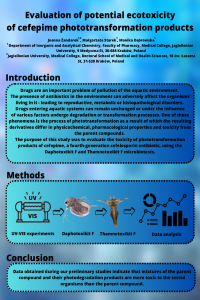
Drugs are an important problem of pollution of the aquatic environment. Global drugs consumption, their use in human and veterinary medicine and agriculture are among the main sources of environmental pollution. Among the detected drugs, antibiotics are an important group, as they have high biological activity, and most of them dissolve well in water. The presence of antibiotics in the environment can adversely affect the organisms living in it - leading to reproductive, metabolic or histopathological disorders.
Drugs entering aquatic systems can remain unchanged or under the influence of various factors undergo degradation or transformation processes. One of these phenomena is the process of phototransformation as a result of which the resulting derivatives differ in physicochemical, pharmacological properties and toxicity from the parent compounds. The purpose of this preliminary study was to determine the potential ecotoxicity of the degradation products of cefepime, 4th generation cephalosporins. Toxicity was assessed using in silico methods, and then microbiotests were performed: Daphotoxikit and Thamnotoxikit. The used tests allow for a simple and quick assessment of how the tested mixtures of substances affect the survival of bioindicators. In addition, there is no need for continuous culture of test organisms. The tests do not require Ethics Committee approval and comply with the 3Rs principle (Reduction, Replacement, Refinement), which aims to reduce the use of laboratory animals. Data obtained during our preliminary studies indicate that mixtures of the parent compound and their photodegradation products are more toxic to the tested organisms than the parent compound.
Keywords
phototransformation
microbiotests
antibiotics
Manuscript
engproc-072047-done.pdf
Poster
poster Evaluation of potential ecotoxicity of cefepime phototransformation products.pdf
ENHANCED REMOVAL OF Cr (VI) FROM WASTEWATER WITH GREEN AND LOW-COST NANOMATERIAL USING FUZZY INFERENCE SYSTEMS (FIS) AND ARTIFICIAL NEURAL NETWORKS (ANN)
Structure-Based Functional Annotation of an Uncharacterized Conserved Protein of Acinetobacter baumannii: An in-silico Approach