Event submissions
Published

This submission belongs to the session S3. Food Processes of the event The 2nd International Electronic Conference on Processes
Published date
19 May, 2023
Academic Editor
'%3e%3cpath%20d='M12.6657%2010.9104C12.4185%2010.325%2012.0599%209.79327%2011.6097%209.34482C11.1609%208.89508%2010.6293%208.5365%2010.0442%208.28888C10.0389%208.28626%2010.0337%208.28495%2010.0285%208.28233C10.8446%207.69279%2011.3752%206.73249%2011.3752%205.64904C11.3752%203.8542%209.92103%202.39999%208.1262%202.39999C6.33136%202.39999%204.87715%203.8542%204.87715%205.64904C4.87715%206.73249%205.40774%207.69279%206.22393%208.28364C6.21869%208.28626%206.21345%208.28757%206.20821%208.29019C5.62129%208.5378%205.09463%208.89284%204.64265%209.34613C4.1929%209.79493%203.83432%2010.3266%203.58671%2010.9117C3.34345%2011.4845%203.21226%2012.0987%203.20023%2012.7209C3.19988%2012.7349%203.20233%2012.7488%203.20744%2012.7619C3.21255%2012.7749%203.22022%2012.7867%203.22998%2012.7968C3.23975%2012.8068%203.25142%2012.8147%203.26431%2012.8202C3.2772%2012.8256%203.29105%2012.8284%203.30504%2012.8284H4.09109C4.14874%2012.8284%204.19459%2012.7825%204.1959%2012.7262C4.2221%2011.7148%204.62823%2010.7676%205.34617%2010.0497C6.08899%209.30683%207.0755%208.89808%208.1262%208.89808C9.17689%208.89808%2010.1634%209.30683%2010.9062%2010.0497C11.6242%2010.7676%2012.0303%2011.7148%2012.0565%2012.7262C12.0578%2012.7838%2012.1037%2012.8284%2012.1613%2012.8284H12.9474C12.9613%2012.8284%2012.9752%2012.8256%2012.9881%2012.8202C13.001%2012.8147%2013.0126%2012.8068%2013.0224%2012.7968C13.0322%2012.7867%2013.0398%2012.7749%2013.0449%2012.7619C13.0501%2012.7488%2013.0525%2012.7349%2013.0522%2012.7209C13.0391%2012.0947%2012.9094%2011.4855%2012.6657%2010.9104ZM8.1262%207.9024C7.52486%207.9024%206.9589%207.6679%206.53312%207.24211C6.10733%206.81633%205.87283%206.25037%205.87283%205.64904C5.87283%205.0477%206.10733%204.48174%206.53312%204.05596C6.9589%203.63018%207.52486%203.39567%208.1262%203.39567C8.72753%203.39567%209.29349%203.63018%209.71927%204.05596C10.1451%204.48174%2010.3796%205.0477%2010.3796%205.64904C10.3796%206.25037%2010.1451%206.81633%209.71927%207.24211C9.29349%207.6679%208.72753%207.9024%208.1262%207.9024Z'%20fill='%235D1EE1'/%3e%3c/g%3e%3c/svg%3e) Chi-Fai Chau
Chi-Fai ChauCitation
Sepidar Seyyedi-Mansour, Pauline Donn, Paula Garcia-Oliveira, Javier Echave, Franklin Chamorro, Antia G. Pereira, Aurora Silva, Ana Perez-Vazquez, Jesus Simal-Gandara, Miguel A. Prieto, Leila Roufegari-nejad, Optimizing the thermal processing of honey by studying the physicochemical properties and its hydroxymethylfurfural content, in Proceedings of The 2nd International Electronic Conference on Processes, 17 May–31 May 2023, MDPI: Basel, Switzerland, doi: 10.3390/ECP2023-14713
Share
Email
Facebook
Twitter
LinkedIn
Optimizing the thermal processing of honey by studying the physicochemical properties and its hydroxymethylfurfural content
'%3e%3cpath%20d='M12.6647%2010.9104C12.4176%2010.325%2012.0589%209.7933%2011.6088%209.34485C11.16%208.89511%2010.6283%208.53653%2010.0432%208.28891C10.038%208.28629%2010.0327%208.28498%2010.0275%208.28236C10.8437%207.69282%2011.3743%206.73252%2011.3743%205.64907C11.3743%203.85423%209.92005%202.40002%208.12522%202.40002C6.33038%202.40002%204.87618%203.85423%204.87618%205.64907C4.87618%206.73252%205.40677%207.69282%206.22296%208.28367C6.21772%208.28629%206.21248%208.2876%206.20724%208.29022C5.62031%208.53783%205.09365%208.89287%204.64167%209.34616C4.19192%209.79496%203.83334%2010.3266%203.58573%2010.9117C3.34247%2011.4846%203.21128%2012.0987%203.19925%2012.721C3.1989%2012.735%203.20135%2012.7489%203.20646%2012.7619C3.21157%2012.7749%203.21924%2012.7868%203.22901%2012.7968C3.23877%2012.8068%203.25045%2012.8148%203.26334%2012.8202C3.27623%2012.8256%203.29007%2012.8284%203.30406%2012.8284H4.09012C4.14776%2012.8284%204.19362%2012.7825%204.19493%2012.7262C4.22113%2011.7148%204.62726%2010.7676%205.34519%2010.0497C6.08802%209.30686%207.07452%208.89811%208.12522%208.89811C9.17592%208.89811%2010.1624%209.30686%2010.9052%2010.0497C11.6232%2010.7676%2012.0293%2011.7148%2012.0555%2012.7262C12.0568%2012.7839%2012.1027%2012.8284%2012.1603%2012.8284H12.9464C12.9604%2012.8284%2012.9742%2012.8256%2012.9871%2012.8202C13%2012.8148%2013.0117%2012.8068%2013.0214%2012.7968C13.0312%2012.7868%2013.0389%2012.7749%2013.044%2012.7619C13.0491%2012.7489%2013.0515%2012.735%2013.0512%2012.721C13.0381%2012.0947%2012.9084%2011.4856%2012.6647%2010.9104ZM8.12522%207.90243C7.52388%207.90243%206.95792%207.66793%206.53214%207.24215C6.10636%206.81636%205.87185%206.2504%205.87185%205.64907C5.87185%205.04773%206.10636%204.48177%206.53214%204.05599C6.95792%203.63021%207.52388%203.3957%208.12522%203.3957C8.72655%203.3957%209.29252%203.63021%209.7183%204.05599C10.1441%204.48177%2010.3786%205.04773%2010.3786%205.64907C10.3786%206.2504%2010.1441%206.81636%209.7183%207.24215C9.29252%207.66793%208.72655%207.90243%208.12522%207.90243Z'%20fill='%235D1EE1'/%3e%3c/g%3e%3c/svg%3e)
Sepidar Seyyedi-Mansour 1
Pauline Donn 1
Paula Garcia-Oliveira 2,3

Javier Echave 1

Franklin Chamorro 2

Antia G. Pereira 2,3

Aurora Silva 2,4
Ana Perez-Vazquez 2

Jesus Simal-Gandara 2

Miguel A. Prieto 2,3
Leila Roufegari-nejad 5
1. Nutrition and Bromatology Group, Department of Analytical and Food Chemistry, Faculty of Food Science and Technology, University of Vigo, Ourense Campus, E32004 Ourense, Spain
2. Nutrition and Bromatology Group, Department of Analytical and Food Chemistry, Faculty of Food Science and Technology, University of Vigo, Ourense Campus, E32004 Ourense, Spain.
3. Centro de Investigação de Montanha (CIMO), Instituto Politécnico de Bragança, Campus de Santa Apolonia, 5300-253 Bragança, Portugal.
4. REQUIMTE/LAQV, Instituto Superior de Engenharia do Porto, Instituto Politécnico do Porto, Rua Dr António Bernardino de Almeida 431, 4200-072 Porto, Portugal.
5. Department of Food Science and Technology, Azad University, Tabriz branch, Iran Basmenj road, 5157944533, Tabriz, Iran.
Abstract
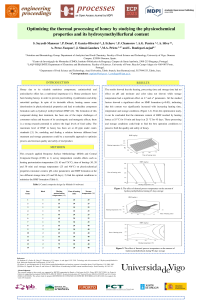
Hydroxymethylfurfural (HMF) is one of the compounds formed due to the heat treatment and storage of honey. The maximum level of HMF in honey has been set at 40 ppm under codex standards. In this study, the effects of heating temperature (55, 65 and 75°C), heating time (10, 20 and 30 min) as well as storage temperature (25 and 40°C) were assayed during the three months of storage based on response surface methodology (RSM). The effect of the above-mentioned variables on physicochemical properties (Lab color factors, pH and moisture) and the samples' HMF content (based on spectrophotometric technique) was studied. The prediction model of each treatment was calculated. The outcomes during the 45 and 90 days of storage were analyzed. Results showed that temperature, time of heat treatment and storage duration did not affect pH, moisture content and color; while storage temperature had a significant effect on L* and a*. HMF content was affected by all the variables, so its rate increased significantly with increasing thermal process and storage time. Among the studied samples, HMF content exceeded the standard limit in the sample heated at 75°C for 20 min and kept at 40°C for 90 days. The optimal level of HMF resulted by heating at 55°C for 10 min and under the storage temperature of 25°C for 45 days.
Keywords
Honey
Hydroxymethylfurfural
Response surface methodology
Storage
Thermal Process.
Manuscript
sciforum-072134.pdf
Poster
ECP2023_Poster_Sepidar_2.pdf
Supercritical Fluid CO2 extraction technology to produce an innovative healthy product from almond wastes.
Sustainable Engineering of an Outdoor Jacket Made from Waste in 2030