Event submissions
Published

This submission belongs to the session S1. Environmental and Green Processes of the event The 2nd International Electronic Conference on Processes
Published date
19 May, 2023
Academic Editor
'%3e%3cpath%20d='M12.6657%2010.9104C12.4185%2010.325%2012.0599%209.79327%2011.6097%209.34482C11.1609%208.89508%2010.6293%208.5365%2010.0442%208.28888C10.0389%208.28626%2010.0337%208.28495%2010.0285%208.28233C10.8446%207.69279%2011.3752%206.73249%2011.3752%205.64904C11.3752%203.8542%209.92103%202.39999%208.1262%202.39999C6.33136%202.39999%204.87715%203.8542%204.87715%205.64904C4.87715%206.73249%205.40774%207.69279%206.22393%208.28364C6.21869%208.28626%206.21345%208.28757%206.20821%208.29019C5.62129%208.5378%205.09463%208.89284%204.64265%209.34613C4.1929%209.79493%203.83432%2010.3266%203.58671%2010.9117C3.34345%2011.4845%203.21226%2012.0987%203.20023%2012.7209C3.19988%2012.7349%203.20233%2012.7488%203.20744%2012.7619C3.21255%2012.7749%203.22022%2012.7867%203.22998%2012.7968C3.23975%2012.8068%203.25142%2012.8147%203.26431%2012.8202C3.2772%2012.8256%203.29105%2012.8284%203.30504%2012.8284H4.09109C4.14874%2012.8284%204.19459%2012.7825%204.1959%2012.7262C4.2221%2011.7148%204.62823%2010.7676%205.34617%2010.0497C6.08899%209.30683%207.0755%208.89808%208.1262%208.89808C9.17689%208.89808%2010.1634%209.30683%2010.9062%2010.0497C11.6242%2010.7676%2012.0303%2011.7148%2012.0565%2012.7262C12.0578%2012.7838%2012.1037%2012.8284%2012.1613%2012.8284H12.9474C12.9613%2012.8284%2012.9752%2012.8256%2012.9881%2012.8202C13.001%2012.8147%2013.0126%2012.8068%2013.0224%2012.7968C13.0322%2012.7867%2013.0398%2012.7749%2013.0449%2012.7619C13.0501%2012.7488%2013.0525%2012.7349%2013.0522%2012.7209C13.0391%2012.0947%2012.9094%2011.4855%2012.6657%2010.9104ZM8.1262%207.9024C7.52486%207.9024%206.9589%207.6679%206.53312%207.24211C6.10733%206.81633%205.87283%206.25037%205.87283%205.64904C5.87283%205.0477%206.10733%204.48174%206.53312%204.05596C6.9589%203.63018%207.52486%203.39567%208.1262%203.39567C8.72753%203.39567%209.29349%203.63018%209.71927%204.05596C10.1451%204.48174%2010.3796%205.0477%2010.3796%205.64904C10.3796%206.25037%2010.1451%206.81633%209.71927%207.24211C9.29349%207.6679%208.72753%207.9024%208.1262%207.9024Z'%20fill='%235D1EE1'/%3e%3c/g%3e%3c/svg%3e) Jui-Yuan Lee
Jui-Yuan LeeCitation
Laura Marterer, Nora Torst, Oussema Ahmed Haddar, Lilia Sabantina, Sustainable Engineering of an Outdoor Jacket Made from Waste in 2030, in Proceedings of The 2nd International Electronic Conference on Processes, 17 May–31 May 2023, MDPI: Basel, Switzerland, doi: 10.3390/ECP2023-14715
Share
Email
Facebook
Twitter
LinkedIn
Sustainable Engineering of an Outdoor Jacket Made from Waste in 2030
'%3e%3cpath%20d='M12.6647%2010.9104C12.4176%2010.325%2012.0589%209.7933%2011.6088%209.34485C11.16%208.89511%2010.6283%208.53653%2010.0432%208.28891C10.038%208.28629%2010.0327%208.28498%2010.0275%208.28236C10.8437%207.69282%2011.3743%206.73252%2011.3743%205.64907C11.3743%203.85423%209.92005%202.40002%208.12522%202.40002C6.33038%202.40002%204.87618%203.85423%204.87618%205.64907C4.87618%206.73252%205.40677%207.69282%206.22296%208.28367C6.21772%208.28629%206.21248%208.2876%206.20724%208.29022C5.62031%208.53783%205.09365%208.89287%204.64167%209.34616C4.19192%209.79496%203.83334%2010.3266%203.58573%2010.9117C3.34247%2011.4846%203.21128%2012.0987%203.19925%2012.721C3.1989%2012.735%203.20135%2012.7489%203.20646%2012.7619C3.21157%2012.7749%203.21924%2012.7868%203.22901%2012.7968C3.23877%2012.8068%203.25045%2012.8148%203.26334%2012.8202C3.27623%2012.8256%203.29007%2012.8284%203.30406%2012.8284H4.09012C4.14776%2012.8284%204.19362%2012.7825%204.19493%2012.7262C4.22113%2011.7148%204.62726%2010.7676%205.34519%2010.0497C6.08802%209.30686%207.07452%208.89811%208.12522%208.89811C9.17592%208.89811%2010.1624%209.30686%2010.9052%2010.0497C11.6232%2010.7676%2012.0293%2011.7148%2012.0555%2012.7262C12.0568%2012.7839%2012.1027%2012.8284%2012.1603%2012.8284H12.9464C12.9604%2012.8284%2012.9742%2012.8256%2012.9871%2012.8202C13%2012.8148%2013.0117%2012.8068%2013.0214%2012.7968C13.0312%2012.7868%2013.0389%2012.7749%2013.044%2012.7619C13.0491%2012.7489%2013.0515%2012.735%2013.0512%2012.721C13.0381%2012.0947%2012.9084%2011.4856%2012.6647%2010.9104ZM8.12522%207.90243C7.52388%207.90243%206.95792%207.66793%206.53214%207.24215C6.10636%206.81636%205.87185%206.2504%205.87185%205.64907C5.87185%205.04773%206.10636%204.48177%206.53214%204.05599C6.95792%203.63021%207.52388%203.3957%208.12522%203.3957C8.72655%203.3957%209.29252%203.63021%209.7183%204.05599C10.1441%204.48177%2010.3786%205.04773%2010.3786%205.64907C10.3786%206.2504%2010.1441%206.81636%209.7183%207.24215C9.29252%207.66793%208.72655%207.90243%208.12522%207.90243Z'%20fill='%235D1EE1'/%3e%3c/g%3e%3c/svg%3e)
Laura Marterer 1
Nora Torst 1
Oussema Ahmed Haddar 1

Lilia Sabantina 2
1. Niederrhein University of Applied Sciences, Department of Textile and Clothing Management, 41065,
Moenchengladbach, Germany
2. Department of Clothing Technology and Garment Engineering, Berlin University of Applied Sciences-HTW Berlin, 12459 Berlin, Germany
Abstract
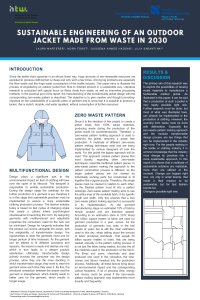
Due to the linear nature of the textile industry, vast amounts of non-renewable resources are utilized to manufacture low-cost clothing that is only worn a few times, leading to significant issues such as fiber waste and excessive water consumption. This study endeavors to demonstrate the sustainable production of an outdoor jacket, from fiber to finished product. A literature review is conducted, with a particular emphasis on utilizing waste-derived fibers and innovative processing techniques. The practical section of the report outlines the creation of a transformable jacket design with a zero-waste pattern. The goal is to inspire innovative thinking on sustainability in garment production and showcase the possibility of producing a stylish, long-lasting, and water-resistant jacket without further resource consumption. The primary aim of this research was to investigate the potential for upcycling waste materials to create a fashionable outdoor jacket. The focus is on using innovative, non-toxic materials sourced from waste and recycled products from the textile and other industries that are available in sufficient quantities. Moreover, the paper presents water-conserving, innovative processes and environmentally-friendly textile finishing materials. Despite the numerous challenges facing the fashion industry, the focus was placed on repurposing waste materials generated by the textile industry or other sectors. As demonstrated in this study, the production of such a sustainable jacket is nearly attainable. Although innovative processing techniques that minimize water and energy consumption and eliminate wastewater discharge are not yet widely available, a range of sustainable solutions is possible. Not only can small, sustainable brands make a difference, but even fast fashion companies can begin to effect change now.
The paper comprises a theoretical and practical section. The former outlines the materials and processes used to manufacture the outdoor jacket, while the latter concentrates on the actual implementation. One of the researchers created the design and zero-waste pattern for the jacket, which was then sewn in parts to demonstrate the efficacy of the transformable design. The goal was to create a stylish and practical outdoor jacket that could be worn in various weather conditions and seasons, thanks to its adaptable design. The final product was inspired by current trends, with the aim of introducing the jacket to the market. The intention was to create a garment for everyday use that would be sustainable, durable, and versatile, thanks to the transformable aspect of the design.
Keywords
Sustainable engineering
textiles
clothing
zero-waste concept
sustainable jacket,
Manuscript
engproc-071021-done.pdf
Poster
Poster_Sustainable Engineering of an Outdoor Jacket Made from Waste in 2030.pdf
Optimizing the thermal processing of honey by studying the physicochemical properties and its hydroxymethylfurfural content
The Potential of Algae for Biofuel Production as a Sustainable and Renewable Bioresource