Event submissions
EventsMOL2NET'23, Conference on Molecular, Biomed., Comput. & Network Science and Engineering, 9th ed.
Published
This submission belongs to the session 01. CHEMBIO.INFO-09: Cheminfo., Chemom., Comput. Quantum Chem. & Bioinfo. Congress München, GR-Chapel Hill, USA, 2023. of the event MOL2NET'23, Conference on Molecular, Biomed., Comput. & Network Science and Engineering, 9th ed.
Published date
08 Jul, 2023
Academic Editor
'%3e%3cpath%20d='M12.6657%2010.9104C12.4185%2010.325%2012.0599%209.79327%2011.6097%209.34482C11.1609%208.89508%2010.6293%208.5365%2010.0442%208.28888C10.0389%208.28626%2010.0337%208.28495%2010.0285%208.28233C10.8446%207.69279%2011.3752%206.73249%2011.3752%205.64904C11.3752%203.8542%209.92103%202.39999%208.1262%202.39999C6.33136%202.39999%204.87715%203.8542%204.87715%205.64904C4.87715%206.73249%205.40774%207.69279%206.22393%208.28364C6.21869%208.28626%206.21345%208.28757%206.20821%208.29019C5.62129%208.5378%205.09463%208.89284%204.64265%209.34613C4.1929%209.79493%203.83432%2010.3266%203.58671%2010.9117C3.34345%2011.4845%203.21226%2012.0987%203.20023%2012.7209C3.19988%2012.7349%203.20233%2012.7488%203.20744%2012.7619C3.21255%2012.7749%203.22022%2012.7867%203.22998%2012.7968C3.23975%2012.8068%203.25142%2012.8147%203.26431%2012.8202C3.2772%2012.8256%203.29105%2012.8284%203.30504%2012.8284H4.09109C4.14874%2012.8284%204.19459%2012.7825%204.1959%2012.7262C4.2221%2011.7148%204.62823%2010.7676%205.34617%2010.0497C6.08899%209.30683%207.0755%208.89808%208.1262%208.89808C9.17689%208.89808%2010.1634%209.30683%2010.9062%2010.0497C11.6242%2010.7676%2012.0303%2011.7148%2012.0565%2012.7262C12.0578%2012.7838%2012.1037%2012.8284%2012.1613%2012.8284H12.9474C12.9613%2012.8284%2012.9752%2012.8256%2012.9881%2012.8202C13.001%2012.8147%2013.0126%2012.8068%2013.0224%2012.7968C13.0322%2012.7867%2013.0398%2012.7749%2013.0449%2012.7619C13.0501%2012.7488%2013.0525%2012.7349%2013.0522%2012.7209C13.0391%2012.0947%2012.9094%2011.4855%2012.6657%2010.9104ZM8.1262%207.9024C7.52486%207.9024%206.9589%207.6679%206.53312%207.24211C6.10733%206.81633%205.87283%206.25037%205.87283%205.64904C5.87283%205.0477%206.10733%204.48174%206.53312%204.05596C6.9589%203.63018%207.52486%203.39567%208.1262%203.39567C8.72753%203.39567%209.29349%203.63018%209.71927%204.05596C10.1451%204.48174%2010.3796%205.0477%2010.3796%205.64904C10.3796%206.25037%2010.1451%206.81633%209.71927%207.24211C9.29349%207.6679%208.72753%207.9024%208.1262%207.9024Z'%20fill='%235D1EE1'/%3e%3c/g%3e%3c/svg%3e) mol2net team
mol2net teamCitation
Augustine Chidera Ugwu, Ikenna Frank Ezema, Victor Chukwuebuka Akwu, Obinna Kenneth Didigwu, Jude Ebuka Ogbonna, Charles Okeke Nnadi, In Silico Insights into the Inhibitory Activity of Prodigiosin against Tumour Cells Targeting the Tyrosine Kinases Receptors, in Proceedings of MOL2NET'23, Conference on Molecular, Biomed., Comput. & Network Science and Engineering, 9th ed., 25 December–31 December 2023, MDPI: Basel, Switzerland
Share
Email
Facebook
Twitter
LinkedIn
In Silico Insights into the Inhibitory Activity of Prodigiosin against Tumour Cells Targeting the Tyrosine Kinases Receptors
'%3e%3cpath%20d='M12.6647%2010.9104C12.4176%2010.325%2012.0589%209.7933%2011.6088%209.34485C11.16%208.89511%2010.6283%208.53653%2010.0432%208.28891C10.038%208.28629%2010.0327%208.28498%2010.0275%208.28236C10.8437%207.69282%2011.3743%206.73252%2011.3743%205.64907C11.3743%203.85423%209.92005%202.40002%208.12522%202.40002C6.33038%202.40002%204.87618%203.85423%204.87618%205.64907C4.87618%206.73252%205.40677%207.69282%206.22296%208.28367C6.21772%208.28629%206.21248%208.2876%206.20724%208.29022C5.62031%208.53783%205.09365%208.89287%204.64167%209.34616C4.19192%209.79496%203.83334%2010.3266%203.58573%2010.9117C3.34247%2011.4846%203.21128%2012.0987%203.19925%2012.721C3.1989%2012.735%203.20135%2012.7489%203.20646%2012.7619C3.21157%2012.7749%203.21924%2012.7868%203.22901%2012.7968C3.23877%2012.8068%203.25045%2012.8148%203.26334%2012.8202C3.27623%2012.8256%203.29007%2012.8284%203.30406%2012.8284H4.09012C4.14776%2012.8284%204.19362%2012.7825%204.19493%2012.7262C4.22113%2011.7148%204.62726%2010.7676%205.34519%2010.0497C6.08802%209.30686%207.07452%208.89811%208.12522%208.89811C9.17592%208.89811%2010.1624%209.30686%2010.9052%2010.0497C11.6232%2010.7676%2012.0293%2011.7148%2012.0555%2012.7262C12.0568%2012.7839%2012.1027%2012.8284%2012.1603%2012.8284H12.9464C12.9604%2012.8284%2012.9742%2012.8256%2012.9871%2012.8202C13%2012.8148%2013.0117%2012.8068%2013.0214%2012.7968C13.0312%2012.7868%2013.0389%2012.7749%2013.044%2012.7619C13.0491%2012.7489%2013.0515%2012.735%2013.0512%2012.721C13.0381%2012.0947%2012.9084%2011.4856%2012.6647%2010.9104ZM8.12522%207.90243C7.52388%207.90243%206.95792%207.66793%206.53214%207.24215C6.10636%206.81636%205.87185%206.2504%205.87185%205.64907C5.87185%205.04773%206.10636%204.48177%206.53214%204.05599C6.95792%203.63021%207.52388%203.3957%208.12522%203.3957C8.72655%203.3957%209.29252%203.63021%209.7183%204.05599C10.1441%204.48177%2010.3786%205.04773%2010.3786%205.64907C10.3786%206.2504%2010.1441%206.81636%209.7183%207.24215C9.29252%207.66793%208.72655%207.90243%208.12522%207.90243Z'%20fill='%235D1EE1'/%3e%3c/g%3e%3c/svg%3e)
Augustine Chidera Ugwu 1
Ikenna Frank Ezema 1
Victor Chukwuebuka Akwu 1
Obinna Kenneth Didigwu 1
Jude Ebuka Ogbonna 2

Charles Okeke Nnadi 1,3
1. Department of Pharmaceutical and Medicinal Chemistry, Faculty of Pharmaceutical Sciences, University of Nigeria Nsukka, 410001 Enugu State, Nigeria
2. Department of Pharmaceutical and Medicinal Chemistry, Faculty of Pharmaceutical Sciences, University of Nigeria, Nsukka, 410001, Enugu State, Nigeria
3. Department of Pharmaceutical Chemistry, Faculty of Pharmacy, Madonna University, Elele, Nigeria
Abstract
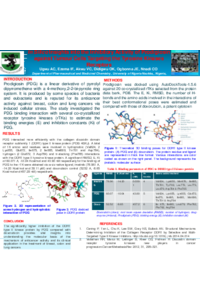
Prodigiosin (PDG) is a linear derivative of pyrrolyl dipyrromethene with a 4-methoxy,2-2-bi-pyrrole ring system. It is produced by some species of bacteria and eubacteria and is reputed for its anticancer activity against breast, colon and lung cancers via induced cellular stress. The study investigated the PDG binding interaction with several co-crystallized receptor tyrosine kinases (rTKs) to estimate the binding energies (E) and inhibition constants (Ki) of PDG. Prodigiosin was docked using AutoDock4.2 against 20 co-crystallized rTKs selected from the protein data bank, PDB. The E, Ki, RMSD, the number of H-bonds and the amino acids involved in the interactions of their best conformational poses were estimated and compared with those of doxorubicin, a potent cytotoxic agent. Comparatively, PDG interacted more efficiently with the collagen discoidin domain receptor subfamily 1 (DDR1) type II kinase protein (PDB: 4BKJ). A total of 16 amino acid residues were involved in hydrophobic (Val624, 2 Lys655, Glu672, Ile675, 2 Ile685, Met699, Thr701 and Asp784), hydrogen (2 Glu672, 3 Asp784) and π-stacking (Phe785) interactions with the DDR1 type II tyrosine kinase protein. A significant RMSD, E, Ki of 60.071 A, -10.04 Kcal/mol and 43.90 nM respectively for the binding of PDG to the rTK were obtained vis-a-viz native ligand, imatinib (78.961 A, -14.20 Kcal/mol and 39.11 ρM) and doxorubicin control (52.52 A, -8.65 Kcal/mol and 457.29 nM) respectively. The significantly higher inhibition of the DDR1 type II kinase protein by PDG compared with doxorubicin provides vital insights into understanding the molecular basis of the mechanism of anticancer activity and its clinical application in the treatment of breast, colon and lung cancers.
Keywords
Tyrosine kinase
Prodigiosin
inhibition constant
Binding energy
hydrogen bonding
Manuscript
Mol2Net-2023-MS.pdf
Poster
Mol2Net-2023.pdf
Cyclosporine A changes the expression profile of genes and proteins related to the JAK/STAT signaling pathway in keratinocytes treated with lipopolysaccharide A
Medical Image Segmentation based on Deep Learning: A Review