Event submissions
Published
This submission belongs to the session S2. Mechanism of action and/or pathophysiology of toxins of the event The 2nd International Electronic Conference on Toxins
Published date
14 Jul, 2023
Academic Editor
'%3e%3cpath%20d='M12.6657%2010.9104C12.4185%2010.325%2012.0599%209.79327%2011.6097%209.34482C11.1609%208.89508%2010.6293%208.5365%2010.0442%208.28888C10.0389%208.28626%2010.0337%208.28495%2010.0285%208.28233C10.8446%207.69279%2011.3752%206.73249%2011.3752%205.64904C11.3752%203.8542%209.92103%202.39999%208.1262%202.39999C6.33136%202.39999%204.87715%203.8542%204.87715%205.64904C4.87715%206.73249%205.40774%207.69279%206.22393%208.28364C6.21869%208.28626%206.21345%208.28757%206.20821%208.29019C5.62129%208.5378%205.09463%208.89284%204.64265%209.34613C4.1929%209.79493%203.83432%2010.3266%203.58671%2010.9117C3.34345%2011.4845%203.21226%2012.0987%203.20023%2012.7209C3.19988%2012.7349%203.20233%2012.7488%203.20744%2012.7619C3.21255%2012.7749%203.22022%2012.7867%203.22998%2012.7968C3.23975%2012.8068%203.25142%2012.8147%203.26431%2012.8202C3.2772%2012.8256%203.29105%2012.8284%203.30504%2012.8284H4.09109C4.14874%2012.8284%204.19459%2012.7825%204.1959%2012.7262C4.2221%2011.7148%204.62823%2010.7676%205.34617%2010.0497C6.08899%209.30683%207.0755%208.89808%208.1262%208.89808C9.17689%208.89808%2010.1634%209.30683%2010.9062%2010.0497C11.6242%2010.7676%2012.0303%2011.7148%2012.0565%2012.7262C12.0578%2012.7838%2012.1037%2012.8284%2012.1613%2012.8284H12.9474C12.9613%2012.8284%2012.9752%2012.8256%2012.9881%2012.8202C13.001%2012.8147%2013.0126%2012.8068%2013.0224%2012.7968C13.0322%2012.7867%2013.0398%2012.7749%2013.0449%2012.7619C13.0501%2012.7488%2013.0525%2012.7349%2013.0522%2012.7209C13.0391%2012.0947%2012.9094%2011.4855%2012.6657%2010.9104ZM8.1262%207.9024C7.52486%207.9024%206.9589%207.6679%206.53312%207.24211C6.10733%206.81633%205.87283%206.25037%205.87283%205.64904C5.87283%205.0477%206.10733%204.48174%206.53312%204.05596C6.9589%203.63018%207.52486%203.39567%208.1262%203.39567C8.72753%203.39567%209.29349%203.63018%209.71927%204.05596C10.1451%204.48174%2010.3796%205.0477%2010.3796%205.64904C10.3796%206.25037%2010.1451%206.81633%209.71927%207.24211C9.29349%207.6679%208.72753%207.9024%208.1262%207.9024Z'%20fill='%235D1EE1'/%3e%3c/g%3e%3c/svg%3e) R. Manjunatha Kini
R. Manjunatha KiniCitation
Franco Martin Maslovski, Carolina Gay, Silvina Echeverria, David Hernández, Laura Leiva, Luciano Fusco, INHIBITORY EFFECTS OF 6-O-PALMITOYL-L-ASCORBIC ACID (ASC16) ON Bothrops alternatus VENOM., in Proceedings of The 2nd International Electronic Conference on Toxins, 14 July–28 July 2023, MDPI: Basel, Switzerland
Share
Email
Facebook
Twitter
LinkedIn
INHIBITORY EFFECTS OF 6-O-PALMITOYL-L-ASCORBIC ACID (ASC16) ON Bothrops alternatus VENOM.
'%3e%3cpath%20d='M12.6647%2010.9104C12.4176%2010.325%2012.0589%209.7933%2011.6088%209.34485C11.16%208.89511%2010.6283%208.53653%2010.0432%208.28891C10.038%208.28629%2010.0327%208.28498%2010.0275%208.28236C10.8437%207.69282%2011.3743%206.73252%2011.3743%205.64907C11.3743%203.85423%209.92005%202.40002%208.12522%202.40002C6.33038%202.40002%204.87618%203.85423%204.87618%205.64907C4.87618%206.73252%205.40677%207.69282%206.22296%208.28367C6.21772%208.28629%206.21248%208.2876%206.20724%208.29022C5.62031%208.53783%205.09365%208.89287%204.64167%209.34616C4.19192%209.79496%203.83334%2010.3266%203.58573%2010.9117C3.34247%2011.4846%203.21128%2012.0987%203.19925%2012.721C3.1989%2012.735%203.20135%2012.7489%203.20646%2012.7619C3.21157%2012.7749%203.21924%2012.7868%203.22901%2012.7968C3.23877%2012.8068%203.25045%2012.8148%203.26334%2012.8202C3.27623%2012.8256%203.29007%2012.8284%203.30406%2012.8284H4.09012C4.14776%2012.8284%204.19362%2012.7825%204.19493%2012.7262C4.22113%2011.7148%204.62726%2010.7676%205.34519%2010.0497C6.08802%209.30686%207.07452%208.89811%208.12522%208.89811C9.17592%208.89811%2010.1624%209.30686%2010.9052%2010.0497C11.6232%2010.7676%2012.0293%2011.7148%2012.0555%2012.7262C12.0568%2012.7839%2012.1027%2012.8284%2012.1603%2012.8284H12.9464C12.9604%2012.8284%2012.9742%2012.8256%2012.9871%2012.8202C13%2012.8148%2013.0117%2012.8068%2013.0214%2012.7968C13.0312%2012.7868%2013.0389%2012.7749%2013.044%2012.7619C13.0491%2012.7489%2013.0515%2012.735%2013.0512%2012.721C13.0381%2012.0947%2012.9084%2011.4856%2012.6647%2010.9104ZM8.12522%207.90243C7.52388%207.90243%206.95792%207.66793%206.53214%207.24215C6.10636%206.81636%205.87185%206.2504%205.87185%205.64907C5.87185%205.04773%206.10636%204.48177%206.53214%204.05599C6.95792%203.63021%207.52388%203.3957%208.12522%203.3957C8.72655%203.3957%209.29252%203.63021%209.7183%204.05599C10.1441%204.48177%2010.3786%205.04773%2010.3786%205.64907C10.3786%206.2504%2010.1441%206.81636%209.7183%207.24215C9.29252%207.66793%208.72655%207.90243%208.12522%207.90243Z'%20fill='%235D1EE1'/%3e%3c/g%3e%3c/svg%3e)
Franco Martin Maslovski 1
Carolina Gay 2
Silvina Echeverria 2
David Hernández 3
Laura Leiva 2
Luciano Fusco 2
1. Consejo Nacional de Investigaciones Científicas y Técnicas (CONICET), Instituto de Química Básica y Aplicada del Nordeste Argentino (IQUIBA)
2. Instituto de Química Básica y Aplicada del Nordeste Argentino (IQUIBA)
3. Facultad de Ciencias Veterinarias, Universidad Nacional del Nordeste (UNNE)
Abstract
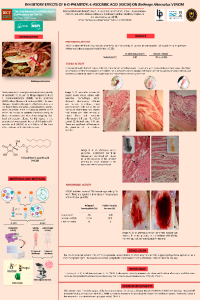
Snake venoms are a complex mixture of toxins, mostly of enzymatic nature, such as Phospholipases A2 (PLA2), Metalloproteinases (SVMP), Serine proteases (SVSP), others. At present, there is a growing interest in the search for natural or synthetic inhibitors acting on these components and thus allow mitigating their local and systemic effects. The main damage induced by the venom of B. alternatus is caused by SVMP, for this reason in the present work we proposed the use of 6-o-palmitoyl-l-ascorbic acid (ASC16) as an inhibitor of the toxic effects induced by the SVMP of B. alternatus venom. For this purpose, ASC16 (0.24 mM) was incubated with crude venom (1µg/µL) for 30 min at 37 °C. Proteolytic activity was measured using azocasein as substrate, and tissue injury (edema, hemorrhage and necrosis) was evaluated in a murine model (CF01). ASC16 inhibited 49.6% proteolytic activity, 78.06 % hemorrhagic activity, also the edema produced by the venom in the presence of ASC16 showed significant difference (p<0.05) compared to the whole venom control without inhibitor. Histological results showed that, as it known, crude venom provoked severe tissue injury, with extensive hemorrhagic areas, abundant inflammatory infiltrate and necrosis. In contrast, the B. alternatus venom treated with ASC16 did not cause hemorrhages and it caused mild lesions with little necrosis of muscle fibers and moderate inflammatory infiltrate. The results obtained indicate that compound ASC16 has potential as an inhibitor of SVMP enzymatic activity, suggesting its possible application as a local therapeutic agent. However, to understand in depth the mechanisms of ASC16 inhibition, further studies are required.
Keywords
ASC16
inhibition
SVMP
Bothrops alternatus
Manuscript
abstract IECT2023 Maslovski,Franco.pdf
Poster
Poster Maslovski Franco-Bothops alternatus venom.pdf
A novel Bacillus toyonensis Biovar Thuringiensis strain showing strong nematicidal activity.
Proteomic insights into toxin diversity in Indian Naja oxiana venom and investigation of immunoreactivity profiles of two polyvalent antivenoms