Event submissions
Published
This submission belongs to the session S3. Use of toxins as tools for research, drug discovery, and therapeutics of the event The 2nd International Electronic Conference on Toxins
Published date
14 Jul, 2023
Academic Editor
'%3e%3cpath%20d='M12.6657%2010.9104C12.4185%2010.325%2012.0599%209.79327%2011.6097%209.34482C11.1609%208.89508%2010.6293%208.5365%2010.0442%208.28888C10.0389%208.28626%2010.0337%208.28495%2010.0285%208.28233C10.8446%207.69279%2011.3752%206.73249%2011.3752%205.64904C11.3752%203.8542%209.92103%202.39999%208.1262%202.39999C6.33136%202.39999%204.87715%203.8542%204.87715%205.64904C4.87715%206.73249%205.40774%207.69279%206.22393%208.28364C6.21869%208.28626%206.21345%208.28757%206.20821%208.29019C5.62129%208.5378%205.09463%208.89284%204.64265%209.34613C4.1929%209.79493%203.83432%2010.3266%203.58671%2010.9117C3.34345%2011.4845%203.21226%2012.0987%203.20023%2012.7209C3.19988%2012.7349%203.20233%2012.7488%203.20744%2012.7619C3.21255%2012.7749%203.22022%2012.7867%203.22998%2012.7968C3.23975%2012.8068%203.25142%2012.8147%203.26431%2012.8202C3.2772%2012.8256%203.29105%2012.8284%203.30504%2012.8284H4.09109C4.14874%2012.8284%204.19459%2012.7825%204.1959%2012.7262C4.2221%2011.7148%204.62823%2010.7676%205.34617%2010.0497C6.08899%209.30683%207.0755%208.89808%208.1262%208.89808C9.17689%208.89808%2010.1634%209.30683%2010.9062%2010.0497C11.6242%2010.7676%2012.0303%2011.7148%2012.0565%2012.7262C12.0578%2012.7838%2012.1037%2012.8284%2012.1613%2012.8284H12.9474C12.9613%2012.8284%2012.9752%2012.8256%2012.9881%2012.8202C13.001%2012.8147%2013.0126%2012.8068%2013.0224%2012.7968C13.0322%2012.7867%2013.0398%2012.7749%2013.0449%2012.7619C13.0501%2012.7488%2013.0525%2012.7349%2013.0522%2012.7209C13.0391%2012.0947%2012.9094%2011.4855%2012.6657%2010.9104ZM8.1262%207.9024C7.52486%207.9024%206.9589%207.6679%206.53312%207.24211C6.10733%206.81633%205.87283%206.25037%205.87283%205.64904C5.87283%205.0477%206.10733%204.48174%206.53312%204.05596C6.9589%203.63018%207.52486%203.39567%208.1262%203.39567C8.72753%203.39567%209.29349%203.63018%209.71927%204.05596C10.1451%204.48174%2010.3796%205.0477%2010.3796%205.64904C10.3796%206.25037%2010.1451%206.81633%209.71927%207.24211C9.29349%207.6679%208.72753%207.9024%208.1262%207.9024Z'%20fill='%235D1EE1'/%3e%3c/g%3e%3c/svg%3e) R. Manjunatha Kini
R. Manjunatha KiniCitation
Gisela Lumila Lopez, Gabriel Moron, Santiago Palma, Belkys Maletto, Laura Leiva, Luciano Fusco, Immune response against Bothrops diporus venom pre-treated with Na₂EDTA formulated with a nanostructured (Coa-ASC16) and CpG-ODN sequences, in Proceedings of The 2nd International Electronic Conference on Toxins, 14 July–28 July 2023, MDPI: Basel, Switzerland
Share
Email
Facebook
Twitter
LinkedIn
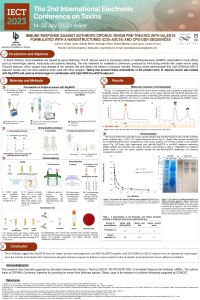
Immune response against Bothrops diporus venom pre-treated with Na2EDTA formulated with a nanostructured (Coa-ASC16) and CpG-ODN sequences
'%3e%3cpath%20d='M12.6647%2010.9104C12.4176%2010.325%2012.0589%209.7933%2011.6088%209.34485C11.16%208.89511%2010.6283%208.53653%2010.0432%208.28891C10.038%208.28629%2010.0327%208.28498%2010.0275%208.28236C10.8437%207.69282%2011.3743%206.73252%2011.3743%205.64907C11.3743%203.85423%209.92005%202.40002%208.12522%202.40002C6.33038%202.40002%204.87618%203.85423%204.87618%205.64907C4.87618%206.73252%205.40677%207.69282%206.22296%208.28367C6.21772%208.28629%206.21248%208.2876%206.20724%208.29022C5.62031%208.53783%205.09365%208.89287%204.64167%209.34616C4.19192%209.79496%203.83334%2010.3266%203.58573%2010.9117C3.34247%2011.4846%203.21128%2012.0987%203.19925%2012.721C3.1989%2012.735%203.20135%2012.7489%203.20646%2012.7619C3.21157%2012.7749%203.21924%2012.7868%203.22901%2012.7968C3.23877%2012.8068%203.25045%2012.8148%203.26334%2012.8202C3.27623%2012.8256%203.29007%2012.8284%203.30406%2012.8284H4.09012C4.14776%2012.8284%204.19362%2012.7825%204.19493%2012.7262C4.22113%2011.7148%204.62726%2010.7676%205.34519%2010.0497C6.08802%209.30686%207.07452%208.89811%208.12522%208.89811C9.17592%208.89811%2010.1624%209.30686%2010.9052%2010.0497C11.6232%2010.7676%2012.0293%2011.7148%2012.0555%2012.7262C12.0568%2012.7839%2012.1027%2012.8284%2012.1603%2012.8284H12.9464C12.9604%2012.8284%2012.9742%2012.8256%2012.9871%2012.8202C13%2012.8148%2013.0117%2012.8068%2013.0214%2012.7968C13.0312%2012.7868%2013.0389%2012.7749%2013.044%2012.7619C13.0491%2012.7489%2013.0515%2012.735%2013.0512%2012.721C13.0381%2012.0947%2012.9084%2011.4856%2012.6647%2010.9104ZM8.12522%207.90243C7.52388%207.90243%206.95792%207.66793%206.53214%207.24215C6.10636%206.81636%205.87185%206.2504%205.87185%205.64907C5.87185%205.04773%206.10636%204.48177%206.53214%204.05599C6.95792%203.63021%207.52388%203.3957%208.12522%203.3957C8.72655%203.3957%209.29252%203.63021%209.7183%204.05599C10.1441%204.48177%2010.3786%205.04773%2010.3786%205.64907C10.3786%206.2504%2010.1441%206.81636%209.7183%207.24215C9.29252%207.66793%208.72655%207.90243%208.12522%207.90243Z'%20fill='%235D1EE1'/%3e%3c/g%3e%3c/svg%3e)
Gisela Lumila Lopez 1
Gabriel Moron 2
Santiago Palma 3
Belkys Maletto 2
Laura Leiva 1
Luciano Fusco 1
1. Consejo Nacional de Investigaciones Científicas y Técnicas (CONICET), Instituto de Química Básica y Aplicada del Nordeste Argentino (IQUIBA-NEA). Corrientes, Argentina.
2. Consejo Nacional de Investigaciones Científicas y Técnicas (CONICET), Centro de Investigaciones en Bioquímica Clínica e Inmunología (CIBICI). Córdoba, Argentina.
3. Universidad Nacional de Córdoba, Facultad de Ciencias Químicas, Departamento de Ciencias Farmacéuticas, UNITEFA (CONICET), Córdoba, Argentina
Abstract
In South America, most snakebites are caused by genus Bothrops. The B. diporus venom is composed mainly of metalloproteinases (SVMPs) responsible for local effects such as hemorrhage, edema, myotoxicity and systemic bleeding. The only treatment for snakebite is antivenom, produced by immunizing animals with snake venom using Freund's adjuvant, which causes local damage at the injection site and affects the welfare of producer animals. To address this issue, B. diporus venom was treated with Na2EDTA and used as inmmunogen in combination with CpG-ODN/Coa-ASC16 adjuvant. Previous works demonstrated that CpG-ODN/Coa-ASC16 adjuvant causes very few local reactions when used with other antigens. For this proposal, B. diporus venom (1.8 mg) was incubated with Na2EDTA (0.2 M, BdV/Na2EDTA) for 1 h at 37°C and then it was subjected to Sephadex G-25 chromatography to remove the excess of chelator. Likewise, B. diporus venom without chelating agent (BdV) underwent the same process. In both samples, the effective inhibition of SVMPs using azocasein as substrate was determined. CF-1 mice (5/group) were immunized subcutaneously on days 0, 15 and 30 with BdV or BdV/Na2EDTA (7-30 μg) formulated with CpG-ODN/Coa-ASC16. On day 45, the final bleeding was performed and sera were obtained for antibody detection. The enzyme-linked immunosorbent assay results indicated that anti-BdV and anti-BdV/EDTA exhibited similar antibody titers (~2.56 x 10⁴) against Bothropic venom. Western Blot analysis revealed that the anti-BdV/EDTA serum recognized the main venom proteins (15-150 kDa) similarly to the anti-BdV serum. Finally, both experimental sera displayed neutralizing abilities against the proteolytic, indirect hemolytic, and coagulant activity tested in vitro. These findings suggest that Na2EDTA does not impair protein immunogenicity, and BdV/Na2EDTA together with CpG-ODN/Coa-ASC16 adjuvant was an appropriate immunogen since the animals immunized with it showed an adequate immune response to B.diporus venom similar to that of animals immunized with venom without an inhibitor.
Keywords
B. diporus
venom
Na2EDTA
adjuvant
CpG-ODN/Coa-ASC16
Manuscript
Abstract.pdf
Poster
Lopez Gisela 2023.pdf
Proteomic insights into toxin diversity in Indian Naja oxiana venom and investigation of immunoreactivity profiles of two polyvalent antivenoms
Machine Learning Analysis Suggests Relative Protein Abundance is Weakly Correlated with Snake Venom Toxicity