Event submissions
Published
This submission belongs to the session S5. Impact of toxins on agriculture of the event The 2nd International Electronic Conference on Toxins
Published date
14 Jul, 2023
Academic Editor
'%3e%3cpath%20d='M12.6657%2010.9104C12.4185%2010.325%2012.0599%209.79327%2011.6097%209.34482C11.1609%208.89508%2010.6293%208.5365%2010.0442%208.28888C10.0389%208.28626%2010.0337%208.28495%2010.0285%208.28233C10.8446%207.69279%2011.3752%206.73249%2011.3752%205.64904C11.3752%203.8542%209.92103%202.39999%208.1262%202.39999C6.33136%202.39999%204.87715%203.8542%204.87715%205.64904C4.87715%206.73249%205.40774%207.69279%206.22393%208.28364C6.21869%208.28626%206.21345%208.28757%206.20821%208.29019C5.62129%208.5378%205.09463%208.89284%204.64265%209.34613C4.1929%209.79493%203.83432%2010.3266%203.58671%2010.9117C3.34345%2011.4845%203.21226%2012.0987%203.20023%2012.7209C3.19988%2012.7349%203.20233%2012.7488%203.20744%2012.7619C3.21255%2012.7749%203.22022%2012.7867%203.22998%2012.7968C3.23975%2012.8068%203.25142%2012.8147%203.26431%2012.8202C3.2772%2012.8256%203.29105%2012.8284%203.30504%2012.8284H4.09109C4.14874%2012.8284%204.19459%2012.7825%204.1959%2012.7262C4.2221%2011.7148%204.62823%2010.7676%205.34617%2010.0497C6.08899%209.30683%207.0755%208.89808%208.1262%208.89808C9.17689%208.89808%2010.1634%209.30683%2010.9062%2010.0497C11.6242%2010.7676%2012.0303%2011.7148%2012.0565%2012.7262C12.0578%2012.7838%2012.1037%2012.8284%2012.1613%2012.8284H12.9474C12.9613%2012.8284%2012.9752%2012.8256%2012.9881%2012.8202C13.001%2012.8147%2013.0126%2012.8068%2013.0224%2012.7968C13.0322%2012.7867%2013.0398%2012.7749%2013.0449%2012.7619C13.0501%2012.7488%2013.0525%2012.7349%2013.0522%2012.7209C13.0391%2012.0947%2012.9094%2011.4855%2012.6657%2010.9104ZM8.1262%207.9024C7.52486%207.9024%206.9589%207.6679%206.53312%207.24211C6.10733%206.81633%205.87283%206.25037%205.87283%205.64904C5.87283%205.0477%206.10733%204.48174%206.53312%204.05596C6.9589%203.63018%207.52486%203.39567%208.1262%203.39567C8.72753%203.39567%209.29349%203.63018%209.71927%204.05596C10.1451%204.48174%2010.3796%205.0477%2010.3796%205.64904C10.3796%206.25037%2010.1451%206.81633%209.71927%207.24211C9.29349%207.6679%208.72753%207.9024%208.1262%207.9024Z'%20fill='%235D1EE1'/%3e%3c/g%3e%3c/svg%3e) Sarah De Saeger
Sarah De SaegerCitation
Felipe Penagos-Tabares, Mubarik Mahmood, Muhammad Zafar Ullah Khan, Hafiz Muhammad Amjad Talha, Muhammad Sajid, Kanwal Rafique, Saima Naveed, Johannes Faas, Juan Ignacio Artavia, Michael Sulyok, Anneliese Müller, Rudolf Krska, Qendrim Zebeli, Ubiquitous contamination with multiple mycotoxins and other fungal metabolites in dietary rations of dairy cattle in Punjab, Pakistan, in Proceedings of The 2nd International Electronic Conference on Toxins, 14 July–28 July 2023, MDPI: Basel, Switzerland
Share
Email
Facebook
Twitter
LinkedIn
Ubiquitous contamination with multiple mycotoxins and other fungal metabolites in dietary rations of dairy cattle in Punjab, Pakistan
'%3e%3cpath%20d='M12.6647%2010.9104C12.4176%2010.325%2012.0589%209.7933%2011.6088%209.34485C11.16%208.89511%2010.6283%208.53653%2010.0432%208.28891C10.038%208.28629%2010.0327%208.28498%2010.0275%208.28236C10.8437%207.69282%2011.3743%206.73252%2011.3743%205.64907C11.3743%203.85423%209.92005%202.40002%208.12522%202.40002C6.33038%202.40002%204.87618%203.85423%204.87618%205.64907C4.87618%206.73252%205.40677%207.69282%206.22296%208.28367C6.21772%208.28629%206.21248%208.2876%206.20724%208.29022C5.62031%208.53783%205.09365%208.89287%204.64167%209.34616C4.19192%209.79496%203.83334%2010.3266%203.58573%2010.9117C3.34247%2011.4846%203.21128%2012.0987%203.19925%2012.721C3.1989%2012.735%203.20135%2012.7489%203.20646%2012.7619C3.21157%2012.7749%203.21924%2012.7868%203.22901%2012.7968C3.23877%2012.8068%203.25045%2012.8148%203.26334%2012.8202C3.27623%2012.8256%203.29007%2012.8284%203.30406%2012.8284H4.09012C4.14776%2012.8284%204.19362%2012.7825%204.19493%2012.7262C4.22113%2011.7148%204.62726%2010.7676%205.34519%2010.0497C6.08802%209.30686%207.07452%208.89811%208.12522%208.89811C9.17592%208.89811%2010.1624%209.30686%2010.9052%2010.0497C11.6232%2010.7676%2012.0293%2011.7148%2012.0555%2012.7262C12.0568%2012.7839%2012.1027%2012.8284%2012.1603%2012.8284H12.9464C12.9604%2012.8284%2012.9742%2012.8256%2012.9871%2012.8202C13%2012.8148%2013.0117%2012.8068%2013.0214%2012.7968C13.0312%2012.7868%2013.0389%2012.7749%2013.044%2012.7619C13.0491%2012.7489%2013.0515%2012.735%2013.0512%2012.721C13.0381%2012.0947%2012.9084%2011.4856%2012.6647%2010.9104ZM8.12522%207.90243C7.52388%207.90243%206.95792%207.66793%206.53214%207.24215C6.10636%206.81636%205.87185%206.2504%205.87185%205.64907C5.87185%205.04773%206.10636%204.48177%206.53214%204.05599C6.95792%203.63021%207.52388%203.3957%208.12522%203.3957C8.72655%203.3957%209.29252%203.63021%209.7183%204.05599C10.1441%204.48177%2010.3786%205.04773%2010.3786%205.64907C10.3786%206.2504%2010.1441%206.81636%209.7183%207.24215C9.29252%207.66793%208.72655%207.90243%208.12522%207.90243Z'%20fill='%235D1EE1'/%3e%3c/g%3e%3c/svg%3e)
Felipe Penagos-Tabares 1,2,3
Mubarik Mahmood 4
Muhammad Zafar Ullah Khan 5
Hafiz Muhammad Amjad Talha 4
Muhammad Sajid 4
Kanwal Rafique 4
Saima Naveed 6
Johannes Faas 7
Juan Ignacio Artavia 7
Michael Sulyok 8
Anneliese Müller 7
Rudolf Krska 8,9
Qendrim Zebeli 2,10
1. Unit Nutritional Physiology, Institute of Physiology, Pathophysiology and Biophysics, Department of Biomedical Sciences, University of Veterinary Medicine Vienna, Veterinärplatz 1, 1210 Vienna, Austria
2. Christian-Doppler-Laboratory for Innovative Gut Health Concepts in Livestock (CDL-LiveGUT), Department for Farm Animals and Veterinary Public Health, University of Veterinary Medicine, Veterinaerplatz 1, Vienna, 1210, Austria
3. FFoQSI GmbH – Austrian Competence Centre for Feed and Food Quality, Safety and Innovation, Technopark 1C 3430 Tulln, Austria
4. Department of Animal Sciences, University of Veterinary and Animal Sciences, Lahore, Subcampus Jhang, 12 km Chiniot Road, Jhang 35200, Pakistan
5. Agri-Food Research & Sustainable Solutions (Private) Limited (ARASS) F-1, IBL Market, Ghouri Block, Bahria Town, Lahore, 54000, Pakistan
6. Department of Animal Nutrition, Ravi Campus-Pattoki, University of Veterinary and Animal Sciences, Lahore, 55300, Pakistan
7. DSM-BIOMIN Research Center, Technopark 1, Tulln a.d. Donau, 3430, Austria
8. University of Natural Resources and Life Sciences, Vienna, Department of Agrobiotechnology, IFA-Tulln, Institute of Bioanalytics and Agro-Metabolomics, Konrad-Lorenz-Strasse 20, 3430 Tulln an der Donau, Austria
9. Institute for Global Food Security, School of Biological Sciences, University Road, Belfast BT7 1NN, United Kingdom
10. Institute of Animal Nutrition and Functional Plant Compounds, Department for Farm Animals and Veterinary Public Health, University of Veterinary Medicine Vienna, Veterinaerplatz 1, Vienna 1210, Austria
Abstract
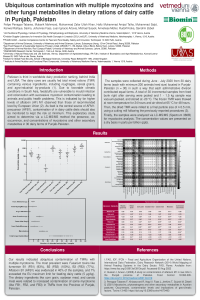
Pakistan is third in worldwide dairy production ranking, behind India and USA. The climatic conditions of South Asia favour the contamination of crops with mycotoxins, such as aflatoxins, which can impair human/animal health. This study targeted the analysis of a broad range of mycotoxins and fungal secondary metabolites (>500) in total mixed rations (TMR) (n=30) using a validated multi-metabolite liquid chromatography/electrospray ionization-tandem mass spectrometric (LC/ESI–MS/MS). The samples were collected in big commercial dairy farms (> 200 lactating cows) in Punjab, Pakistan, detecting 96 mycotoxins/fungal metabolites. Contamination with multiple mycotoxins was ubiquitous. On average, the samples contained 14 mycotoxins/sample (range: 11 - 20). Metabolites derived from “other fungi” and Fusarium spp. showed the highest occurrences, concentration, and diversity among the detected fungal compounds. Aflatoxin B1 (AFB1) occurred in 40% of the samples, and 7% exceeded the EU maximum limit for feeding dairy cattle (5 μg/kg). The maximum concentration of this potent carcinogenic was 33.8 μg/kg (more than 7 times over the EU maximum limit). No other mycotoxin than AFB1 exceeded the EU guidance values. Excepting for ergot alkaloids (73%), all the groups of metabolites (i.e., derived from Alternaria spp., Aspergillus spp., Fusarium spp., Penicillium spp., and other fungi) occurred in 100% of the TMR samples. Although the contamination levels of single mycotoxins are relatively low, the effects on animal health, reproduction, and productivity under the detected realistic scenario (“cocktails effect”) are still unpredictable. Thus, future toxicological studies should address interactions (additivity, potentiation, synergism, and antagonism) as well as the long-term exposure effects of “mycotoxin mixtures”.
Keywords
Dairy
Feed safety
Mixtures toxicology
Mycotoxin co-occurrence
Manuscript
IECT_Mycotoxins diets of dairy cattle, Pakistan.pdf
Poster
Poster-Mycotoxins Pakistan.pdf
Machine Learning Analysis Suggests Relative Protein Abundance is Weakly Correlated with Snake Venom Toxicity
Cellular activity of paralytic shellfish samples extracted from Semele proficua and Senilia senilis