Event submissions
Published
This submission belongs to the session S3. Use of toxins as tools for research, drug discovery, and therapeutics of the event The 2nd International Electronic Conference on Toxins
Published date
14 Jul, 2023
Academic Editor
'%3e%3cpath%20d='M12.6657%2010.9104C12.4185%2010.325%2012.0599%209.79327%2011.6097%209.34482C11.1609%208.89508%2010.6293%208.5365%2010.0442%208.28888C10.0389%208.28626%2010.0337%208.28495%2010.0285%208.28233C10.8446%207.69279%2011.3752%206.73249%2011.3752%205.64904C11.3752%203.8542%209.92103%202.39999%208.1262%202.39999C6.33136%202.39999%204.87715%203.8542%204.87715%205.64904C4.87715%206.73249%205.40774%207.69279%206.22393%208.28364C6.21869%208.28626%206.21345%208.28757%206.20821%208.29019C5.62129%208.5378%205.09463%208.89284%204.64265%209.34613C4.1929%209.79493%203.83432%2010.3266%203.58671%2010.9117C3.34345%2011.4845%203.21226%2012.0987%203.20023%2012.7209C3.19988%2012.7349%203.20233%2012.7488%203.20744%2012.7619C3.21255%2012.7749%203.22022%2012.7867%203.22998%2012.7968C3.23975%2012.8068%203.25142%2012.8147%203.26431%2012.8202C3.2772%2012.8256%203.29105%2012.8284%203.30504%2012.8284H4.09109C4.14874%2012.8284%204.19459%2012.7825%204.1959%2012.7262C4.2221%2011.7148%204.62823%2010.7676%205.34617%2010.0497C6.08899%209.30683%207.0755%208.89808%208.1262%208.89808C9.17689%208.89808%2010.1634%209.30683%2010.9062%2010.0497C11.6242%2010.7676%2012.0303%2011.7148%2012.0565%2012.7262C12.0578%2012.7838%2012.1037%2012.8284%2012.1613%2012.8284H12.9474C12.9613%2012.8284%2012.9752%2012.8256%2012.9881%2012.8202C13.001%2012.8147%2013.0126%2012.8068%2013.0224%2012.7968C13.0322%2012.7867%2013.0398%2012.7749%2013.0449%2012.7619C13.0501%2012.7488%2013.0525%2012.7349%2013.0522%2012.7209C13.0391%2012.0947%2012.9094%2011.4855%2012.6657%2010.9104ZM8.1262%207.9024C7.52486%207.9024%206.9589%207.6679%206.53312%207.24211C6.10733%206.81633%205.87283%206.25037%205.87283%205.64904C5.87283%205.0477%206.10733%204.48174%206.53312%204.05596C6.9589%203.63018%207.52486%203.39567%208.1262%203.39567C8.72753%203.39567%209.29349%203.63018%209.71927%204.05596C10.1451%204.48174%2010.3796%205.0477%2010.3796%205.64904C10.3796%206.25037%2010.1451%206.81633%209.71927%207.24211C9.29349%207.6679%208.72753%207.9024%208.1262%207.9024Z'%20fill='%235D1EE1'/%3e%3c/g%3e%3c/svg%3e) Cesare Montecucco
Cesare MontecuccoCitation
Kristina R. Denisova, Nikita A. Orlov, Alexey V. Feofanov, Oksana V. Nekrasova, Properties of Atto488-Agitoxin 2 As a Fluorescent Ligand of Kv1.3 Сhannel, in Proceedings of The 2nd International Electronic Conference on Toxins, 14 July–28 July 2023, MDPI: Basel, Switzerland
Share
Email
Facebook
Twitter
LinkedIn
Properties of Atto488-Agitoxin 2 As a Fluorescent Ligand of Kv1.3 Сhannel
'%3e%3cpath%20d='M12.6647%2010.9104C12.4176%2010.325%2012.0589%209.7933%2011.6088%209.34485C11.16%208.89511%2010.6283%208.53653%2010.0432%208.28891C10.038%208.28629%2010.0327%208.28498%2010.0275%208.28236C10.8437%207.69282%2011.3743%206.73252%2011.3743%205.64907C11.3743%203.85423%209.92005%202.40002%208.12522%202.40002C6.33038%202.40002%204.87618%203.85423%204.87618%205.64907C4.87618%206.73252%205.40677%207.69282%206.22296%208.28367C6.21772%208.28629%206.21248%208.2876%206.20724%208.29022C5.62031%208.53783%205.09365%208.89287%204.64167%209.34616C4.19192%209.79496%203.83334%2010.3266%203.58573%2010.9117C3.34247%2011.4846%203.21128%2012.0987%203.19925%2012.721C3.1989%2012.735%203.20135%2012.7489%203.20646%2012.7619C3.21157%2012.7749%203.21924%2012.7868%203.22901%2012.7968C3.23877%2012.8068%203.25045%2012.8148%203.26334%2012.8202C3.27623%2012.8256%203.29007%2012.8284%203.30406%2012.8284H4.09012C4.14776%2012.8284%204.19362%2012.7825%204.19493%2012.7262C4.22113%2011.7148%204.62726%2010.7676%205.34519%2010.0497C6.08802%209.30686%207.07452%208.89811%208.12522%208.89811C9.17592%208.89811%2010.1624%209.30686%2010.9052%2010.0497C11.6232%2010.7676%2012.0293%2011.7148%2012.0555%2012.7262C12.0568%2012.7839%2012.1027%2012.8284%2012.1603%2012.8284H12.9464C12.9604%2012.8284%2012.9742%2012.8256%2012.9871%2012.8202C13%2012.8148%2013.0117%2012.8068%2013.0214%2012.7968C13.0312%2012.7868%2013.0389%2012.7749%2013.044%2012.7619C13.0491%2012.7489%2013.0515%2012.735%2013.0512%2012.721C13.0381%2012.0947%2012.9084%2011.4856%2012.6647%2010.9104ZM8.12522%207.90243C7.52388%207.90243%206.95792%207.66793%206.53214%207.24215C6.10636%206.81636%205.87185%206.2504%205.87185%205.64907C5.87185%205.04773%206.10636%204.48177%206.53214%204.05599C6.95792%203.63021%207.52388%203.3957%208.12522%203.3957C8.72655%203.3957%209.29252%203.63021%209.7183%204.05599C10.1441%204.48177%2010.3786%205.04773%2010.3786%205.64907C10.3786%206.2504%2010.1441%206.81636%209.7183%207.24215C9.29252%207.66793%208.72655%207.90243%208.12522%207.90243Z'%20fill='%235D1EE1'/%3e%3c/g%3e%3c/svg%3e)
Kristina R. Denisova 1,2
Nikita A. Orlov 1,2

Alexey V. Feofanov 1,2
Oksana V. Nekrasova 1
1. Shemyakin-Ovchinnikov Institute of Bioorganic Chemistry, Russian Academy of Sciences, 117997 Moscow, Russia
2. Faculty of Biology, Lomonosov Moscow State University, 119234 Moscow, Russia
Abstract
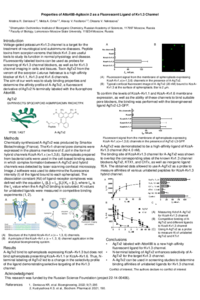
Voltage-gated potassium Kv1.3 channel play a role in many physiological processes and is a prospective target for the treatment of neurological and autoimmune diseases. Many peptides from scorpion venoms are highly specific and potent blockers of Kv1.3 and other channels from Kv1 family, that makes them important pharmacological compounds. Agitoxin 2 (AgTx2) is one of these blockers with a subnanomolar affinity to eukaryotic channels Kv1.1, Kv1.3 and Kv1.6. Fluorescently labeled peptide blockers are useful tools for studying channels by the means of fluorescence microscopy techniques. These tagged blockers can be obtained either by chemical synthesis or by genetically encoding a peptide fused to a fluorescent protein. Previously studied conjugates of AgTx2 with tetramethylrhodamine, as well as bioengineered fusions with GFP and RFP showed high affinity to Kv1 channels [1].
The aim of the present study was to characterize properties of A-AgTx2, a new fluorescently labeled ligand of Kv1 channels, and its possible applications. A-AgTx2 (AgTx2 N-terminally labeled with the fluorophore Atto488) was produced by Smartox (France) and studied by us using laser scanning confocal microscopy and E.coli spheroplasts that express hybrid channels KcsA-Kv1.x (x=1, 3, 6) in the plasma membrane [2]. As shown earlier, hybrid channels KcsA-Kv1.x (x=1, 3, 6) mimic corresponding eukaryotic Kv1.x channels in the ability to bind peptide blockers[3].
In contrast to AgTx2, the A-AgTx2 ligand was determined to bind to KcsA-Kv1.3, but not to KcsA-Kv1.1 and KcsA-Kv1.6 channels. Our studies have shown that N-terminal labeling AgTx2 modifies its pharmacological profile, as it was showed previously for GFP-AgTx2 ligand [1]. Thus, a new selective and high-affinity ligand of the Kv1.3 channel was obtained with the dissociation constant value 4.3±0.2 nM. A-AgTx2 can be used in a combination with KcsA-Kv1.3 hybrid channel for the recognition of unlabeled Kv1.3 blockers and for the quantitative analysis of their affinity to Kv1.3 channel.
The studies were supported by the Russian Science Foundation (grant no. 22-14-00406).
References
- Nekrasova, O.V.; Primak, A.L.; Ignatova, A.A.; Novoseletsky, V.N.; Geras’kina, O.V.; Kudryashova, K.S.; Yakimov, S.A.; Kirpichnikov, M.P.; Arseniev, A.S.; Feofanov, A.V. N-Terminal Tagging with GFP Enhances Selectivity of Agitoxin 2 to Kv1.3-Channel Binding Site. Toxins 2020, 12, doi:10.3390/toxins12120802.
- Denisova, K.R.; Orlov, N.A.; Yakimov, S.A.; Kirpichnikov, M.P.; Feofanov, A.V.; Nekrasova, O.V. Atto488-Agitoxin 2—A Fluorescent Ligand with Increased Selectivity for Kv1.3 Channel Binding Site. Bioengineering 2022, 9, 295, doi:10.3390/bioengineering9070295.
- Kudryashova, K.S.; Nekrasova, O.V.; Kirpichnikov, M.P.; Feofanov, A.V. Chimeras of KcsA and Kv1 as a Bioengineering Tool to Study Voltage-Gated Potassium Channels and Their Ligands. Biochem. Pharmacol. 2021, 190, doi:10.1016/j.bcp.2021.114646.
Keywords
agitoxin 2
Kv1.3 channel
pore blocker
fluorescent ligand
affinity
KcsA
hybrid channels
Manuscript
A_Agtx2_thesis_denisova_new.pdf
Poster
IECT 22023.pdf
Cellular activity of paralytic shellfish samples extracted from Semele proficua and Senilia senilis
First results on paretic syndrome research in gulls from Málaga (S Spain) reveals that they did not bear BMAA, paralytic and amnesic shellfish toxins.