Event submissions
Published
This submission belongs to the session S4. Impact of toxins on public health of the event The 2nd International Electronic Conference on Toxins
Published date
14 Jul, 2023
Academic Editor
'%3e%3cpath%20d='M12.6657%2010.9104C12.4185%2010.325%2012.0599%209.79327%2011.6097%209.34482C11.1609%208.89508%2010.6293%208.5365%2010.0442%208.28888C10.0389%208.28626%2010.0337%208.28495%2010.0285%208.28233C10.8446%207.69279%2011.3752%206.73249%2011.3752%205.64904C11.3752%203.8542%209.92103%202.39999%208.1262%202.39999C6.33136%202.39999%204.87715%203.8542%204.87715%205.64904C4.87715%206.73249%205.40774%207.69279%206.22393%208.28364C6.21869%208.28626%206.21345%208.28757%206.20821%208.29019C5.62129%208.5378%205.09463%208.89284%204.64265%209.34613C4.1929%209.79493%203.83432%2010.3266%203.58671%2010.9117C3.34345%2011.4845%203.21226%2012.0987%203.20023%2012.7209C3.19988%2012.7349%203.20233%2012.7488%203.20744%2012.7619C3.21255%2012.7749%203.22022%2012.7867%203.22998%2012.7968C3.23975%2012.8068%203.25142%2012.8147%203.26431%2012.8202C3.2772%2012.8256%203.29105%2012.8284%203.30504%2012.8284H4.09109C4.14874%2012.8284%204.19459%2012.7825%204.1959%2012.7262C4.2221%2011.7148%204.62823%2010.7676%205.34617%2010.0497C6.08899%209.30683%207.0755%208.89808%208.1262%208.89808C9.17689%208.89808%2010.1634%209.30683%2010.9062%2010.0497C11.6242%2010.7676%2012.0303%2011.7148%2012.0565%2012.7262C12.0578%2012.7838%2012.1037%2012.8284%2012.1613%2012.8284H12.9474C12.9613%2012.8284%2012.9752%2012.8256%2012.9881%2012.8202C13.001%2012.8147%2013.0126%2012.8068%2013.0224%2012.7968C13.0322%2012.7867%2013.0398%2012.7749%2013.0449%2012.7619C13.0501%2012.7488%2013.0525%2012.7349%2013.0522%2012.7209C13.0391%2012.0947%2012.9094%2011.4855%2012.6657%2010.9104ZM8.1262%207.9024C7.52486%207.9024%206.9589%207.6679%206.53312%207.24211C6.10733%206.81633%205.87283%206.25037%205.87283%205.64904C5.87283%205.0477%206.10733%204.48174%206.53312%204.05596C6.9589%203.63018%207.52486%203.39567%208.1262%203.39567C8.72753%203.39567%209.29349%203.63018%209.71927%204.05596C10.1451%204.48174%2010.3796%205.0477%2010.3796%205.64904C10.3796%206.25037%2010.1451%206.81633%209.71927%207.24211C9.29349%207.6679%208.72753%207.9024%208.1262%207.9024Z'%20fill='%235D1EE1'/%3e%3c/g%3e%3c/svg%3e) Panagiota Katikou
Panagiota KatikouCitation
Lucía Soliño Soliño, Michelle Preterotti Lemke, Leopold L. Ilag, Elena Gorokhova, Pedro Reis Costa, Salvador García-Barcelona, Sandra Lage, First results on paretic syndrome research in gulls from Málaga (S Spain) reveals that they did not bear BMAA, paralytic and amnesic shellfish toxins., in Proceedings of The 2nd International Electronic Conference on Toxins, 14 July–28 July 2023, MDPI: Basel, Switzerland
Share
Email
Facebook
Twitter
LinkedIn
First results on paretic syndrome research in gulls from Málaga (S Spain) reveals that they did not bear BMAA, paralytic and amnesic shellfish toxins.
'%3e%3cpath%20d='M12.6647%2010.9104C12.4176%2010.325%2012.0589%209.7933%2011.6088%209.34485C11.16%208.89511%2010.6283%208.53653%2010.0432%208.28891C10.038%208.28629%2010.0327%208.28498%2010.0275%208.28236C10.8437%207.69282%2011.3743%206.73252%2011.3743%205.64907C11.3743%203.85423%209.92005%202.40002%208.12522%202.40002C6.33038%202.40002%204.87618%203.85423%204.87618%205.64907C4.87618%206.73252%205.40677%207.69282%206.22296%208.28367C6.21772%208.28629%206.21248%208.2876%206.20724%208.29022C5.62031%208.53783%205.09365%208.89287%204.64167%209.34616C4.19192%209.79496%203.83334%2010.3266%203.58573%2010.9117C3.34247%2011.4846%203.21128%2012.0987%203.19925%2012.721C3.1989%2012.735%203.20135%2012.7489%203.20646%2012.7619C3.21157%2012.7749%203.21924%2012.7868%203.22901%2012.7968C3.23877%2012.8068%203.25045%2012.8148%203.26334%2012.8202C3.27623%2012.8256%203.29007%2012.8284%203.30406%2012.8284H4.09012C4.14776%2012.8284%204.19362%2012.7825%204.19493%2012.7262C4.22113%2011.7148%204.62726%2010.7676%205.34519%2010.0497C6.08802%209.30686%207.07452%208.89811%208.12522%208.89811C9.17592%208.89811%2010.1624%209.30686%2010.9052%2010.0497C11.6232%2010.7676%2012.0293%2011.7148%2012.0555%2012.7262C12.0568%2012.7839%2012.1027%2012.8284%2012.1603%2012.8284H12.9464C12.9604%2012.8284%2012.9742%2012.8256%2012.9871%2012.8202C13%2012.8148%2013.0117%2012.8068%2013.0214%2012.7968C13.0312%2012.7868%2013.0389%2012.7749%2013.044%2012.7619C13.0491%2012.7489%2013.0515%2012.735%2013.0512%2012.721C13.0381%2012.0947%2012.9084%2011.4856%2012.6647%2010.9104ZM8.12522%207.90243C7.52388%207.90243%206.95792%207.66793%206.53214%207.24215C6.10636%206.81636%205.87185%206.2504%205.87185%205.64907C5.87185%205.04773%206.10636%204.48177%206.53214%204.05599C6.95792%203.63021%207.52388%203.3957%208.12522%203.3957C8.72655%203.3957%209.29252%203.63021%209.7183%204.05599C10.1441%204.48177%2010.3786%205.04773%2010.3786%205.64907C10.3786%206.2504%2010.1441%206.81636%209.7183%207.24215C9.29252%207.66793%208.72655%207.90243%208.12522%207.90243Z'%20fill='%235D1EE1'/%3e%3c/g%3e%3c/svg%3e)
Lucía Soliño Soliño 1,2
Michelle Preterotti Lemke 3,4
Leopold L. Ilag 3
Elena Gorokhova 4

Pedro Reis Costa 1,2
Salvador García-Barcelona 5

Sandra Lage 4,6
1. Portuguese Institute of the Sea and Atmosphere (IPMA), Rua Alfredo Magalhães Ramalho, 6, 1495-006 Lisbon, Portugal
2. Centre of Marine Sciences (CCMAR/CIMAR LA), Campus de Gambelas, University of Algarve, 8005-139 Faro, Portugal
3. Department of Materials and Environmental Chemistry, Stockholm University, 106 91 Stockholm, Sweden
4. Department of Environmental Science, Stockholm University, 106 91 Stockholm, Sweden
5. Centro Oceanográfico de Málaga (IEO, CSIC), 29640 Fuengirola, Málaga, Spain
6. Centre of Marine Sciences (CCMAR/CIMAR LA), Campus de Gambelas, University of Algarve, 8005-139 Faro, Portugal
Abstract
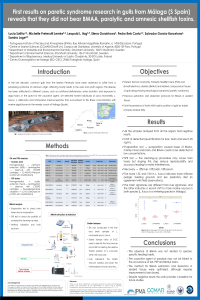
In the last decade, Common Gulls from the Iberian Peninsula have been observed to suffer from a paralyzing syndrome of unknown origin, affecting mostly adults in the west and south regions. This disease has been attributed to different causes, such as nutritional deficiencies, avian botulism, and exposure to algal toxins. In the quest for the causative agent, we selected twelve individuals of Larus michahellis, L. fuscus, L. ridibundus and Ichthyaetus melanocephalus that succumbed to this illness concomitantly with marine algal blooms in the nearby coasts of Málaga (Spain). Amnesic and paralytic shellfish toxins were analyzed in the gull´s liver, kidney and feces. Furthermore, the neurotoxin β-Methylamino-L-alanine, and its analogues were measured in the liver, brain and blood serum of the same individuals by UPLC-MS/MS. Liver and brain were also used to determine stable isotope (SI) signature as a trophic marker. None of the analyzed neurotoxins were detected in any of the samples, indicating that poisoning due to blooms caused by the algae producers of these neurotoxins was unlikely cause of the bird death. Moreover, despite similar symptoms, the SI signatures revealed significant differences in the feeding grounds between the species. These results point to the causative agent not being related to the food sources of the birds.
Keywords
phycotoxins
harmful algae blooms
bioaccumulation
food webs
avian botulism
Manuscript
Poster_LS_221028.pdf
Poster
Poster_LS_221028.pdf
Properties of Atto488-Agitoxin 2 As a Fluorescent Ligand of Kv1.3 Сhannel
A novel clean-up method based on cyclodextrin polymers for the detection of tetrodotoxins in natural samples with a cell-based assay