Event submissions
Published
This submission belongs to the session S4. Impact of toxins on public health of the event The 2nd International Electronic Conference on Toxins
Published date
14 Jul, 2023
Academic Editor
'%3e%3cpath%20d='M12.6657%2010.9104C12.4185%2010.325%2012.0599%209.79327%2011.6097%209.34482C11.1609%208.89508%2010.6293%208.5365%2010.0442%208.28888C10.0389%208.28626%2010.0337%208.28495%2010.0285%208.28233C10.8446%207.69279%2011.3752%206.73249%2011.3752%205.64904C11.3752%203.8542%209.92103%202.39999%208.1262%202.39999C6.33136%202.39999%204.87715%203.8542%204.87715%205.64904C4.87715%206.73249%205.40774%207.69279%206.22393%208.28364C6.21869%208.28626%206.21345%208.28757%206.20821%208.29019C5.62129%208.5378%205.09463%208.89284%204.64265%209.34613C4.1929%209.79493%203.83432%2010.3266%203.58671%2010.9117C3.34345%2011.4845%203.21226%2012.0987%203.20023%2012.7209C3.19988%2012.7349%203.20233%2012.7488%203.20744%2012.7619C3.21255%2012.7749%203.22022%2012.7867%203.22998%2012.7968C3.23975%2012.8068%203.25142%2012.8147%203.26431%2012.8202C3.2772%2012.8256%203.29105%2012.8284%203.30504%2012.8284H4.09109C4.14874%2012.8284%204.19459%2012.7825%204.1959%2012.7262C4.2221%2011.7148%204.62823%2010.7676%205.34617%2010.0497C6.08899%209.30683%207.0755%208.89808%208.1262%208.89808C9.17689%208.89808%2010.1634%209.30683%2010.9062%2010.0497C11.6242%2010.7676%2012.0303%2011.7148%2012.0565%2012.7262C12.0578%2012.7838%2012.1037%2012.8284%2012.1613%2012.8284H12.9474C12.9613%2012.8284%2012.9752%2012.8256%2012.9881%2012.8202C13.001%2012.8147%2013.0126%2012.8068%2013.0224%2012.7968C13.0322%2012.7867%2013.0398%2012.7749%2013.0449%2012.7619C13.0501%2012.7488%2013.0525%2012.7349%2013.0522%2012.7209C13.0391%2012.0947%2012.9094%2011.4855%2012.6657%2010.9104ZM8.1262%207.9024C7.52486%207.9024%206.9589%207.6679%206.53312%207.24211C6.10733%206.81633%205.87283%206.25037%205.87283%205.64904C5.87283%205.0477%206.10733%204.48174%206.53312%204.05596C6.9589%203.63018%207.52486%203.39567%208.1262%203.39567C8.72753%203.39567%209.29349%203.63018%209.71927%204.05596C10.1451%204.48174%2010.3796%205.0477%2010.3796%205.64904C10.3796%206.25037%2010.1451%206.81633%209.71927%207.24211C9.29349%207.6679%208.72753%207.9024%208.1262%207.9024Z'%20fill='%235D1EE1'/%3e%3c/g%3e%3c/svg%3e) Panagiota Katikou
Panagiota KatikouCitation
Lourdes Barreiro Crespo, Sandra Gimeno, Andrés Sanchez-Henao, Jean Turquet, Fanny Maillot, Cintia Flores, Jorge Diogène, María Rambla-Alegre, Toxicity and toxin profile on Ocean Indian fish containing CTX-like compounds, in Proceedings of The 2nd International Electronic Conference on Toxins, 14 July–28 July 2023, MDPI: Basel, Switzerland
Share
Email
Facebook
Twitter
LinkedIn
Toxicity and toxin profile on Ocean Indian fish containing CTX-like compounds
'%3e%3cpath%20d='M12.6647%2010.9104C12.4176%2010.325%2012.0589%209.7933%2011.6088%209.34485C11.16%208.89511%2010.6283%208.53653%2010.0432%208.28891C10.038%208.28629%2010.0327%208.28498%2010.0275%208.28236C10.8437%207.69282%2011.3743%206.73252%2011.3743%205.64907C11.3743%203.85423%209.92005%202.40002%208.12522%202.40002C6.33038%202.40002%204.87618%203.85423%204.87618%205.64907C4.87618%206.73252%205.40677%207.69282%206.22296%208.28367C6.21772%208.28629%206.21248%208.2876%206.20724%208.29022C5.62031%208.53783%205.09365%208.89287%204.64167%209.34616C4.19192%209.79496%203.83334%2010.3266%203.58573%2010.9117C3.34247%2011.4846%203.21128%2012.0987%203.19925%2012.721C3.1989%2012.735%203.20135%2012.7489%203.20646%2012.7619C3.21157%2012.7749%203.21924%2012.7868%203.22901%2012.7968C3.23877%2012.8068%203.25045%2012.8148%203.26334%2012.8202C3.27623%2012.8256%203.29007%2012.8284%203.30406%2012.8284H4.09012C4.14776%2012.8284%204.19362%2012.7825%204.19493%2012.7262C4.22113%2011.7148%204.62726%2010.7676%205.34519%2010.0497C6.08802%209.30686%207.07452%208.89811%208.12522%208.89811C9.17592%208.89811%2010.1624%209.30686%2010.9052%2010.0497C11.6232%2010.7676%2012.0293%2011.7148%2012.0555%2012.7262C12.0568%2012.7839%2012.1027%2012.8284%2012.1603%2012.8284H12.9464C12.9604%2012.8284%2012.9742%2012.8256%2012.9871%2012.8202C13%2012.8148%2013.0117%2012.8068%2013.0214%2012.7968C13.0312%2012.7868%2013.0389%2012.7749%2013.044%2012.7619C13.0491%2012.7489%2013.0515%2012.735%2013.0512%2012.721C13.0381%2012.0947%2012.9084%2011.4856%2012.6647%2010.9104ZM8.12522%207.90243C7.52388%207.90243%206.95792%207.66793%206.53214%207.24215C6.10636%206.81636%205.87185%206.2504%205.87185%205.64907C5.87185%205.04773%206.10636%204.48177%206.53214%204.05599C6.95792%203.63021%207.52388%203.3957%208.12522%203.3957C8.72655%203.3957%209.29252%203.63021%209.7183%204.05599C10.1441%204.48177%2010.3786%205.04773%2010.3786%205.64907C10.3786%206.2504%2010.1441%206.81636%209.7183%207.24215C9.29252%207.66793%208.72655%207.90243%208.12522%207.90243Z'%20fill='%235D1EE1'/%3e%3c/g%3e%3c/svg%3e)
Lourdes Barreiro Crespo 1
Sandra Gimeno 2
Andrés Sanchez-Henao 2
Jean Turquet 3
Fanny Maillot 3
Cintia Flores 4
Jorge Diogène 2
María Rambla-Alegre 2
1. Marine and Continental Waters, IRTA, Ctra. Poble Nou km 5.5, La Ràpita, 43540, Spain
2. IRTA
3. CITEB
4. IDAEA - CSIC
Abstract
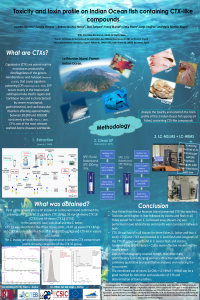
Ciguatoxins (CTXs) are potent marine neurotoxins that cause ciguatera fish poisoning (CFP). CFP occurs mainly in the tropical and subtropical Indo-Pacific region and Caribbean Sea. However, their presence, toxicity and toxin profile have been poorly described in the Indian Ocean.
In this study, the liver, muscle, and viscera of four fish specimens of three different species (one Lutjanus bohar, two Variola louti and one Carcharinus leucas) caught in the waters of La Réunion Island were analysed. One of the V. louti was obtained after a CFP incident. Toxicity was analysed by screening CTX-like toxicity with the neuro-2acell-based assay. Their toxicity values ranged between 0,013 to 1,26 µg equiv CTX1B/kg in flesh, 2,55 to 16,40 equiv CTX1B/kg in liver and 0,51 to 3,12 equiv CTX1B/kg in viscera. In general, liver and viscera showed higher concentrations of CTX-like compounds than flesh.
The three fish tissue extract clean-up were evaluated using the combination of Florisil and C18 SPE cartridges, recoveries of CTX1B were between 48,6 and 89.7% depending on the tissue. Additionally, a new screening method using a UPLC coupled with a Xevo TQXS for CTXs was optimized at 11 minutes per sample and in which a total of fourteen analogues, with three transitions each one, were included. This method together with three other methods including more than 30 known CTX congeners into the LC-MS/MS were used.
The toxin profile for the four fish specimens were evaluated using liquid chromatography coupled to mass spectrometry (LC-MS/MS) and to high resolution mass spectrometry (LC-HRMS). Several potential CTX congeners were identified: the flesh of the V.louti after a CFP incident confirmed the presence of CTX1B, (0.12 µg equiv CTX1B/kg), 52-epi-54-doxyCTX1B and 54-deoxyCTX1B.. In the second V. louti individual and the L. bohar, CTX1B was identified in the three tissues. The C. leucas samples revealed the presence of a complex CTX contaminant profile showing congeners of CTX3C-group.
Keywords
marine toxins
ciguatoxin
ciguatera
chromatography
clean-up
CBA
liver
flesh
viscera
La Réunion Island
Manuscript
Lourdes et al. 2023_IECT_Ciguatoxrun_JDF_MR2.pdf
Poster
2. Toxin Profile CTX's Poster.pdf
Natural Peptides and Plant Extracts protect Skin Cells in culture against venom-induced cytotoxicity
Immunological and antimicrobial effects of venoms of endemic species of Cyprus