Event submissions
Published
This submission belongs to the session S2. Mechanism of action and/or pathophysiology of toxins of the event The 2nd International Electronic Conference on Toxins
Published date
14 Jul, 2023
Academic Editor
'%3e%3cpath%20d='M12.6657%2010.9104C12.4185%2010.325%2012.0599%209.79327%2011.6097%209.34482C11.1609%208.89508%2010.6293%208.5365%2010.0442%208.28888C10.0389%208.28626%2010.0337%208.28495%2010.0285%208.28233C10.8446%207.69279%2011.3752%206.73249%2011.3752%205.64904C11.3752%203.8542%209.92103%202.39999%208.1262%202.39999C6.33136%202.39999%204.87715%203.8542%204.87715%205.64904C4.87715%206.73249%205.40774%207.69279%206.22393%208.28364C6.21869%208.28626%206.21345%208.28757%206.20821%208.29019C5.62129%208.5378%205.09463%208.89284%204.64265%209.34613C4.1929%209.79493%203.83432%2010.3266%203.58671%2010.9117C3.34345%2011.4845%203.21226%2012.0987%203.20023%2012.7209C3.19988%2012.7349%203.20233%2012.7488%203.20744%2012.7619C3.21255%2012.7749%203.22022%2012.7867%203.22998%2012.7968C3.23975%2012.8068%203.25142%2012.8147%203.26431%2012.8202C3.2772%2012.8256%203.29105%2012.8284%203.30504%2012.8284H4.09109C4.14874%2012.8284%204.19459%2012.7825%204.1959%2012.7262C4.2221%2011.7148%204.62823%2010.7676%205.34617%2010.0497C6.08899%209.30683%207.0755%208.89808%208.1262%208.89808C9.17689%208.89808%2010.1634%209.30683%2010.9062%2010.0497C11.6242%2010.7676%2012.0303%2011.7148%2012.0565%2012.7262C12.0578%2012.7838%2012.1037%2012.8284%2012.1613%2012.8284H12.9474C12.9613%2012.8284%2012.9752%2012.8256%2012.9881%2012.8202C13.001%2012.8147%2013.0126%2012.8068%2013.0224%2012.7968C13.0322%2012.7867%2013.0398%2012.7749%2013.0449%2012.7619C13.0501%2012.7488%2013.0525%2012.7349%2013.0522%2012.7209C13.0391%2012.0947%2012.9094%2011.4855%2012.6657%2010.9104ZM8.1262%207.9024C7.52486%207.9024%206.9589%207.6679%206.53312%207.24211C6.10733%206.81633%205.87283%206.25037%205.87283%205.64904C5.87283%205.0477%206.10733%204.48174%206.53312%204.05596C6.9589%203.63018%207.52486%203.39567%208.1262%203.39567C8.72753%203.39567%209.29349%203.63018%209.71927%204.05596C10.1451%204.48174%2010.3796%205.0477%2010.3796%205.64904C10.3796%206.25037%2010.1451%206.81633%209.71927%207.24211C9.29349%207.6679%208.72753%207.9024%208.1262%207.9024Z'%20fill='%235D1EE1'/%3e%3c/g%3e%3c/svg%3e) R. Manjunatha Kini
R. Manjunatha KiniCitation
Tolis Panayi, Michalis Chrysanthou, Danae Melanthiou, Eleni Argyro Themistokli, Christos Papaneophytou, Christos Petrou, Yiannis Sarigiannis, Vicky Nicolaidou, Immunological and antimicrobial effects of venoms of endemic species of Cyprus, in Proceedings of The 2nd International Electronic Conference on Toxins, 14 July–28 July 2023, MDPI: Basel, Switzerland
Share
Email
Facebook
Twitter
LinkedIn
Immunological and antimicrobial effects of venoms of endemic species of Cyprus
'%3e%3cpath%20d='M12.6647%2010.9104C12.4176%2010.325%2012.0589%209.7933%2011.6088%209.34485C11.16%208.89511%2010.6283%208.53653%2010.0432%208.28891C10.038%208.28629%2010.0327%208.28498%2010.0275%208.28236C10.8437%207.69282%2011.3743%206.73252%2011.3743%205.64907C11.3743%203.85423%209.92005%202.40002%208.12522%202.40002C6.33038%202.40002%204.87618%203.85423%204.87618%205.64907C4.87618%206.73252%205.40677%207.69282%206.22296%208.28367C6.21772%208.28629%206.21248%208.2876%206.20724%208.29022C5.62031%208.53783%205.09365%208.89287%204.64167%209.34616C4.19192%209.79496%203.83334%2010.3266%203.58573%2010.9117C3.34247%2011.4846%203.21128%2012.0987%203.19925%2012.721C3.1989%2012.735%203.20135%2012.7489%203.20646%2012.7619C3.21157%2012.7749%203.21924%2012.7868%203.22901%2012.7968C3.23877%2012.8068%203.25045%2012.8148%203.26334%2012.8202C3.27623%2012.8256%203.29007%2012.8284%203.30406%2012.8284H4.09012C4.14776%2012.8284%204.19362%2012.7825%204.19493%2012.7262C4.22113%2011.7148%204.62726%2010.7676%205.34519%2010.0497C6.08802%209.30686%207.07452%208.89811%208.12522%208.89811C9.17592%208.89811%2010.1624%209.30686%2010.9052%2010.0497C11.6232%2010.7676%2012.0293%2011.7148%2012.0555%2012.7262C12.0568%2012.7839%2012.1027%2012.8284%2012.1603%2012.8284H12.9464C12.9604%2012.8284%2012.9742%2012.8256%2012.9871%2012.8202C13%2012.8148%2013.0117%2012.8068%2013.0214%2012.7968C13.0312%2012.7868%2013.0389%2012.7749%2013.044%2012.7619C13.0491%2012.7489%2013.0515%2012.735%2013.0512%2012.721C13.0381%2012.0947%2012.9084%2011.4856%2012.6647%2010.9104ZM8.12522%207.90243C7.52388%207.90243%206.95792%207.66793%206.53214%207.24215C6.10636%206.81636%205.87185%206.2504%205.87185%205.64907C5.87185%205.04773%206.10636%204.48177%206.53214%204.05599C6.95792%203.63021%207.52388%203.3957%208.12522%203.3957C8.72655%203.3957%209.29252%203.63021%209.7183%204.05599C10.1441%204.48177%2010.3786%205.04773%2010.3786%205.64907C10.3786%206.2504%2010.1441%206.81636%209.7183%207.24215C9.29252%207.66793%208.72655%207.90243%208.12522%207.90243Z'%20fill='%235D1EE1'/%3e%3c/g%3e%3c/svg%3e)
Tolis Panayi 1
Michalis Chrysanthou 2
Danae Melanthiou 2
Eleni Argyro Themistokli 2

Christos Papaneophytou 2
Christos Petrou 1

Yiannis Sarigiannis 1

Vicky Nicolaidou 2
1. Department of Health Sciences, School of Life and Health Sciences, University of Nicosia
2. Department of Life Sciences, School of Life and Health Sciences and Engineering, University of Nicosia
Abstract
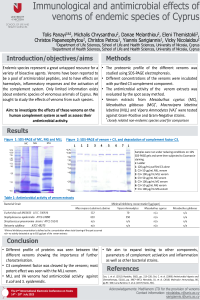
Endemic species represent a great untapped resource for a variety of bioactive agents that may have great potential for many applications. In addition, a better understanding of envenomation's pathogenic mechanisms would allow the exploration of approaches to deal with this event. It has been reported that venoms are a pool of antimicrobial peptides, including against clinically relevant Gram positive and Gram negative bacteria. Many studies have also demonstrated the effect of venoms on hemolysis, inflammatory responses and the activation of the complement system. We sought to study the effects of venoms from Cypriot endemic species, the Cypriot blunt-nosed viper, Macrovibera l. lebetina and the scorpion Mesobuthus cyprius. It was found that both crude venoms at different concentrations, promote significant degradation of the C3 complement component, as shown by SDS-PAGE analysis, also generating anaphylatoxins. Furthermore, the venoms were tested for their antimicrobial activity against Staphylococcus epidermidis, Streptococcus pneumoniae and Escherichia coli via the microdilution method at a final concentration range of 10-300 μg/ml. Both crude venoms did not display any antimicrobial activity against the tested organisms. Further characterization and investigation of selected peptides and proteins is underway for their antimicrobial activity and effects on other complement components.
Keywords
venom
complement
snake
scorpion
antimicrobial
Manuscript
Panayi et al., 2023 2nd International Electronic Conference on Toxins.pdf
Poster
Panayi et al., sciforum poster 2023.pdf
Toxicity and toxin profile on Ocean Indian fish containing CTX-like compounds
Newly identified toxin transcripts in Myanmar Russell’s viper venom gland