Event submissions
Published

This submission belongs to the session S6. Evolution of toxins of the event The 2nd International Electronic Conference on Toxins
Published date
17 Jul, 2023
Academic Editor
'%3e%3cpath%20d='M12.6657%2010.9104C12.4185%2010.325%2012.0599%209.79327%2011.6097%209.34482C11.1609%208.89508%2010.6293%208.5365%2010.0442%208.28888C10.0389%208.28626%2010.0337%208.28495%2010.0285%208.28233C10.8446%207.69279%2011.3752%206.73249%2011.3752%205.64904C11.3752%203.8542%209.92103%202.39999%208.1262%202.39999C6.33136%202.39999%204.87715%203.8542%204.87715%205.64904C4.87715%206.73249%205.40774%207.69279%206.22393%208.28364C6.21869%208.28626%206.21345%208.28757%206.20821%208.29019C5.62129%208.5378%205.09463%208.89284%204.64265%209.34613C4.1929%209.79493%203.83432%2010.3266%203.58671%2010.9117C3.34345%2011.4845%203.21226%2012.0987%203.20023%2012.7209C3.19988%2012.7349%203.20233%2012.7488%203.20744%2012.7619C3.21255%2012.7749%203.22022%2012.7867%203.22998%2012.7968C3.23975%2012.8068%203.25142%2012.8147%203.26431%2012.8202C3.2772%2012.8256%203.29105%2012.8284%203.30504%2012.8284H4.09109C4.14874%2012.8284%204.19459%2012.7825%204.1959%2012.7262C4.2221%2011.7148%204.62823%2010.7676%205.34617%2010.0497C6.08899%209.30683%207.0755%208.89808%208.1262%208.89808C9.17689%208.89808%2010.1634%209.30683%2010.9062%2010.0497C11.6242%2010.7676%2012.0303%2011.7148%2012.0565%2012.7262C12.0578%2012.7838%2012.1037%2012.8284%2012.1613%2012.8284H12.9474C12.9613%2012.8284%2012.9752%2012.8256%2012.9881%2012.8202C13.001%2012.8147%2013.0126%2012.8068%2013.0224%2012.7968C13.0322%2012.7867%2013.0398%2012.7749%2013.0449%2012.7619C13.0501%2012.7488%2013.0525%2012.7349%2013.0522%2012.7209C13.0391%2012.0947%2012.9094%2011.4855%2012.6657%2010.9104ZM8.1262%207.9024C7.52486%207.9024%206.9589%207.6679%206.53312%207.24211C6.10733%206.81633%205.87283%206.25037%205.87283%205.64904C5.87283%205.0477%206.10733%204.48174%206.53312%204.05596C6.9589%203.63018%207.52486%203.39567%208.1262%203.39567C8.72753%203.39567%209.29349%203.63018%209.71927%204.05596C10.1451%204.48174%2010.3796%205.0477%2010.3796%205.64904C10.3796%206.25037%2010.1451%206.81633%209.71927%207.24211C9.29349%207.6679%208.72753%207.9024%208.1262%207.9024Z'%20fill='%235D1EE1'/%3e%3c/g%3e%3c/svg%3e) Sarah De Saeger
Sarah De SaegerCitation
Ivana Jevtic, Sandra Jakšić, Daniela Šojić Merkulov, Szabolcs Bognár, Biljana Abramović, EFFICACY OF FUMONISIN B₁ REMOVAL FROM VARIOUS SIMULATED WATER TYPES USING UV AND UV/H₂O₂ TREATMENTS, in Proceedings of The 2nd International Electronic Conference on Toxins, 14 July–28 July 2023, MDPI: Basel, Switzerland, doi: 10.3390/IECT2023-14802
Share
Email
Facebook
Twitter
LinkedIn
EFFICACY OF FUMONISIN B1 REMOVAL FROM VARIOUS SIMULATED WATER TYPES USING UV AND UV/H2O2 TREATMENTS

Ivana Jevtic 1
'%3e%3cpath%20d='M12.6647%2010.9104C12.4176%2010.325%2012.0589%209.7933%2011.6088%209.34485C11.16%208.89511%2010.6283%208.53653%2010.0432%208.28891C10.038%208.28629%2010.0327%208.28498%2010.0275%208.28236C10.8437%207.69282%2011.3743%206.73252%2011.3743%205.64907C11.3743%203.85423%209.92005%202.40002%208.12522%202.40002C6.33038%202.40002%204.87618%203.85423%204.87618%205.64907C4.87618%206.73252%205.40677%207.69282%206.22296%208.28367C6.21772%208.28629%206.21248%208.2876%206.20724%208.29022C5.62031%208.53783%205.09365%208.89287%204.64167%209.34616C4.19192%209.79496%203.83334%2010.3266%203.58573%2010.9117C3.34247%2011.4846%203.21128%2012.0987%203.19925%2012.721C3.1989%2012.735%203.20135%2012.7489%203.20646%2012.7619C3.21157%2012.7749%203.21924%2012.7868%203.22901%2012.7968C3.23877%2012.8068%203.25045%2012.8148%203.26334%2012.8202C3.27623%2012.8256%203.29007%2012.8284%203.30406%2012.8284H4.09012C4.14776%2012.8284%204.19362%2012.7825%204.19493%2012.7262C4.22113%2011.7148%204.62726%2010.7676%205.34519%2010.0497C6.08802%209.30686%207.07452%208.89811%208.12522%208.89811C9.17592%208.89811%2010.1624%209.30686%2010.9052%2010.0497C11.6232%2010.7676%2012.0293%2011.7148%2012.0555%2012.7262C12.0568%2012.7839%2012.1027%2012.8284%2012.1603%2012.8284H12.9464C12.9604%2012.8284%2012.9742%2012.8256%2012.9871%2012.8202C13%2012.8148%2013.0117%2012.8068%2013.0214%2012.7968C13.0312%2012.7868%2013.0389%2012.7749%2013.044%2012.7619C13.0491%2012.7489%2013.0515%2012.735%2013.0512%2012.721C13.0381%2012.0947%2012.9084%2011.4856%2012.6647%2010.9104ZM8.12522%207.90243C7.52388%207.90243%206.95792%207.66793%206.53214%207.24215C6.10636%206.81636%205.87185%206.2504%205.87185%205.64907C5.87185%205.04773%206.10636%204.48177%206.53214%204.05599C6.95792%203.63021%207.52388%203.3957%208.12522%203.3957C8.72655%203.3957%209.29252%203.63021%209.7183%204.05599C10.1441%204.48177%2010.3786%205.04773%2010.3786%205.64907C10.3786%206.2504%2010.1441%206.81636%209.7183%207.24215C9.29252%207.66793%208.72655%207.90243%208.12522%207.90243Z'%20fill='%235D1EE1'/%3e%3c/g%3e%3c/svg%3e)
Sandra Jakšić 2

Daniela Šojić Merkulov 3
Szabolcs Bognár 3

Biljana Abramović 3
1. Academy of Professional Studies Šabac: Šabac, RS
2. Scientific Veterinary Institute Novi Sad, Rumenački put 20, 21000 Novi Sad, Serbia
3. University of Novi Sad Faculty of Sciences, Department of Chemistry, Biochemistry and Environmental Protection, Trg Dositeja Obradovića 3, 21000 Novi Sad, Serbia
Abstract
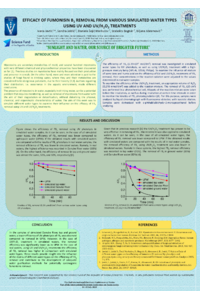
Fumonisins are known as secondary metabolites of the mold Fusarium verticillioides that most often contaminate cereals and animal feed. According to recent research, these mycotoxins have also been detected in the aquatic environment, which may be the result of washing off the crops during rainy periods, or because of their possible production in the water. Since fumonisin B1 (FB1) is highly toxic and has dangerous effects on the health of living organisms, in this research the influence of different water matrix on the effectiveness of UV and UV/H2O2 treatments was investigated. Namely, different water types (water from Danube River, tap, and underground) were simulated with the addition of humic acid and major ions for each type of water into ultrapure water (UPW). Results showed a lower removal efficiency of FB1 by direct UV photolysis in the simulated water samples in comparison to the UPW. In the case of UV/H2O2 treatment, the efficiency of FB1 removal in simulated waters was also lower compared to UPW. However, this treatment was more effective than direct photolysis. Namely, in UPW 100% of FB1 removal was achieved after 90 min of irradiation, while among the investigated simulated water samples the highest removal efficiency was reached in tap water, when 50% of FB1 was degraded after the same time of irradiation. These results provide insight into the influence of the matrix of different water types on the efficiency of FB1 removal and contribute to the development of adequate water purification methods for potentially carcinogenic fumonisins.
Keywords
mycotoxins
fumonisin B1
removal
simulated different water types
UV photolysis
UV/H2O2 treatment.
Manuscript
sciforum-073485 .pdf
Poster
Poster Jevtic I..pdf
Sub-Chronic Toxicological Evaluation of the Sesquiterpene Lactone-enriched Fraction of Tithonia diversifolia (Hemsley) A. Gray in Experimental Rats
Inflammatory effect of a PLA2 isolated from Bothrops diporus venom