Event submissions
Published
This submission belongs to the session S3. Use of toxins as tools for research, drug discovery, and therapeutics of the event The 2nd International Electronic Conference on Toxins
Published date
18 Jul, 2023
Academic Editor
'%3e%3cpath%20d='M12.6657%2010.9104C12.4185%2010.325%2012.0599%209.79327%2011.6097%209.34482C11.1609%208.89508%2010.6293%208.5365%2010.0442%208.28888C10.0389%208.28626%2010.0337%208.28495%2010.0285%208.28233C10.8446%207.69279%2011.3752%206.73249%2011.3752%205.64904C11.3752%203.8542%209.92103%202.39999%208.1262%202.39999C6.33136%202.39999%204.87715%203.8542%204.87715%205.64904C4.87715%206.73249%205.40774%207.69279%206.22393%208.28364C6.21869%208.28626%206.21345%208.28757%206.20821%208.29019C5.62129%208.5378%205.09463%208.89284%204.64265%209.34613C4.1929%209.79493%203.83432%2010.3266%203.58671%2010.9117C3.34345%2011.4845%203.21226%2012.0987%203.20023%2012.7209C3.19988%2012.7349%203.20233%2012.7488%203.20744%2012.7619C3.21255%2012.7749%203.22022%2012.7867%203.22998%2012.7968C3.23975%2012.8068%203.25142%2012.8147%203.26431%2012.8202C3.2772%2012.8256%203.29105%2012.8284%203.30504%2012.8284H4.09109C4.14874%2012.8284%204.19459%2012.7825%204.1959%2012.7262C4.2221%2011.7148%204.62823%2010.7676%205.34617%2010.0497C6.08899%209.30683%207.0755%208.89808%208.1262%208.89808C9.17689%208.89808%2010.1634%209.30683%2010.9062%2010.0497C11.6242%2010.7676%2012.0303%2011.7148%2012.0565%2012.7262C12.0578%2012.7838%2012.1037%2012.8284%2012.1613%2012.8284H12.9474C12.9613%2012.8284%2012.9752%2012.8256%2012.9881%2012.8202C13.001%2012.8147%2013.0126%2012.8068%2013.0224%2012.7968C13.0322%2012.7867%2013.0398%2012.7749%2013.0449%2012.7619C13.0501%2012.7488%2013.0525%2012.7349%2013.0522%2012.7209C13.0391%2012.0947%2012.9094%2011.4855%2012.6657%2010.9104ZM8.1262%207.9024C7.52486%207.9024%206.9589%207.6679%206.53312%207.24211C6.10733%206.81633%205.87283%206.25037%205.87283%205.64904C5.87283%205.0477%206.10733%204.48174%206.53312%204.05596C6.9589%203.63018%207.52486%203.39567%208.1262%203.39567C8.72753%203.39567%209.29349%203.63018%209.71927%204.05596C10.1451%204.48174%2010.3796%205.0477%2010.3796%205.64904C10.3796%206.25037%2010.1451%206.81633%209.71927%207.24211C9.29349%207.6679%208.72753%207.9024%208.1262%207.9024Z'%20fill='%235D1EE1'/%3e%3c/g%3e%3c/svg%3e) Sakthivel Vaiyapuri
Sakthivel VaiyapuriCitation
Daniela Jaqueline Sasovsky, Ana Karina Oliveira, Bruno Lomonte, Jay Wiliam Fox, Soledad Bustillo, Inflammatory effect of a PLA₂ isolated from Bothrops diporus venom, in Proceedings of The 2nd International Electronic Conference on Toxins, 14 July–28 July 2023, MDPI: Basel, Switzerland
Share
Email
Facebook
Twitter
LinkedIn
Inflammatory effect of a PLA2 isolated from Bothrops diporus venom
'%3e%3cpath%20d='M12.6647%2010.9104C12.4176%2010.325%2012.0589%209.7933%2011.6088%209.34485C11.16%208.89511%2010.6283%208.53653%2010.0432%208.28891C10.038%208.28629%2010.0327%208.28498%2010.0275%208.28236C10.8437%207.69282%2011.3743%206.73252%2011.3743%205.64907C11.3743%203.85423%209.92005%202.40002%208.12522%202.40002C6.33038%202.40002%204.87618%203.85423%204.87618%205.64907C4.87618%206.73252%205.40677%207.69282%206.22296%208.28367C6.21772%208.28629%206.21248%208.2876%206.20724%208.29022C5.62031%208.53783%205.09365%208.89287%204.64167%209.34616C4.19192%209.79496%203.83334%2010.3266%203.58573%2010.9117C3.34247%2011.4846%203.21128%2012.0987%203.19925%2012.721C3.1989%2012.735%203.20135%2012.7489%203.20646%2012.7619C3.21157%2012.7749%203.21924%2012.7868%203.22901%2012.7968C3.23877%2012.8068%203.25045%2012.8148%203.26334%2012.8202C3.27623%2012.8256%203.29007%2012.8284%203.30406%2012.8284H4.09012C4.14776%2012.8284%204.19362%2012.7825%204.19493%2012.7262C4.22113%2011.7148%204.62726%2010.7676%205.34519%2010.0497C6.08802%209.30686%207.07452%208.89811%208.12522%208.89811C9.17592%208.89811%2010.1624%209.30686%2010.9052%2010.0497C11.6232%2010.7676%2012.0293%2011.7148%2012.0555%2012.7262C12.0568%2012.7839%2012.1027%2012.8284%2012.1603%2012.8284H12.9464C12.9604%2012.8284%2012.9742%2012.8256%2012.9871%2012.8202C13%2012.8148%2013.0117%2012.8068%2013.0214%2012.7968C13.0312%2012.7868%2013.0389%2012.7749%2013.044%2012.7619C13.0491%2012.7489%2013.0515%2012.735%2013.0512%2012.721C13.0381%2012.0947%2012.9084%2011.4856%2012.6647%2010.9104ZM8.12522%207.90243C7.52388%207.90243%206.95792%207.66793%206.53214%207.24215C6.10636%206.81636%205.87185%206.2504%205.87185%205.64907C5.87185%205.04773%206.10636%204.48177%206.53214%204.05599C6.95792%203.63021%207.52388%203.3957%208.12522%203.3957C8.72655%203.3957%209.29252%203.63021%209.7183%204.05599C10.1441%204.48177%2010.3786%205.04773%2010.3786%205.64907C10.3786%206.2504%2010.1441%206.81636%209.7183%207.24215C9.29252%207.66793%208.72655%207.90243%208.12522%207.90243Z'%20fill='%235D1EE1'/%3e%3c/g%3e%3c/svg%3e)
Daniela Jaqueline Sasovsky 1
Ana Karina Oliveira 2

Bruno Lomonte 3
Jay Wiliam Fox 2

Soledad Bustillo 1
1. Grupo de Investigaciones Biológicas y Moleculares (GIByM). IQUIBA-NEA. Universidad Nacional del Nordeste. CONICET
2. University of Virginia School of Medicine. United States.
3. Instituto Clodomiro Picado. Costa Rica
Abstract
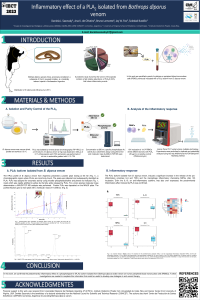
In northeastern Argentina the vast majority of snakebite envenomings are caused by Bothrops diporus. Proteomic studies have shown that about 24.1% of its venom consists of phospholipases A2 (PLA2s) that induce inflammatory events. However, there are no previous reports on the specific inflammatory mediators released by immune and endothelial cells in response to these toxins. Thus, in this work we quantified a panel of cytokines on peripheral blood mononuclear cells (PBMC) previously incubated with a PLA2 isoform from B. diporus venom. Briefly, PLA2 was isolated by reverse phase chromatography (RP-HPLC) on a C18 column. B. diporus venom (2 mg) was dissolved in 200 μL of 0.1% trifluoroacetic acid (TFA) and elution was performed at 1 mL/min in acetonitrile gradient with 0.1% TFA. Specific phospholipase activity, concentration at 280nm and molecular mass by MALDI-TOF MS (Shimadzu MALDI-8030) were determined. In order to analyze the inflammatory response induced by this toxin on human PBMC, Luminex multiplex technology was used. After 10h incubation of 1x10⁶ PBMCs, from three different donors in technical duplicate, with PLA2 (25 μg/mL) or positive control (PMA/Ionomycin) the Human Panel Th17 for GM-CSF, IFNγ, IL-1β, IL-2, IL-4, IL-5, IL-6, IL-9, IL-10, IL-12p70, IL-13, IL-15, IL-17A, IL-17E/IL-25, IL-17F, IL-21, IL-22, IL-23, IL-27, IL-28A, IL-31, IL-33, MIP-3α, TNFα and TNFβ was used. The statistical analysis was performed using the Two-Way ANOVA and FDR Benjamini-Hochberg method. Results clearly showed that the PLA2 (14,048Da) isoform isolated from B. diporus venom, induced a significant increase in the release of the pro-inflammatory cytokines Il6 and TNFa and the macrophage inflammatory chemokine MIP3a, after 10h incubation. Even the IL-10, an anti-inflammatory cytokine, was also over expressed; the predominantly inflammatory effect induced by PLA2 was confirmed. Further studies, eg. on oxidative stress, will complete this information that could be useful to develop new strategies in anti-venom therapy.
Keywords
Bothrops diporus
PLA2
Cytokines
Inflammatory effect
Manuscript
sciforum-072636 .pdf
Poster
Sasovsky Daniela J.pdf
EFFICACY OF FUMONISIN B1 REMOVAL FROM VARIOUS SIMULATED WATER TYPES USING UV AND UV/H2O2 TREATMENTS
Nigella Sativa: A Potential Natural Antidote for Poisoning Cases