Event submissions
Published
This submission belongs to the session S2. Mechanism of action and/or pathophysiology of toxins of the event The 2nd International Electronic Conference on Toxins
Published date
17 Aug, 2023
Academic Editor
'%3e%3cpath%20d='M12.6657%2010.9104C12.4185%2010.325%2012.0599%209.79327%2011.6097%209.34482C11.1609%208.89508%2010.6293%208.5365%2010.0442%208.28888C10.0389%208.28626%2010.0337%208.28495%2010.0285%208.28233C10.8446%207.69279%2011.3752%206.73249%2011.3752%205.64904C11.3752%203.8542%209.92103%202.39999%208.1262%202.39999C6.33136%202.39999%204.87715%203.8542%204.87715%205.64904C4.87715%206.73249%205.40774%207.69279%206.22393%208.28364C6.21869%208.28626%206.21345%208.28757%206.20821%208.29019C5.62129%208.5378%205.09463%208.89284%204.64265%209.34613C4.1929%209.79493%203.83432%2010.3266%203.58671%2010.9117C3.34345%2011.4845%203.21226%2012.0987%203.20023%2012.7209C3.19988%2012.7349%203.20233%2012.7488%203.20744%2012.7619C3.21255%2012.7749%203.22022%2012.7867%203.22998%2012.7968C3.23975%2012.8068%203.25142%2012.8147%203.26431%2012.8202C3.2772%2012.8256%203.29105%2012.8284%203.30504%2012.8284H4.09109C4.14874%2012.8284%204.19459%2012.7825%204.1959%2012.7262C4.2221%2011.7148%204.62823%2010.7676%205.34617%2010.0497C6.08899%209.30683%207.0755%208.89808%208.1262%208.89808C9.17689%208.89808%2010.1634%209.30683%2010.9062%2010.0497C11.6242%2010.7676%2012.0303%2011.7148%2012.0565%2012.7262C12.0578%2012.7838%2012.1037%2012.8284%2012.1613%2012.8284H12.9474C12.9613%2012.8284%2012.9752%2012.8256%2012.9881%2012.8202C13.001%2012.8147%2013.0126%2012.8068%2013.0224%2012.7968C13.0322%2012.7867%2013.0398%2012.7749%2013.0449%2012.7619C13.0501%2012.7488%2013.0525%2012.7349%2013.0522%2012.7209C13.0391%2012.0947%2012.9094%2011.4855%2012.6657%2010.9104ZM8.1262%207.9024C7.52486%207.9024%206.9589%207.6679%206.53312%207.24211C6.10733%206.81633%205.87283%206.25037%205.87283%205.64904C5.87283%205.0477%206.10733%204.48174%206.53312%204.05596C6.9589%203.63018%207.52486%203.39567%208.1262%203.39567C8.72753%203.39567%209.29349%203.63018%209.71927%204.05596C10.1451%204.48174%2010.3796%205.0477%2010.3796%205.64904C10.3796%206.25037%2010.1451%206.81633%209.71927%207.24211C9.29349%207.6679%208.72753%207.9024%208.1262%207.9024Z'%20fill='%235D1EE1'/%3e%3c/g%3e%3c/svg%3e) Hang Fai (Henry) Kwok
Hang Fai (Henry) KwokCitation
Javier Moral-Sanz, Isabel Fernandez, Ana Vela-Sebastian, P. Alewood, Zoltan Dekan, Thomas Kremsmayr, Markus Muttenthaler, Evelyne Deplazes, Maria Ikonomopoulou, Lipid membrane composition determines binding, disruption and cytotoxicity of Gomesin peptides, in Proceedings of The 2nd International Electronic Conference on Toxins, 14 July–28 July 2023, MDPI: Basel, Switzerland
Share
Email
Facebook
Twitter
LinkedIn
Lipid membrane composition determines binding, disruption and cytotoxicity of Gomesin peptides

Javier Moral-Sanz 1
'%3e%3cpath%20d='M12.6647%2010.9104C12.4176%2010.325%2012.0589%209.7933%2011.6088%209.34485C11.16%208.89511%2010.6283%208.53653%2010.0432%208.28891C10.038%208.28629%2010.0327%208.28498%2010.0275%208.28236C10.8437%207.69282%2011.3743%206.73252%2011.3743%205.64907C11.3743%203.85423%209.92005%202.40002%208.12522%202.40002C6.33038%202.40002%204.87618%203.85423%204.87618%205.64907C4.87618%206.73252%205.40677%207.69282%206.22296%208.28367C6.21772%208.28629%206.21248%208.2876%206.20724%208.29022C5.62031%208.53783%205.09365%208.89287%204.64167%209.34616C4.19192%209.79496%203.83334%2010.3266%203.58573%2010.9117C3.34247%2011.4846%203.21128%2012.0987%203.19925%2012.721C3.1989%2012.735%203.20135%2012.7489%203.20646%2012.7619C3.21157%2012.7749%203.21924%2012.7868%203.22901%2012.7968C3.23877%2012.8068%203.25045%2012.8148%203.26334%2012.8202C3.27623%2012.8256%203.29007%2012.8284%203.30406%2012.8284H4.09012C4.14776%2012.8284%204.19362%2012.7825%204.19493%2012.7262C4.22113%2011.7148%204.62726%2010.7676%205.34519%2010.0497C6.08802%209.30686%207.07452%208.89811%208.12522%208.89811C9.17592%208.89811%2010.1624%209.30686%2010.9052%2010.0497C11.6232%2010.7676%2012.0293%2011.7148%2012.0555%2012.7262C12.0568%2012.7839%2012.1027%2012.8284%2012.1603%2012.8284H12.9464C12.9604%2012.8284%2012.9742%2012.8256%2012.9871%2012.8202C13%2012.8148%2013.0117%2012.8068%2013.0214%2012.7968C13.0312%2012.7868%2013.0389%2012.7749%2013.044%2012.7619C13.0491%2012.7489%2013.0515%2012.735%2013.0512%2012.721C13.0381%2012.0947%2012.9084%2011.4856%2012.6647%2010.9104ZM8.12522%207.90243C7.52388%207.90243%206.95792%207.66793%206.53214%207.24215C6.10636%206.81636%205.87185%206.2504%205.87185%205.64907C5.87185%205.04773%206.10636%204.48177%206.53214%204.05599C6.95792%203.63021%207.52388%203.3957%208.12522%203.3957C8.72655%203.3957%209.29252%203.63021%209.7183%204.05599C10.1441%204.48177%2010.3786%205.04773%2010.3786%205.64907C10.3786%206.2504%2010.1441%206.81636%209.7183%207.24215C9.29252%207.66793%208.72655%207.90243%208.12522%207.90243Z'%20fill='%235D1EE1'/%3e%3c/g%3e%3c/svg%3e)
Isabel Fernandez 1
Ana Vela-Sebastian 1
P. Alewood 2
Zoltan Dekan 2
Thomas Kremsmayr 2
Markus Muttenthaler 3
Evelyne Deplazes 2
Maria Ikonomopoulou 1
1. Madrid Institute for Advanced Studies in Food, Madrid, E28049, Spain
2. The University of Queensland, St. Lucia, QLD 4072, Australia
3. University of Vienna, 1090, Vienna
The University of Queensland, St. Lucia, QLD 4072, Australia
Abstract
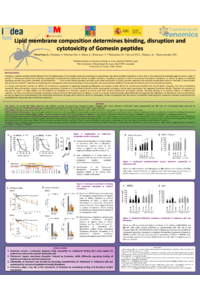
Background. Gomesin is a cationic peptide originally isolated from the haemocytes of the Brazilian tarantula Acanthoscurria gomesiana that shows in-vitro and in-vivo efficacy against cancer. Several mechanisms have been proposed to explain the antitumoral activity of Gomesin. These include binding and disruption of the plasma membrane, and modulation of signalling cascades that control cell death and proliferation. Gomesin shows affinity for membranes containing negatively-charged phospholipids with a weak affinity for membranes rich in neutral lipids. However, the influence of cholesterol content has not been fully explored. The present study aims to further investigate the importance of cholesterol in the ability of Gomesin to interact with artificial membranes and cellular models to exert its cytotoxicity.
Methods. Electrochemical impedance spectroscopy and tethered bilayer lipid membranes assays were used to analyze protein binding to the membrane or membrane disruption induced by Gomesin, respectively. These assays were coupled to cellular models of BRAF-mutated melanoma and healthy fibroblast cells by studying changes in viability induced by Gomesin under the influence of modulators of the cholesterol content.
Results. Our investigations revealed that fibroblasts are less affected by Gomesin cytotoxicity and presented a higher content of cholesterol. Interestingly, we identified that two natural Gomesin variants, AgGom and HiGom, contain several consensus sequences for the binding of cholesterol. Studies in artificial membranes revealed that AgGom and HiGom bind preferentially to membranes containing phosphatidylserine and cholesterol in a manner that is dependent on both the cholesterol content and the peptide concentration. Additionally, cholesterol impaired membrane disruption induced by HiGom while differently regulating binding of AgGom and HiGom to artificial membranes. Moreover, the cytotoxicity of Gomesin was blunted by increasing concentrations of cholesterol in melanoma cells but potentiated by cholesterol depletion in healthy fibroblasts.
Conclusions
Our results support a specific role for cholesterol in the selective cytotoxicity of Gomesin peptides in a manner that can modulate membrane fluidity, peptide binding and membrane disruption.
Keywords
Melanoma
Gomesin
Cholesterol
plasma membrane
Manuscript
sciforum-072681.pdf
Poster
Moral-Sanz Toxins 2023 July.pdf
Insecticidal activity of microencapsulated Vip3Ag4 protein in Bacillus megaterium.
Analysis of European Union Rapid Alert System (RASFF) Notifications for emerging marine and freshwater toxins in the last decade: appearance trends and links with occurrence data and risk assessment advancements