Event submissions
EventsThe 2nd International Electronic Conference on Chemical Sensors and Analytical Chemistry
Published
This submission belongs to the session S1. Electrochemical Devices and Sensors of the event The 2nd International Electronic Conference on Chemical Sensors and Analytical Chemistry
Published date
18 Sep, 2023
Academic Editor
'%3e%3cpath%20d='M12.6657%2010.9104C12.4185%2010.325%2012.0599%209.79327%2011.6097%209.34482C11.1609%208.89508%2010.6293%208.5365%2010.0442%208.28888C10.0389%208.28626%2010.0337%208.28495%2010.0285%208.28233C10.8446%207.69279%2011.3752%206.73249%2011.3752%205.64904C11.3752%203.8542%209.92103%202.39999%208.1262%202.39999C6.33136%202.39999%204.87715%203.8542%204.87715%205.64904C4.87715%206.73249%205.40774%207.69279%206.22393%208.28364C6.21869%208.28626%206.21345%208.28757%206.20821%208.29019C5.62129%208.5378%205.09463%208.89284%204.64265%209.34613C4.1929%209.79493%203.83432%2010.3266%203.58671%2010.9117C3.34345%2011.4845%203.21226%2012.0987%203.20023%2012.7209C3.19988%2012.7349%203.20233%2012.7488%203.20744%2012.7619C3.21255%2012.7749%203.22022%2012.7867%203.22998%2012.7968C3.23975%2012.8068%203.25142%2012.8147%203.26431%2012.8202C3.2772%2012.8256%203.29105%2012.8284%203.30504%2012.8284H4.09109C4.14874%2012.8284%204.19459%2012.7825%204.1959%2012.7262C4.2221%2011.7148%204.62823%2010.7676%205.34617%2010.0497C6.08899%209.30683%207.0755%208.89808%208.1262%208.89808C9.17689%208.89808%2010.1634%209.30683%2010.9062%2010.0497C11.6242%2010.7676%2012.0303%2011.7148%2012.0565%2012.7262C12.0578%2012.7838%2012.1037%2012.8284%2012.1613%2012.8284H12.9474C12.9613%2012.8284%2012.9752%2012.8256%2012.9881%2012.8202C13.001%2012.8147%2013.0126%2012.8068%2013.0224%2012.7968C13.0322%2012.7867%2013.0398%2012.7749%2013.0449%2012.7619C13.0501%2012.7488%2013.0525%2012.7349%2013.0522%2012.7209C13.0391%2012.0947%2012.9094%2011.4855%2012.6657%2010.9104ZM8.1262%207.9024C7.52486%207.9024%206.9589%207.6679%206.53312%207.24211C6.10733%206.81633%205.87283%206.25037%205.87283%205.64904C5.87283%205.0477%206.10733%204.48174%206.53312%204.05596C6.9589%203.63018%207.52486%203.39567%208.1262%203.39567C8.72753%203.39567%209.29349%203.63018%209.71927%204.05596C10.1451%204.48174%2010.3796%205.0477%2010.3796%205.64904C10.3796%206.25037%2010.1451%206.81633%209.71927%207.24211C9.29349%207.6679%208.72753%207.9024%208.1262%207.9024Z'%20fill='%235D1EE1'/%3e%3c/g%3e%3c/svg%3e) Nicole Jaffrezic-Renault
Nicole Jaffrezic-RenaultCitation
Xavier Cetó, Roger Serentill-Grau, Desirée García-González, Marta Bonet-SanEmeterio, Manel del Valle, Preparation and characterization of in-lab formulated carbon-black/polylactic acid (CB/PLA) 3d-printed sensors, in Proceedings of The 2nd International Electronic Conference on Chemical Sensors and Analytical Chemistry, 16 September–30 September 2023, MDPI: Basel, Switzerland
Share
Email
Facebook
Twitter
LinkedIn
Preparation and characterization of in-lab formulated carbon-black/polylactic acid (CB/PLA) 3d-printed sensors

Xavier Cetó 1
'%3e%3cpath%20d='M12.6647%2010.9104C12.4176%2010.325%2012.0589%209.7933%2011.6088%209.34485C11.16%208.89511%2010.6283%208.53653%2010.0432%208.28891C10.038%208.28629%2010.0327%208.28498%2010.0275%208.28236C10.8437%207.69282%2011.3743%206.73252%2011.3743%205.64907C11.3743%203.85423%209.92005%202.40002%208.12522%202.40002C6.33038%202.40002%204.87618%203.85423%204.87618%205.64907C4.87618%206.73252%205.40677%207.69282%206.22296%208.28367C6.21772%208.28629%206.21248%208.2876%206.20724%208.29022C5.62031%208.53783%205.09365%208.89287%204.64167%209.34616C4.19192%209.79496%203.83334%2010.3266%203.58573%2010.9117C3.34247%2011.4846%203.21128%2012.0987%203.19925%2012.721C3.1989%2012.735%203.20135%2012.7489%203.20646%2012.7619C3.21157%2012.7749%203.21924%2012.7868%203.22901%2012.7968C3.23877%2012.8068%203.25045%2012.8148%203.26334%2012.8202C3.27623%2012.8256%203.29007%2012.8284%203.30406%2012.8284H4.09012C4.14776%2012.8284%204.19362%2012.7825%204.19493%2012.7262C4.22113%2011.7148%204.62726%2010.7676%205.34519%2010.0497C6.08802%209.30686%207.07452%208.89811%208.12522%208.89811C9.17592%208.89811%2010.1624%209.30686%2010.9052%2010.0497C11.6232%2010.7676%2012.0293%2011.7148%2012.0555%2012.7262C12.0568%2012.7839%2012.1027%2012.8284%2012.1603%2012.8284H12.9464C12.9604%2012.8284%2012.9742%2012.8256%2012.9871%2012.8202C13%2012.8148%2013.0117%2012.8068%2013.0214%2012.7968C13.0312%2012.7868%2013.0389%2012.7749%2013.044%2012.7619C13.0491%2012.7489%2013.0515%2012.735%2013.0512%2012.721C13.0381%2012.0947%2012.9084%2011.4856%2012.6647%2010.9104ZM8.12522%207.90243C7.52388%207.90243%206.95792%207.66793%206.53214%207.24215C6.10636%206.81636%205.87185%206.2504%205.87185%205.64907C5.87185%205.04773%206.10636%204.48177%206.53214%204.05599C6.95792%203.63021%207.52388%203.3957%208.12522%203.3957C8.72655%203.3957%209.29252%203.63021%209.7183%204.05599C10.1441%204.48177%2010.3786%205.04773%2010.3786%205.64907C10.3786%206.2504%2010.1441%206.81636%209.7183%207.24215C9.29252%207.66793%208.72655%207.90243%208.12522%207.90243Z'%20fill='%235D1EE1'/%3e%3c/g%3e%3c/svg%3e)
Roger Serentill-Grau 1
Desirée García-González 1
Marta Bonet-SanEmeterio 1

Manel del Valle 1
1. Department of Chemistry, Faculty of Sciences, Universitat Autònoma de Barcelona, 08193 Bellaterra, Barcelona, Spain
Abstract
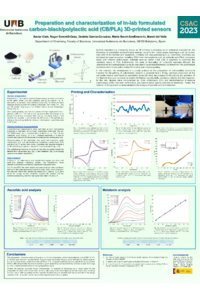
Additive manufacturing (most commonly known as 3D printing) is emerging as an alternative approach for the fabrication of customized electrochemical sensors, owing to their many unique advantages such as its low-cost (both of the material and equipment), tunability and easy prototyping. Concretely, electrodes are fabricated by fused deposition modelling (FDM) from thermoplastics such as poly-lactic acid (PLA) or acrylonitrile-butadiene-styrene (ABS), commonly doped with different carbon-based materials such as carbon black, carbon nanotubes (CNTs) or graphene to overcome the insulating nature of PLA and ABS. Furthermore, the ease of fabrication of composite materials (through the incorporation of redox mediators/electrocatalysts during the extrusion of customized filaments) combined with the automatized fabrication and miniaturization makes 3D printing even more appealing.
In this direction, the development of a simple protocol for the preparation of bulk-modified conductive filaments for the printing of voltammetric sensors is explored herein. Firstly, optimum proportions of the composite material were found by percolation theory. Next, the process for the printing and activation of the filament were also optimized to ensure the highest reproducibility, sensitivity, stability and fast response. To this aim, devices were characterized by cyclic voltammetry (CV) and electrochemical impedance spectroscopy (EIS), and their performance was benchmarked against commercial electrodes. Additionally, morphological characterization of the electrodes was conducted by scanning electron microscopy-energy dispersive X-ray spectroscopy (SEM-EDX). Finally, the potential of the approach is demonstrated through the amperometric detection of melatonin in over the counter (OTC) pharmaceuticals.
Keywords
3D printing
additive manufacturing
modified electrode
voltammetric sensors
conductive filaments
melatonin
Poster
Poster-073887'.pdf
Exploring the Photophysical Properties and Self-Assembly of a Spiropyran/Merocyanine Amphiphile in Different Solvents
Food contact materials and their chemical risk for the consumer’s health