Event submissions
EventsThe 2nd International Electronic Conference on Chemical Sensors and Analytical Chemistry
Published
This submission belongs to the session S3. Materials for Chemical Sensing of the event The 2nd International Electronic Conference on Chemical Sensors and Analytical Chemistry
Published date
18 Sep, 2023
Academic Editor
'%3e%3cpath%20d='M12.6657%2010.9104C12.4185%2010.325%2012.0599%209.79327%2011.6097%209.34482C11.1609%208.89508%2010.6293%208.5365%2010.0442%208.28888C10.0389%208.28626%2010.0337%208.28495%2010.0285%208.28233C10.8446%207.69279%2011.3752%206.73249%2011.3752%205.64904C11.3752%203.8542%209.92103%202.39999%208.1262%202.39999C6.33136%202.39999%204.87715%203.8542%204.87715%205.64904C4.87715%206.73249%205.40774%207.69279%206.22393%208.28364C6.21869%208.28626%206.21345%208.28757%206.20821%208.29019C5.62129%208.5378%205.09463%208.89284%204.64265%209.34613C4.1929%209.79493%203.83432%2010.3266%203.58671%2010.9117C3.34345%2011.4845%203.21226%2012.0987%203.20023%2012.7209C3.19988%2012.7349%203.20233%2012.7488%203.20744%2012.7619C3.21255%2012.7749%203.22022%2012.7867%203.22998%2012.7968C3.23975%2012.8068%203.25142%2012.8147%203.26431%2012.8202C3.2772%2012.8256%203.29105%2012.8284%203.30504%2012.8284H4.09109C4.14874%2012.8284%204.19459%2012.7825%204.1959%2012.7262C4.2221%2011.7148%204.62823%2010.7676%205.34617%2010.0497C6.08899%209.30683%207.0755%208.89808%208.1262%208.89808C9.17689%208.89808%2010.1634%209.30683%2010.9062%2010.0497C11.6242%2010.7676%2012.0303%2011.7148%2012.0565%2012.7262C12.0578%2012.7838%2012.1037%2012.8284%2012.1613%2012.8284H12.9474C12.9613%2012.8284%2012.9752%2012.8256%2012.9881%2012.8202C13.001%2012.8147%2013.0126%2012.8068%2013.0224%2012.7968C13.0322%2012.7867%2013.0398%2012.7749%2013.0449%2012.7619C13.0501%2012.7488%2013.0525%2012.7349%2013.0522%2012.7209C13.0391%2012.0947%2012.9094%2011.4855%2012.6657%2010.9104ZM8.1262%207.9024C7.52486%207.9024%206.9589%207.6679%206.53312%207.24211C6.10733%206.81633%205.87283%206.25037%205.87283%205.64904C5.87283%205.0477%206.10733%204.48174%206.53312%204.05596C6.9589%203.63018%207.52486%203.39567%208.1262%203.39567C8.72753%203.39567%209.29349%203.63018%209.71927%204.05596C10.1451%204.48174%2010.3796%205.0477%2010.3796%205.64904C10.3796%206.25037%2010.1451%206.81633%209.71927%207.24211C9.29349%207.6679%208.72753%207.9024%208.1262%207.9024Z'%20fill='%235D1EE1'/%3e%3c/g%3e%3c/svg%3e) Marco Frasconi
Marco FrasconiCitation
Nabi Ullah, Saraf Khan, Dariusz Guziejewski, Synthesis of Copper Selenide Nanobelts for Electrochemical Detection of Hydrogen Peroxide, in Proceedings of The 2nd International Electronic Conference on Chemical Sensors and Analytical Chemistry, 16 September–30 September 2023, MDPI: Basel, Switzerland
Share
Email
Facebook
Twitter
LinkedIn
Synthesis of Copper Selenide Nanobelts for Electrochemical Detection of Hydrogen Peroxide
'%3e%3cpath%20d='M12.6647%2010.9104C12.4176%2010.325%2012.0589%209.7933%2011.6088%209.34485C11.16%208.89511%2010.6283%208.53653%2010.0432%208.28891C10.038%208.28629%2010.0327%208.28498%2010.0275%208.28236C10.8437%207.69282%2011.3743%206.73252%2011.3743%205.64907C11.3743%203.85423%209.92005%202.40002%208.12522%202.40002C6.33038%202.40002%204.87618%203.85423%204.87618%205.64907C4.87618%206.73252%205.40677%207.69282%206.22296%208.28367C6.21772%208.28629%206.21248%208.2876%206.20724%208.29022C5.62031%208.53783%205.09365%208.89287%204.64167%209.34616C4.19192%209.79496%203.83334%2010.3266%203.58573%2010.9117C3.34247%2011.4846%203.21128%2012.0987%203.19925%2012.721C3.1989%2012.735%203.20135%2012.7489%203.20646%2012.7619C3.21157%2012.7749%203.21924%2012.7868%203.22901%2012.7968C3.23877%2012.8068%203.25045%2012.8148%203.26334%2012.8202C3.27623%2012.8256%203.29007%2012.8284%203.30406%2012.8284H4.09012C4.14776%2012.8284%204.19362%2012.7825%204.19493%2012.7262C4.22113%2011.7148%204.62726%2010.7676%205.34519%2010.0497C6.08802%209.30686%207.07452%208.89811%208.12522%208.89811C9.17592%208.89811%2010.1624%209.30686%2010.9052%2010.0497C11.6232%2010.7676%2012.0293%2011.7148%2012.0555%2012.7262C12.0568%2012.7839%2012.1027%2012.8284%2012.1603%2012.8284H12.9464C12.9604%2012.8284%2012.9742%2012.8256%2012.9871%2012.8202C13%2012.8148%2013.0117%2012.8068%2013.0214%2012.7968C13.0312%2012.7868%2013.0389%2012.7749%2013.044%2012.7619C13.0491%2012.7489%2013.0515%2012.735%2013.0512%2012.721C13.0381%2012.0947%2012.9084%2011.4856%2012.6647%2010.9104ZM8.12522%207.90243C7.52388%207.90243%206.95792%207.66793%206.53214%207.24215C6.10636%206.81636%205.87185%206.2504%205.87185%205.64907C5.87185%205.04773%206.10636%204.48177%206.53214%204.05599C6.95792%203.63021%207.52388%203.3957%208.12522%203.3957C8.72655%203.3957%209.29252%203.63021%209.7183%204.05599C10.1441%204.48177%2010.3786%205.04773%2010.3786%205.64907C10.3786%206.2504%2010.1441%206.81636%209.7183%207.24215C9.29252%207.66793%208.72655%207.90243%208.12522%207.90243Z'%20fill='%235D1EE1'/%3e%3c/g%3e%3c/svg%3e)
Nabi Ullah 1
Saraf Khan 2
Dariusz Guziejewski 2
1. University of Lodz
2. Department of Inorganic and Analytical Chemistry, Faculty of Chemistry, University of Lodz, Tamka 12, 90 403 Lodz, Poland
Abstract
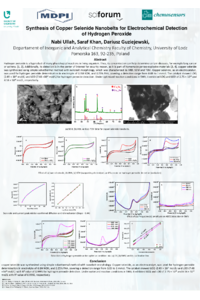
Hydrogen peroxide, a vital component in oxidative reactions during biosynthesis, serves as a crucial defense against bacteria, particularly in urine. Nevertheless, its presence can also indicate severe diseases and disorders, such as asthma or lung cancer. Consequently, the demand for more precise and sensitive materials and techniques to detect hydrogen peroxide is rapidly growing. This study aim to explore the electrochemical sensing capabilities of newly developed copper selenide nanobelts.
Copper selenide was choose an electrocatalyst for the detection of hydrogen peroxide, based on copper study for H2O2 detection even in its gaseous form. To synthesize the copper selenide nanobelts, a straightforward solvothermal method was employed, utilizing DETA (Diethylenetriamine) as both a reaction medium and a morphology-directing agent. The reaction was conducted at 180°C for 16 hours to obtain the final product.
Characterization techniques including SEM, TEM, and XRD were employed to confirm the nanobelts' morphology, crystallinity, and purity. Encouragingly, the copper selenide nanobelts exhibited excellent sensitivity in detecting hydrogen peroxide in an electrolyte solution consisting of 0.1M KOH and 0.25% PAA. The sensing application of copper selenide was studied across a range of hydrogen peroxide concentrations, from 0.03 to 1 mmol, demonstrating a highly linear response with impressively low limits of detection (LOD) and quantification (LOQ) values.
This research sheds light on the significant role of copper selenide nanobelts for precise and sensitive detection, paving the way for advancements in diagnosing and monitoring various diseases and disorders associated with hydrogen peroxide levels.
Keywords
Copper selenide
Nanbelts
Hydrogen peroxide
electrchemical detection,
Manuscript
Poster.pdf
Poster
Poster.pdf
Nanotechnology at its peak: flexibility and efficacy of nanosensors in food safety
Direct electrochemical reduction of hydrogen peroxide catalyzed with copper (II) ions in the presence of polyacrylic acid and poly(2-acrylamido-2-methyl-1-propanesulfonic acid) as supporting electrolytes.