Event submissions
EventsThe 2nd International Electronic Conference on Chemical Sensors and Analytical Chemistry
Published
This submission belongs to the session S7. (Bio)chemical Sensing of the event The 2nd International Electronic Conference on Chemical Sensors and Analytical Chemistry
Published date
18 Sep, 2023
Academic Editor
'%3e%3cpath%20d='M12.6657%2010.9104C12.4185%2010.325%2012.0599%209.79327%2011.6097%209.34482C11.1609%208.89508%2010.6293%208.5365%2010.0442%208.28888C10.0389%208.28626%2010.0337%208.28495%2010.0285%208.28233C10.8446%207.69279%2011.3752%206.73249%2011.3752%205.64904C11.3752%203.8542%209.92103%202.39999%208.1262%202.39999C6.33136%202.39999%204.87715%203.8542%204.87715%205.64904C4.87715%206.73249%205.40774%207.69279%206.22393%208.28364C6.21869%208.28626%206.21345%208.28757%206.20821%208.29019C5.62129%208.5378%205.09463%208.89284%204.64265%209.34613C4.1929%209.79493%203.83432%2010.3266%203.58671%2010.9117C3.34345%2011.4845%203.21226%2012.0987%203.20023%2012.7209C3.19988%2012.7349%203.20233%2012.7488%203.20744%2012.7619C3.21255%2012.7749%203.22022%2012.7867%203.22998%2012.7968C3.23975%2012.8068%203.25142%2012.8147%203.26431%2012.8202C3.2772%2012.8256%203.29105%2012.8284%203.30504%2012.8284H4.09109C4.14874%2012.8284%204.19459%2012.7825%204.1959%2012.7262C4.2221%2011.7148%204.62823%2010.7676%205.34617%2010.0497C6.08899%209.30683%207.0755%208.89808%208.1262%208.89808C9.17689%208.89808%2010.1634%209.30683%2010.9062%2010.0497C11.6242%2010.7676%2012.0303%2011.7148%2012.0565%2012.7262C12.0578%2012.7838%2012.1037%2012.8284%2012.1613%2012.8284H12.9474C12.9613%2012.8284%2012.9752%2012.8256%2012.9881%2012.8202C13.001%2012.8147%2013.0126%2012.8068%2013.0224%2012.7968C13.0322%2012.7867%2013.0398%2012.7749%2013.0449%2012.7619C13.0501%2012.7488%2013.0525%2012.7349%2013.0522%2012.7209C13.0391%2012.0947%2012.9094%2011.4855%2012.6657%2010.9104ZM8.1262%207.9024C7.52486%207.9024%206.9589%207.6679%206.53312%207.24211C6.10733%206.81633%205.87283%206.25037%205.87283%205.64904C5.87283%205.0477%206.10733%204.48174%206.53312%204.05596C6.9589%203.63018%207.52486%203.39567%208.1262%203.39567C8.72753%203.39567%209.29349%203.63018%209.71927%204.05596C10.1451%204.48174%2010.3796%205.0477%2010.3796%205.64904C10.3796%206.25037%2010.1451%206.81633%209.71927%207.24211C9.29349%207.6679%208.72753%207.9024%208.1262%207.9024Z'%20fill='%235D1EE1'/%3e%3c/g%3e%3c/svg%3e) Camelia Bala
Camelia BalaCitation
Clara Perez-Gonzalez, Coral Salvo-Comino, Patricia Najera-Morales, Fernando Martin-Pedrosa, María Luz Rodríguez-Mendez, Cristina Garcia-Cabezon, Differential pulse voltammetry as an analytical tool for raw milk analysis using electrochemical biosensors, in Proceedings of The 2nd International Electronic Conference on Chemical Sensors and Analytical Chemistry, 16 September–30 September 2023, MDPI: Basel, Switzerland
Share
Email
Facebook
Twitter
LinkedIn
Differential pulse voltammetry as an analytical tool for raw milk analysis using electrochemical biosensors
'%3e%3cpath%20d='M12.6647%2010.9104C12.4176%2010.325%2012.0589%209.7933%2011.6088%209.34485C11.16%208.89511%2010.6283%208.53653%2010.0432%208.28891C10.038%208.28629%2010.0327%208.28498%2010.0275%208.28236C10.8437%207.69282%2011.3743%206.73252%2011.3743%205.64907C11.3743%203.85423%209.92005%202.40002%208.12522%202.40002C6.33038%202.40002%204.87618%203.85423%204.87618%205.64907C4.87618%206.73252%205.40677%207.69282%206.22296%208.28367C6.21772%208.28629%206.21248%208.2876%206.20724%208.29022C5.62031%208.53783%205.09365%208.89287%204.64167%209.34616C4.19192%209.79496%203.83334%2010.3266%203.58573%2010.9117C3.34247%2011.4846%203.21128%2012.0987%203.19925%2012.721C3.1989%2012.735%203.20135%2012.7489%203.20646%2012.7619C3.21157%2012.7749%203.21924%2012.7868%203.22901%2012.7968C3.23877%2012.8068%203.25045%2012.8148%203.26334%2012.8202C3.27623%2012.8256%203.29007%2012.8284%203.30406%2012.8284H4.09012C4.14776%2012.8284%204.19362%2012.7825%204.19493%2012.7262C4.22113%2011.7148%204.62726%2010.7676%205.34519%2010.0497C6.08802%209.30686%207.07452%208.89811%208.12522%208.89811C9.17592%208.89811%2010.1624%209.30686%2010.9052%2010.0497C11.6232%2010.7676%2012.0293%2011.7148%2012.0555%2012.7262C12.0568%2012.7839%2012.1027%2012.8284%2012.1603%2012.8284H12.9464C12.9604%2012.8284%2012.9742%2012.8256%2012.9871%2012.8202C13%2012.8148%2013.0117%2012.8068%2013.0214%2012.7968C13.0312%2012.7868%2013.0389%2012.7749%2013.044%2012.7619C13.0491%2012.7489%2013.0515%2012.735%2013.0512%2012.721C13.0381%2012.0947%2012.9084%2011.4856%2012.6647%2010.9104ZM8.12522%207.90243C7.52388%207.90243%206.95792%207.66793%206.53214%207.24215C6.10636%206.81636%205.87185%206.2504%205.87185%205.64907C5.87185%205.04773%206.10636%204.48177%206.53214%204.05599C6.95792%203.63021%207.52388%203.3957%208.12522%203.3957C8.72655%203.3957%209.29252%203.63021%209.7183%204.05599C10.1441%204.48177%2010.3786%205.04773%2010.3786%205.64907C10.3786%206.2504%2010.1441%206.81636%209.7183%207.24215C9.29252%207.66793%208.72655%207.90243%208.12522%207.90243Z'%20fill='%235D1EE1'/%3e%3c/g%3e%3c/svg%3e)
Clara Perez-Gonzalez 1
Coral Salvo-Comino 1
Patricia Najera-Morales 1
Fernando Martin-Pedrosa 1

María Luz Rodríguez-Mendez 1
Cristina Garcia-Cabezon 1
1. Group UVaSens, University of Valladolid, Escuela de Ingenierías Industriales Paseo del Cauce, 59, 47011 Valladolid
Abstract
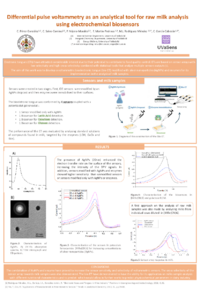
Electrochemical sensors and biosensors have great interest in food quality control due to their fast analysis and low prices. However, there are several problems related to the fouling of the electrodes and the preservation conditions that restrict their use in real sample analysis. An alternate method for analyzing complex liquids, such as milk, relies on a multivariate description of the chemical composition of samples based on non-specific fingerprints provided by an array of sensors and the quimiometric analysis of their responses [1-2]. The purpose of this work was to develop an array of biosensors for its application in milk analysis using differential pulse voltammetry (DPV) as the transduction mechanism. In order to develop sensors with enhanced sensitivities and selectivity towards certain molecules, such as galactose and glucose, enzymes were immobilized on the sensors surface resulting in an array of five sensors. Higher sensitivities were achieved in the responses of the biosensors developed showing evident increases on the intensities in presence of the target molecules on standard solutions confirming the correct immobilization of the biomaterial. Furthermore, a first approach on the analysis of raw milk samples was also made by analyzing milks from individual cows to determine differences in their nutritional composition.
[1]Wasilewski T., Kamysz W., Gębicki J. "Bioelectronic tongue: Current status and perspectives" Biosensors and Bioelectronics 150, 2020, 111923. https://doi.org/10.1016/j.bios.2019.111923.
[2] Skládal P. "Smart bioelectronic tongues for food and drinks control" TrAC Trends in Analytical Chemistry 127, 2020, 115887. https://doi.org/10.1016/j.trac.2020.115887.
Keywords
Biosensors
Enzymes
Electrochemistry
Differental Pullse Voltammetry
Manuscript
csac 2023 poster.pdf
Poster
csac 2023 poster.pdf
Direct electrochemical reduction of hydrogen peroxide catalyzed with copper (II) ions in the presence of polyacrylic acid and poly(2-acrylamido-2-methyl-1-propanesulfonic acid) as supporting electrolytes.
An Electrochemical Sensor Based on Chitosan Molecularly Imprinted Polymers for the Selective Detection of Diphenylamine