Event submissions
EventsThe 2nd International Electronic Conference on Chemical Sensors and Analytical Chemistry
Published

This submission belongs to the session S1. Electrochemical Devices and Sensors of the event The 2nd International Electronic Conference on Chemical Sensors and Analytical Chemistry
Published date
28 Sep, 2023
Academic Editor
'%3e%3cpath%20d='M12.6657%2010.9104C12.4185%2010.325%2012.0599%209.79327%2011.6097%209.34482C11.1609%208.89508%2010.6293%208.5365%2010.0442%208.28888C10.0389%208.28626%2010.0337%208.28495%2010.0285%208.28233C10.8446%207.69279%2011.3752%206.73249%2011.3752%205.64904C11.3752%203.8542%209.92103%202.39999%208.1262%202.39999C6.33136%202.39999%204.87715%203.8542%204.87715%205.64904C4.87715%206.73249%205.40774%207.69279%206.22393%208.28364C6.21869%208.28626%206.21345%208.28757%206.20821%208.29019C5.62129%208.5378%205.09463%208.89284%204.64265%209.34613C4.1929%209.79493%203.83432%2010.3266%203.58671%2010.9117C3.34345%2011.4845%203.21226%2012.0987%203.20023%2012.7209C3.19988%2012.7349%203.20233%2012.7488%203.20744%2012.7619C3.21255%2012.7749%203.22022%2012.7867%203.22998%2012.7968C3.23975%2012.8068%203.25142%2012.8147%203.26431%2012.8202C3.2772%2012.8256%203.29105%2012.8284%203.30504%2012.8284H4.09109C4.14874%2012.8284%204.19459%2012.7825%204.1959%2012.7262C4.2221%2011.7148%204.62823%2010.7676%205.34617%2010.0497C6.08899%209.30683%207.0755%208.89808%208.1262%208.89808C9.17689%208.89808%2010.1634%209.30683%2010.9062%2010.0497C11.6242%2010.7676%2012.0303%2011.7148%2012.0565%2012.7262C12.0578%2012.7838%2012.1037%2012.8284%2012.1613%2012.8284H12.9474C12.9613%2012.8284%2012.9752%2012.8256%2012.9881%2012.8202C13.001%2012.8147%2013.0126%2012.8068%2013.0224%2012.7968C13.0322%2012.7867%2013.0398%2012.7749%2013.0449%2012.7619C13.0501%2012.7488%2013.0525%2012.7349%2013.0522%2012.7209C13.0391%2012.0947%2012.9094%2011.4855%2012.6657%2010.9104ZM8.1262%207.9024C7.52486%207.9024%206.9589%207.6679%206.53312%207.24211C6.10733%206.81633%205.87283%206.25037%205.87283%205.64904C5.87283%205.0477%206.10733%204.48174%206.53312%204.05596C6.9589%203.63018%207.52486%203.39567%208.1262%203.39567C8.72753%203.39567%209.29349%203.63018%209.71927%204.05596C10.1451%204.48174%2010.3796%205.0477%2010.3796%205.64904C10.3796%206.25037%2010.1451%206.81633%209.71927%207.24211C9.29349%207.6679%208.72753%207.9024%208.1262%207.9024Z'%20fill='%235D1EE1'/%3e%3c/g%3e%3c/svg%3e) Nicole Jaffrezic-Renault
Nicole Jaffrezic-RenaultCitation
Wulan Tri Wahyuni, Hana Safitri, Eti Rohaeti, Munawar Khalil, Budi Riza Putra, A Novel Approach to Fabricate Screen-Printed Electrode Based on The Composite of Gold Nanorods-Graphene Oxide for Detection of Uric Acid, in Proceedings of The 2nd International Electronic Conference on Chemical Sensors and Analytical Chemistry, 16 September–30 September 2023, MDPI: Basel, Switzerland, doi: 10.3390/CSAC2023-14908
Share
Email
Facebook
Twitter
LinkedIn
A Novel Approach to Fabricate Screen-Printed Electrode Based on The Composite of Gold Nanorods-Graphene Oxide for Detection of Uric Acid
'%3e%3cpath%20d='M12.6647%2010.9104C12.4176%2010.325%2012.0589%209.7933%2011.6088%209.34485C11.16%208.89511%2010.6283%208.53653%2010.0432%208.28891C10.038%208.28629%2010.0327%208.28498%2010.0275%208.28236C10.8437%207.69282%2011.3743%206.73252%2011.3743%205.64907C11.3743%203.85423%209.92005%202.40002%208.12522%202.40002C6.33038%202.40002%204.87618%203.85423%204.87618%205.64907C4.87618%206.73252%205.40677%207.69282%206.22296%208.28367C6.21772%208.28629%206.21248%208.2876%206.20724%208.29022C5.62031%208.53783%205.09365%208.89287%204.64167%209.34616C4.19192%209.79496%203.83334%2010.3266%203.58573%2010.9117C3.34247%2011.4846%203.21128%2012.0987%203.19925%2012.721C3.1989%2012.735%203.20135%2012.7489%203.20646%2012.7619C3.21157%2012.7749%203.21924%2012.7868%203.22901%2012.7968C3.23877%2012.8068%203.25045%2012.8148%203.26334%2012.8202C3.27623%2012.8256%203.29007%2012.8284%203.30406%2012.8284H4.09012C4.14776%2012.8284%204.19362%2012.7825%204.19493%2012.7262C4.22113%2011.7148%204.62726%2010.7676%205.34519%2010.0497C6.08802%209.30686%207.07452%208.89811%208.12522%208.89811C9.17592%208.89811%2010.1624%209.30686%2010.9052%2010.0497C11.6232%2010.7676%2012.0293%2011.7148%2012.0555%2012.7262C12.0568%2012.7839%2012.1027%2012.8284%2012.1603%2012.8284H12.9464C12.9604%2012.8284%2012.9742%2012.8256%2012.9871%2012.8202C13%2012.8148%2013.0117%2012.8068%2013.0214%2012.7968C13.0312%2012.7868%2013.0389%2012.7749%2013.044%2012.7619C13.0491%2012.7489%2013.0515%2012.735%2013.0512%2012.721C13.0381%2012.0947%2012.9084%2011.4856%2012.6647%2010.9104ZM8.12522%207.90243C7.52388%207.90243%206.95792%207.66793%206.53214%207.24215C6.10636%206.81636%205.87185%206.2504%205.87185%205.64907C5.87185%205.04773%206.10636%204.48177%206.53214%204.05599C6.95792%203.63021%207.52388%203.3957%208.12522%203.3957C8.72655%203.3957%209.29252%203.63021%209.7183%204.05599C10.1441%204.48177%2010.3786%205.04773%2010.3786%205.64907C10.3786%206.2504%2010.1441%206.81636%209.7183%207.24215C9.29252%207.66793%208.72655%207.90243%208.12522%207.90243Z'%20fill='%235D1EE1'/%3e%3c/g%3e%3c/svg%3e)
Wulan Tri Wahyuni 1,2
Hana Safitri 2
Eti Rohaeti 2
Munawar Khalil 3
Budi Riza Putra 4
1. Analytical Chemistry Division, Department of Chemistry, Faculty of Mathematics and Natural Sciences, IPB University, Indonesia
2. Tropical Biopharmaca Research Center, Institute of Research and Community Empowerment, IPB University, Indonesia
3. Department of Chemistry, Faculty of Mathematics and Natural Sciences, University of Indonesia, Indonesia
4. Research Center for Metallurgy, National Research and Innovation Agency (BRIN), South Tangerang, Banten 15314, Indonesia
Abstract
In this work, we report the development of a technique to fabricate a screen-printed electrode (SPE) and its applications for uric acid sensing. The SPE was fabricated using a printing technique using an office printer printed on a photo paper substrate. Particularly, the conductive ink used for printing the working electrode (WE) and counter electrode (CE) consisted of graphene oxide (GO) and gold nanorod (AuNR) material. While the reference electrode (RE) was made by applying the conductive silver paste to the fabricated SPE. The electrochemical measurement of uric acid solution using fabricated SPE GO/AuNR provides a higher signal than the commercially available SPE. The electroanalytical performance of the fabricated SPE based on GO/AuNR toward the measurement of uric acid solution exhibited a linear range of 0.8−200 μM, a detection limit of 0.5 μM, a quantitation limit of 1.0 μM, outstanding repeatability (% relative standard deviation) of 4.885 % as well as good selectivity with ascorbic acid, dopamine, glucose, urea, and sodium as interference. Furthermore, the fabricated SPE based on GO/AuNR was successfully employed for the determination of uric acid concentration in human urine samples using the standard addition approach.
Keywords
screen printed electrode
gold nanorods
graphene oxide
uric acid
sensor
inkjet-printing
Manuscript
manuscript sciforum-075236.pdf
Poster
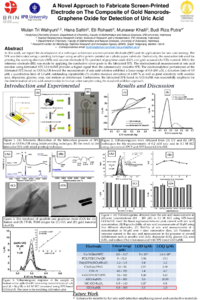
poster for sciforum-075236.pdf
QSPR Modeling for Predicting Sensitivity of Membrane Sensors based on Modified Diphenylphosphoryl Acetamide Ionophores
Amino acid-functionalized polyfluorenes: A class of ultra-sensitive fluorescent sensors favoring Cr2O72-