Event submissions
EventsThe 2nd International Electronic Conference on Chemical Sensors and Analytical Chemistry
Published

This submission belongs to the session S4. Applied Chemical Sensors of the event The 2nd International Electronic Conference on Chemical Sensors and Analytical Chemistry
Published date
12 Oct, 2023
Academic Editor
'%3e%3cpath%20d='M12.6657%2010.9104C12.4185%2010.325%2012.0599%209.79327%2011.6097%209.34482C11.1609%208.89508%2010.6293%208.5365%2010.0442%208.28888C10.0389%208.28626%2010.0337%208.28495%2010.0285%208.28233C10.8446%207.69279%2011.3752%206.73249%2011.3752%205.64904C11.3752%203.8542%209.92103%202.39999%208.1262%202.39999C6.33136%202.39999%204.87715%203.8542%204.87715%205.64904C4.87715%206.73249%205.40774%207.69279%206.22393%208.28364C6.21869%208.28626%206.21345%208.28757%206.20821%208.29019C5.62129%208.5378%205.09463%208.89284%204.64265%209.34613C4.1929%209.79493%203.83432%2010.3266%203.58671%2010.9117C3.34345%2011.4845%203.21226%2012.0987%203.20023%2012.7209C3.19988%2012.7349%203.20233%2012.7488%203.20744%2012.7619C3.21255%2012.7749%203.22022%2012.7867%203.22998%2012.7968C3.23975%2012.8068%203.25142%2012.8147%203.26431%2012.8202C3.2772%2012.8256%203.29105%2012.8284%203.30504%2012.8284H4.09109C4.14874%2012.8284%204.19459%2012.7825%204.1959%2012.7262C4.2221%2011.7148%204.62823%2010.7676%205.34617%2010.0497C6.08899%209.30683%207.0755%208.89808%208.1262%208.89808C9.17689%208.89808%2010.1634%209.30683%2010.9062%2010.0497C11.6242%2010.7676%2012.0303%2011.7148%2012.0565%2012.7262C12.0578%2012.7838%2012.1037%2012.8284%2012.1613%2012.8284H12.9474C12.9613%2012.8284%2012.9752%2012.8256%2012.9881%2012.8202C13.001%2012.8147%2013.0126%2012.8068%2013.0224%2012.7968C13.0322%2012.7867%2013.0398%2012.7749%2013.0449%2012.7619C13.0501%2012.7488%2013.0525%2012.7349%2013.0522%2012.7209C13.0391%2012.0947%2012.9094%2011.4855%2012.6657%2010.9104ZM8.1262%207.9024C7.52486%207.9024%206.9589%207.6679%206.53312%207.24211C6.10733%206.81633%205.87283%206.25037%205.87283%205.64904C5.87283%205.0477%206.10733%204.48174%206.53312%204.05596C6.9589%203.63018%207.52486%203.39567%208.1262%203.39567C8.72753%203.39567%209.29349%203.63018%209.71927%204.05596C10.1451%204.48174%2010.3796%205.0477%2010.3796%205.64904C10.3796%206.25037%2010.1451%206.81633%209.71927%207.24211C9.29349%207.6679%208.72753%207.9024%208.1262%207.9024Z'%20fill='%235D1EE1'/%3e%3c/g%3e%3c/svg%3e) Jose Vicente Ros-Lis
Jose Vicente Ros-LisCitation
Irari Jiménez-López, Jeniffer Molina, Juan Manuel Gutiérrez, Classification of teas using different feature extraction methods from signals of a lab-made electronic nose., in Proceedings of The 2nd International Electronic Conference on Chemical Sensors and Analytical Chemistry, 16 September–30 September 2023, MDPI: Basel, Switzerland, doi: 10.3390/CSAC2023-14933
Share
Email
Facebook
Twitter
LinkedIn
Classification of teas using different feature extraction methods from signals of a lab-made electronic nose.
'%3e%3cpath%20d='M12.6647%2010.9104C12.4176%2010.325%2012.0589%209.7933%2011.6088%209.34485C11.16%208.89511%2010.6283%208.53653%2010.0432%208.28891C10.038%208.28629%2010.0327%208.28498%2010.0275%208.28236C10.8437%207.69282%2011.3743%206.73252%2011.3743%205.64907C11.3743%203.85423%209.92005%202.40002%208.12522%202.40002C6.33038%202.40002%204.87618%203.85423%204.87618%205.64907C4.87618%206.73252%205.40677%207.69282%206.22296%208.28367C6.21772%208.28629%206.21248%208.2876%206.20724%208.29022C5.62031%208.53783%205.09365%208.89287%204.64167%209.34616C4.19192%209.79496%203.83334%2010.3266%203.58573%2010.9117C3.34247%2011.4846%203.21128%2012.0987%203.19925%2012.721C3.1989%2012.735%203.20135%2012.7489%203.20646%2012.7619C3.21157%2012.7749%203.21924%2012.7868%203.22901%2012.7968C3.23877%2012.8068%203.25045%2012.8148%203.26334%2012.8202C3.27623%2012.8256%203.29007%2012.8284%203.30406%2012.8284H4.09012C4.14776%2012.8284%204.19362%2012.7825%204.19493%2012.7262C4.22113%2011.7148%204.62726%2010.7676%205.34519%2010.0497C6.08802%209.30686%207.07452%208.89811%208.12522%208.89811C9.17592%208.89811%2010.1624%209.30686%2010.9052%2010.0497C11.6232%2010.7676%2012.0293%2011.7148%2012.0555%2012.7262C12.0568%2012.7839%2012.1027%2012.8284%2012.1603%2012.8284H12.9464C12.9604%2012.8284%2012.9742%2012.8256%2012.9871%2012.8202C13%2012.8148%2013.0117%2012.8068%2013.0214%2012.7968C13.0312%2012.7868%2013.0389%2012.7749%2013.044%2012.7619C13.0491%2012.7489%2013.0515%2012.735%2013.0512%2012.721C13.0381%2012.0947%2012.9084%2011.4856%2012.6647%2010.9104ZM8.12522%207.90243C7.52388%207.90243%206.95792%207.66793%206.53214%207.24215C6.10636%206.81636%205.87185%206.2504%205.87185%205.64907C5.87185%205.04773%206.10636%204.48177%206.53214%204.05599C6.95792%203.63021%207.52388%203.3957%208.12522%203.3957C8.72655%203.3957%209.29252%203.63021%209.7183%204.05599C10.1441%204.48177%2010.3786%205.04773%2010.3786%205.64907C10.3786%206.2504%2010.1441%206.81636%209.7183%207.24215C9.29252%207.66793%208.72655%207.90243%208.12522%207.90243Z'%20fill='%235D1EE1'/%3e%3c/g%3e%3c/svg%3e)
Irari Jiménez-López 1
Jeniffer Molina 1

Juan Manuel Gutiérrez 1
1. Bioelectronics Section, Department of Electrical Engineering, CINVESTAV-IPN, 07360 Mexico City, Mexico
Abstract
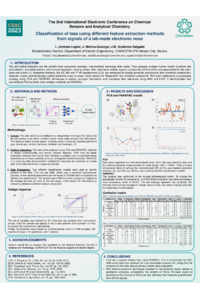
Tea and herbal infusions are the most consumed non-alcoholic beverages worldwide and possess bioactive components with multiple health benefits. They are categorized in different classes that depend on: the elaboration process, origin, and components. Commonly, analytical methods are employed to classify tea according to its a chemical composition by liquid and gas chromatography-mass spectrometry, among others. Novel methods, such as electronic noses (e-noses) effectively provide real-time and objective monitoring of odors for extended periods of time. This work aimed to classify 8 different types of tea (green, white, black, spearmint, mint, hibiscus, lemongrass, chamomile) using two feature extraction methods and two pattern recognition analyses that were compared. A total of 34 tea samples were analyzed by e-nose consisting of a sample handling system as olfactometer, seven chemo-resistive gas sensors, and a 12-bit analog-to-digital converter. Tea samples were measured 10 times to ensure repeatability, resulting in database of 340 tea measures with 2499 samples each per sensor.
Data were pre-processed using Principal Component Analysis (PCA) and Parallel Factor Analysis (PARAFAC). The information extracted was classified by Artificial Neural Network (ANN) and k-nearest neighbor (k-NN). The best architecture in ANN and distance in k-NN were demonstrated by 10 k-fold cross-validation. The classification rate was 93% in ANN and PCA, 73% in ANN and PARAFAC, 94% in k-NN and PCA, and 84% in k-NN and PARAFAC. This demonstrates that conventional PCA is better than complex PARAFAC.
Keywords
tea
e-nose
PCA
PARAFAC
ANN
k-NN
Manuscript
sciforum-073770.pdf
Poster
Poster_073770.pdf
Optical Colorimetric Paper Sensor for Monitoring Food Freshness
Pilot study of the qualitative analysis of urinary stones by near infrared spectroscopy and chemometrics