Event submissions
Published
 10.3390/APD20symposium-14935 (registering DOI)
 This submission belongs to the session S6. Other Topics of the event Antimicrobial Peptides: Yesterday, Today and Tomorrow
Published date
12 Oct, 2023
Academic Editor
'%3e%3cpath%20d='M12.6657%2010.9104C12.4185%2010.325%2012.0599%209.79327%2011.6097%209.34482C11.1609%208.89508%2010.6293%208.5365%2010.0442%208.28888C10.0389%208.28626%2010.0337%208.28495%2010.0285%208.28233C10.8446%207.69279%2011.3752%206.73249%2011.3752%205.64904C11.3752%203.8542%209.92103%202.39999%208.1262%202.39999C6.33136%202.39999%204.87715%203.8542%204.87715%205.64904C4.87715%206.73249%205.40774%207.69279%206.22393%208.28364C6.21869%208.28626%206.21345%208.28757%206.20821%208.29019C5.62129%208.5378%205.09463%208.89284%204.64265%209.34613C4.1929%209.79493%203.83432%2010.3266%203.58671%2010.9117C3.34345%2011.4845%203.21226%2012.0987%203.20023%2012.7209C3.19988%2012.7349%203.20233%2012.7488%203.20744%2012.7619C3.21255%2012.7749%203.22022%2012.7867%203.22998%2012.7968C3.23975%2012.8068%203.25142%2012.8147%203.26431%2012.8202C3.2772%2012.8256%203.29105%2012.8284%203.30504%2012.8284H4.09109C4.14874%2012.8284%204.19459%2012.7825%204.1959%2012.7262C4.2221%2011.7148%204.62823%2010.7676%205.34617%2010.0497C6.08899%209.30683%207.0755%208.89808%208.1262%208.89808C9.17689%208.89808%2010.1634%209.30683%2010.9062%2010.0497C11.6242%2010.7676%2012.0303%2011.7148%2012.0565%2012.7262C12.0578%2012.7838%2012.1037%2012.8284%2012.1613%2012.8284H12.9474C12.9613%2012.8284%2012.9752%2012.8256%2012.9881%2012.8202C13.001%2012.8147%2013.0126%2012.8068%2013.0224%2012.7968C13.0322%2012.7867%2013.0398%2012.7749%2013.0449%2012.7619C13.0501%2012.7488%2013.0525%2012.7349%2013.0522%2012.7209C13.0391%2012.0947%2012.9094%2011.4855%2012.6657%2010.9104ZM8.1262%207.9024C7.52486%207.9024%206.9589%207.6679%206.53312%207.24211C6.10733%206.81633%205.87283%206.25037%205.87283%205.64904C5.87283%205.0477%206.10733%204.48174%206.53312%204.05596C6.9589%203.63018%207.52486%203.39567%208.1262%203.39567C8.72753%203.39567%209.29349%203.63018%209.71927%204.05596C10.1451%204.48174%2010.3796%205.0477%2010.3796%205.64904C10.3796%206.25037%2010.1451%206.81633%209.71927%207.24211C9.29349%207.6679%208.72753%207.9024%208.1262%207.9024Z'%20fill='%235D1EE1'/%3e%3c/g%3e%3c/svg%3e) Guangshun Wang
Guangshun WangCitation
Mariela Marani, Silvana Aguilar, Andrea Micaela Dallagnol, Dario E. Cardozo, Andrés E. Brunetti, Physicochemical profiling of antimicrobial peptides from Physalaemus santafecinus and their potential role in foam nest construction, in Proceedings of Antimicrobial Peptides: Yesterday, Today and Tomorrow, 1 October–7 October 2023, MDPI: Basel, Switzerland, doi: 10.3390/APD20symposium-14935
Share
Email
Facebook
Twitter
LinkedIn
Physicochemical profiling of antimicrobial peptides from Physalaemus santafecinus and their potential role in foam nest construction

Mariela Marani 1
'%3e%3cpath%20d='M12.6647%2010.9104C12.4176%2010.325%2012.0589%209.7933%2011.6088%209.34485C11.16%208.89511%2010.6283%208.53653%2010.0432%208.28891C10.038%208.28629%2010.0327%208.28498%2010.0275%208.28236C10.8437%207.69282%2011.3743%206.73252%2011.3743%205.64907C11.3743%203.85423%209.92005%202.40002%208.12522%202.40002C6.33038%202.40002%204.87618%203.85423%204.87618%205.64907C4.87618%206.73252%205.40677%207.69282%206.22296%208.28367C6.21772%208.28629%206.21248%208.2876%206.20724%208.29022C5.62031%208.53783%205.09365%208.89287%204.64167%209.34616C4.19192%209.79496%203.83334%2010.3266%203.58573%2010.9117C3.34247%2011.4846%203.21128%2012.0987%203.19925%2012.721C3.1989%2012.735%203.20135%2012.7489%203.20646%2012.7619C3.21157%2012.7749%203.21924%2012.7868%203.22901%2012.7968C3.23877%2012.8068%203.25045%2012.8148%203.26334%2012.8202C3.27623%2012.8256%203.29007%2012.8284%203.30406%2012.8284H4.09012C4.14776%2012.8284%204.19362%2012.7825%204.19493%2012.7262C4.22113%2011.7148%204.62726%2010.7676%205.34519%2010.0497C6.08802%209.30686%207.07452%208.89811%208.12522%208.89811C9.17592%208.89811%2010.1624%209.30686%2010.9052%2010.0497C11.6232%2010.7676%2012.0293%2011.7148%2012.0555%2012.7262C12.0568%2012.7839%2012.1027%2012.8284%2012.1603%2012.8284H12.9464C12.9604%2012.8284%2012.9742%2012.8256%2012.9871%2012.8202C13%2012.8148%2013.0117%2012.8068%2013.0214%2012.7968C13.0312%2012.7868%2013.0389%2012.7749%2013.044%2012.7619C13.0491%2012.7489%2013.0515%2012.735%2013.0512%2012.721C13.0381%2012.0947%2012.9084%2011.4856%2012.6647%2010.9104ZM8.12522%207.90243C7.52388%207.90243%206.95792%207.66793%206.53214%207.24215C6.10636%206.81636%205.87185%206.2504%205.87185%205.64907C5.87185%205.04773%206.10636%204.48177%206.53214%204.05599C6.95792%203.63021%207.52388%203.3957%208.12522%203.3957C8.72655%203.3957%209.29252%203.63021%209.7183%204.05599C10.1441%204.48177%2010.3786%205.04773%2010.3786%205.64907C10.3786%206.2504%2010.1441%206.81636%209.7183%207.24215C9.29252%207.66793%208.72655%207.90243%208.12522%207.90243Z'%20fill='%235D1EE1'/%3e%3c/g%3e%3c/svg%3e)
Silvana Aguilar 2
Andrea Micaela Dallagnol 3
Dario E. Cardozo 4
Andrés E. Brunetti 5
1. IPEEC CONICET
2. IPEEC CONICET, Puerto Madryn, Argentina
3. Instituto de Materiales de Misiones (IMAN, CONICET-UNaM). Posadas, Misiones
4. Laboratorio de Histología y Embriología Comparada (LABHEC). Universidad Nacional del Alto Uruguay, San Vicente, Misiones
5. Instituto de Biología Subtropical (IBS, CONICET-UNaM). Posadas, Misiones
Abstract
Foam nest construction is a unique oviposition method that evolved independently in anurans lineages from the Neotropics, Asia, and Africa. The nest’s formation involves protein secretions from the oviduct follow by a series of fast kicking of the hind legs by the amplectant pair. One of their potential functions is protection against pathogens, but with a lack of supportive evidence. In this sense, the overall aims of our project is to understand whether skin’s antimicrobial peptides (AMPs), produced by dermal glands may be incorporated to the foam during nest formation and modulate its microbiome. This study represents the first steps on this regard. Here, we analyzed transcriptomes from dorsal skin region of a male and a female of Physalaemus santafecinus to assess AMP gene expression. To assemble the transcriptome, we used Trinity and Spades, and Transdecoder and Orfpredictor for translation. Using conserved sequences from the signal peptide region of described prepro-peptides in amphibians, over 40 mature peptides were found in male, 37 in the female, and only 2 in oviduct. The two peptides expressed in the oviduct were also present in skin of both sexes. More than 10 peptides were expressed in both sexes, and other several exhibited similar sequences. These are newly described peptides, sharing <50% similarity with the 3569+ AMPs in the APD (Antimicrobial Peptide Database). Physicochemical analysis revealed varied charges, hydrophobicity, and 3D structures. This transcriptomic characterization of Physalaemus santafecinus skin, coupled with biochemical and microbiological data, offers crucial insights into reproductive mechanism and the role of secretions in foam nest construction.
Keywords
amphibia
skin
antimicrobial peptide
microbiome
nest
Poster
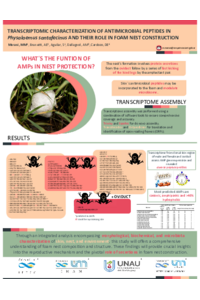
Marani_Poster_AMP_L.santafecinum.pdf
Simultaneous Delivery of Antimicrobial Peptide by Janus-type Dressings for Combating Wound Biofilms